
ONE RUNNING x RUNNING FOR RESILIENCE
PERFORMANCE MERCH
NOW AVAILABLE
ONE RUNNING x RUNNING FOR RESILIENCE PERFORMANCE MERCH NOW AVAILABLE
Suicide free ACT by 2033
We believe that no one is destined for suicide.
That’s why we’re on a mission to connect our community with support, movement, and meaning.
Whether you walk, stroll or run, we’d love for you to join us at one of our free weekly events. We aim for 20 to 30 minutes of self-paced exercise, followed by a drink and a conversation.
All welcome, no rego required.
Choose your own pace and distance.-
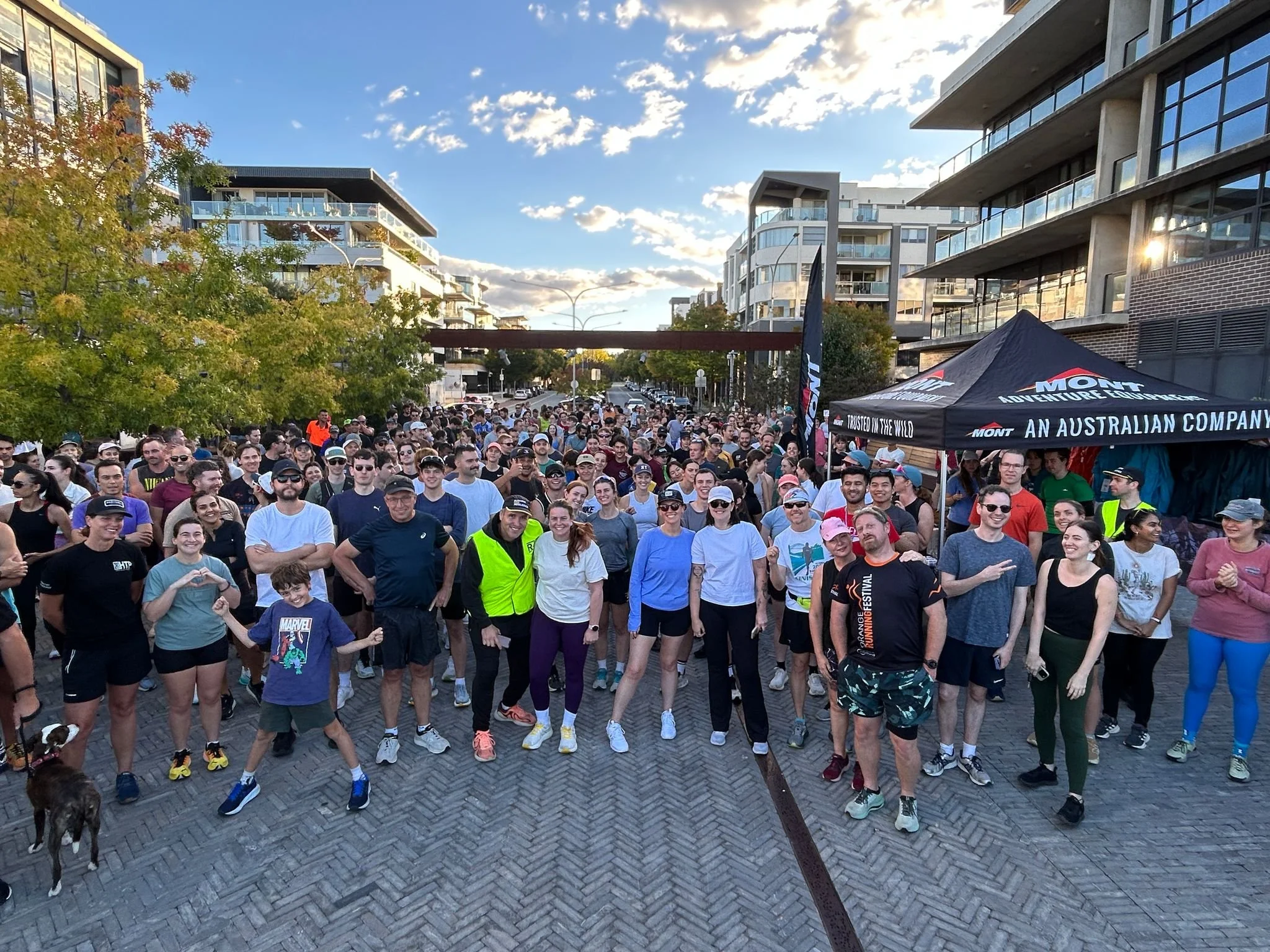
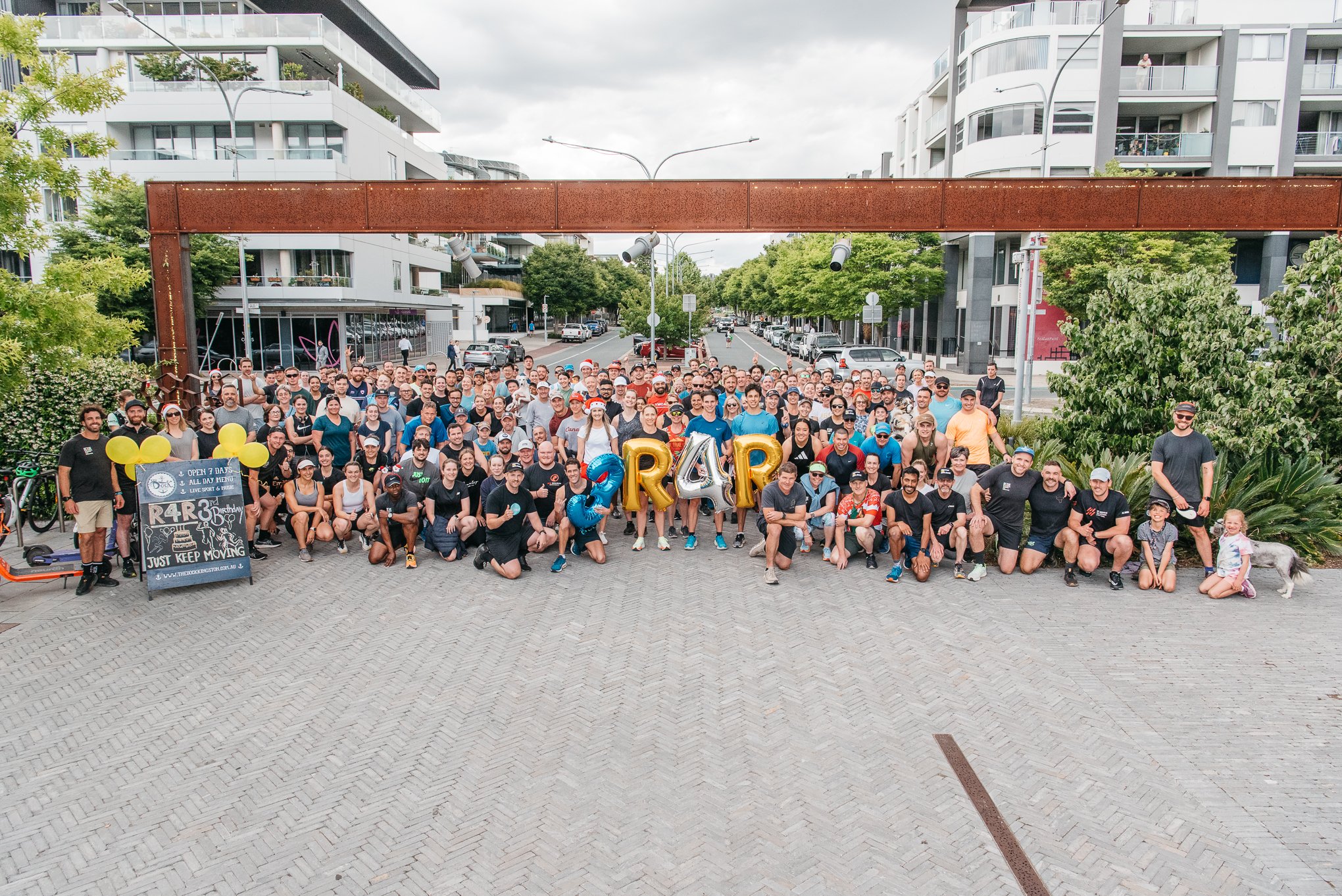
![A large group of people gathered outdoors in the evening, many of them smiling and facing the camera, near a tent with the logo "Mont" on it, with modern apartment buildings and a partly cloudy sky in the background.]()
Wednesday 6PM - Kingston Foreshore
-
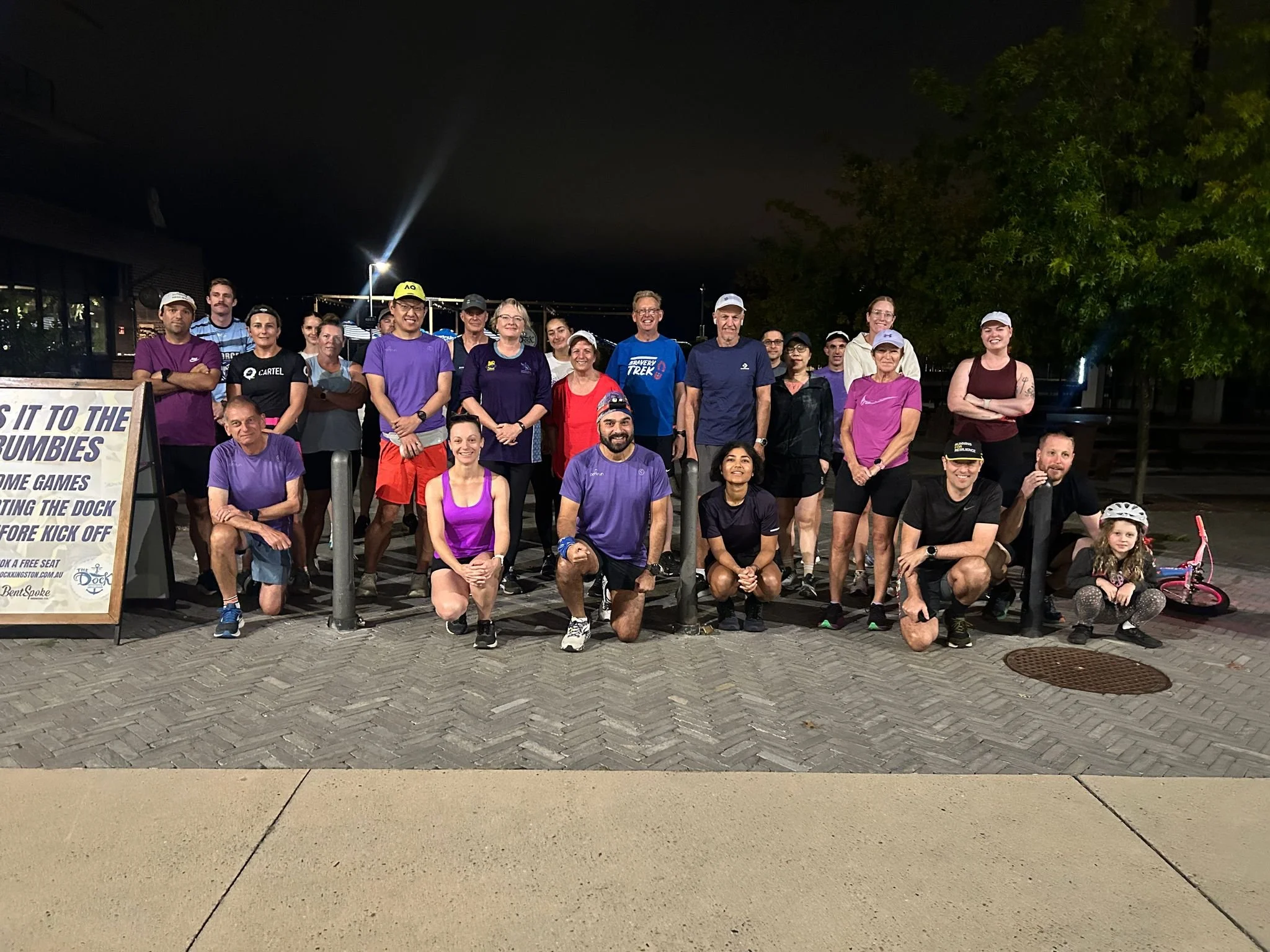
![Group of people posing together outdoors at night, some wearing athletic clothing and helmets, in front of a sign about Dumbo running.]()
Monday 6:15AM - Kingston Foreshore
-
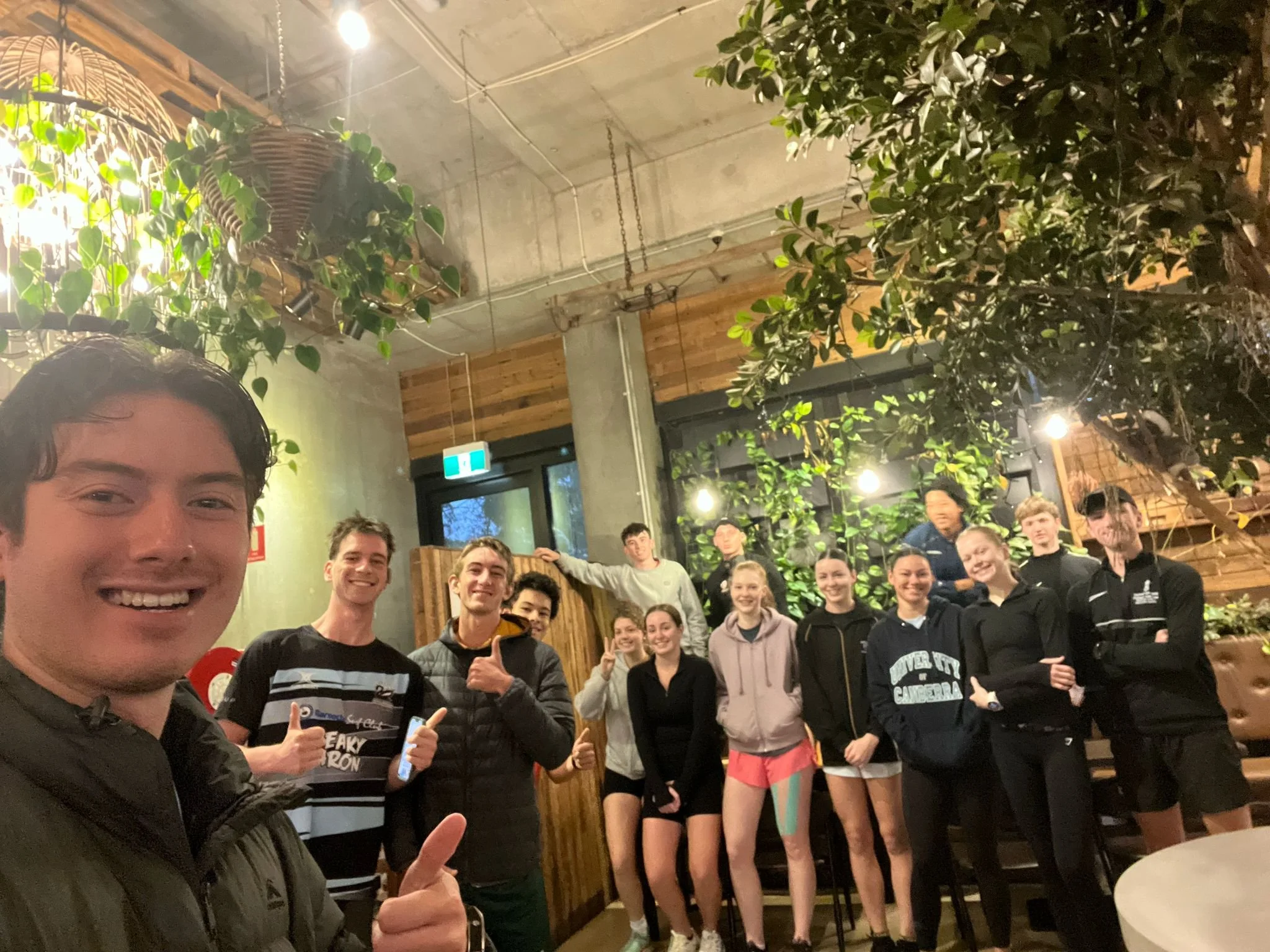
![]()
Tuesday 7AM - University of Canberra
-
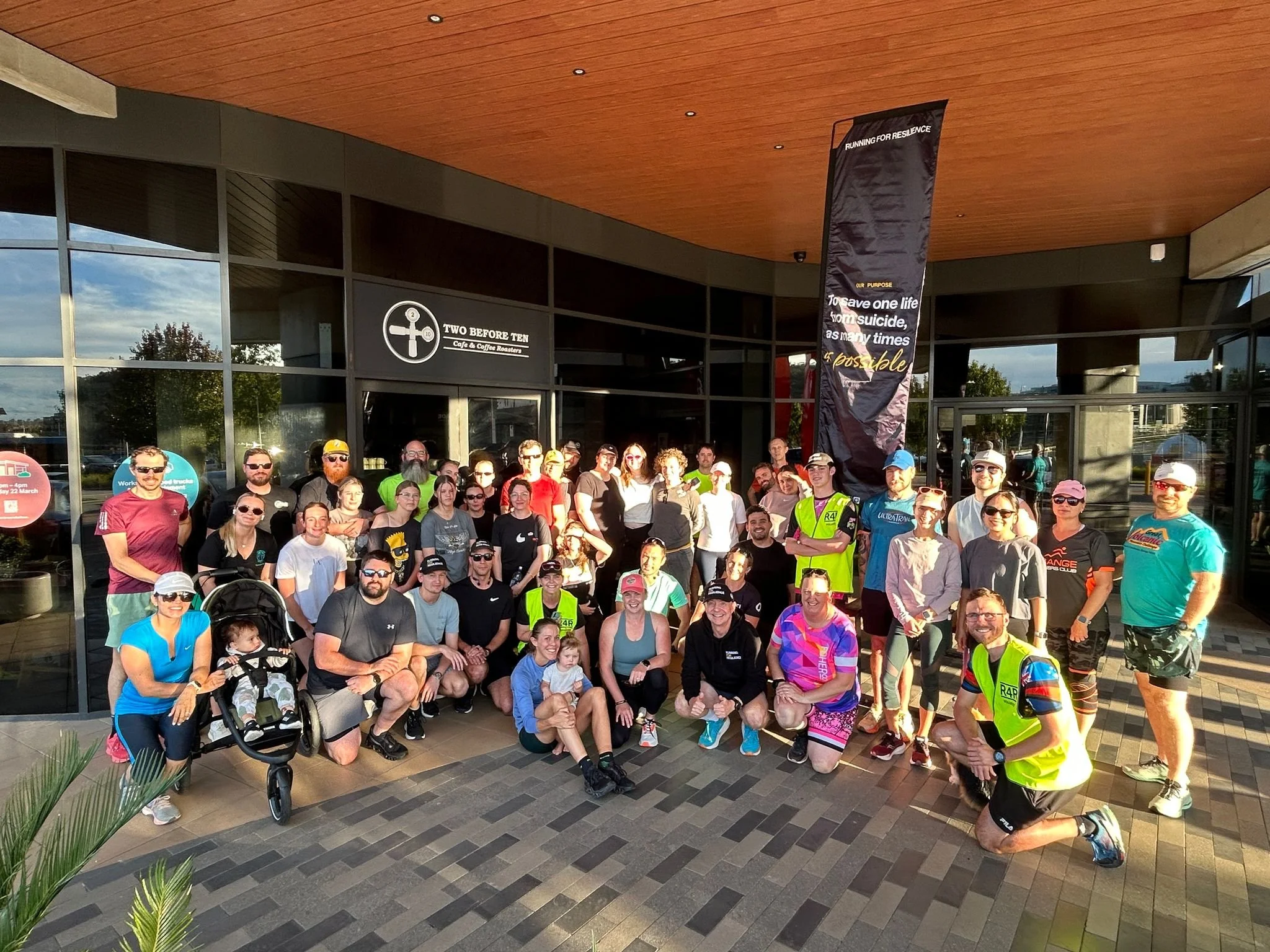
![Large group of people gathered outside a building with a sign that reads 'TWO BEFORE TEN'. The group appears to be participating in a running event, with several individuals wearing athletic clothing and some with bibs. There are mixed ages and a few children, including a child in a stroller. A tall banner beside the group has sustainability and mental health messages. The setting is sunny.]()
Tuesday 6PM - Denman
-
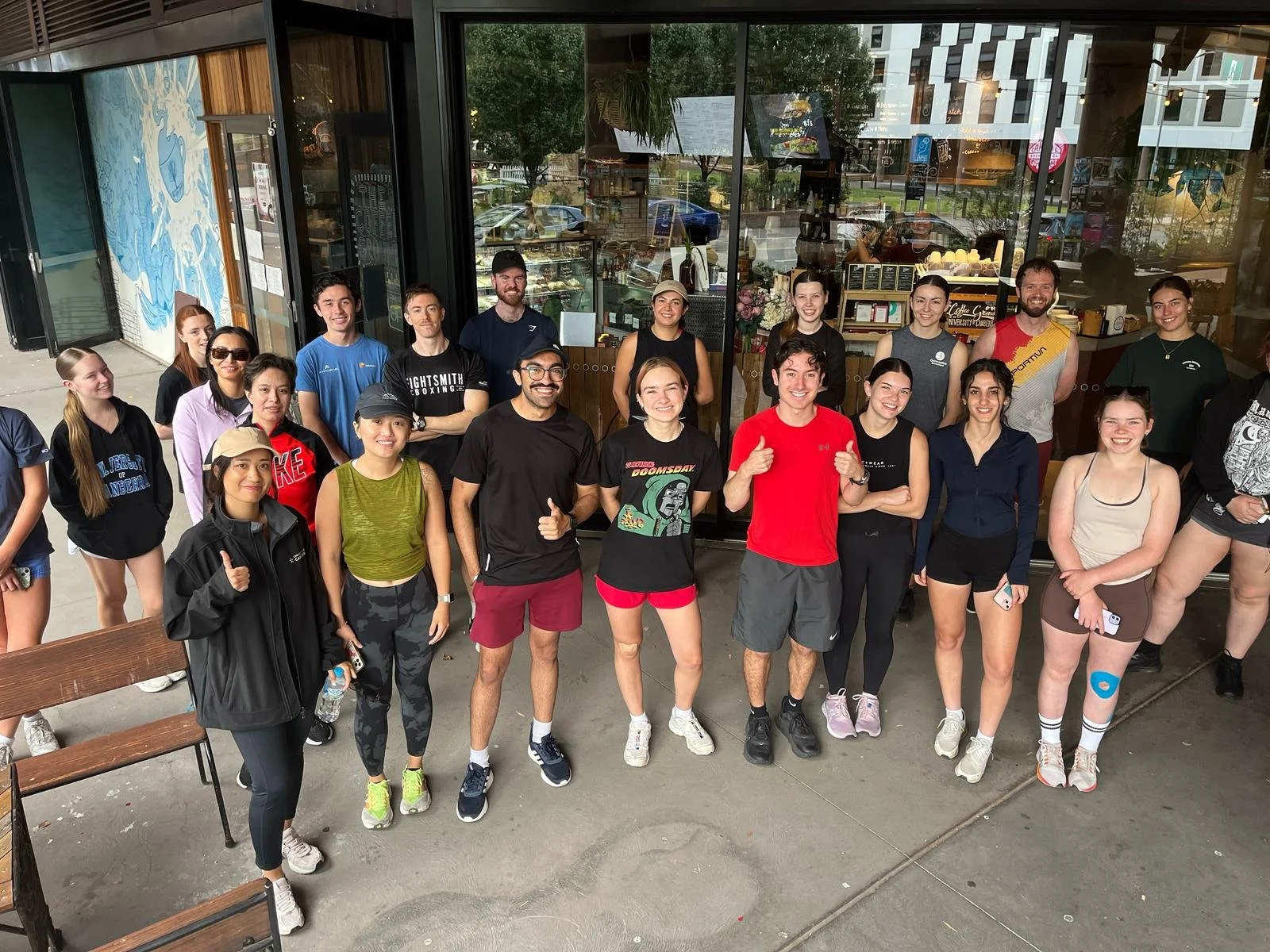
![Group of smiling people, mostly in athletic wear, standing outside a coffee shop, some giving thumbs up, in an urban area with storefronts and parked cars in the background.]()
Thursday 8:30AM - University of Canberra
-
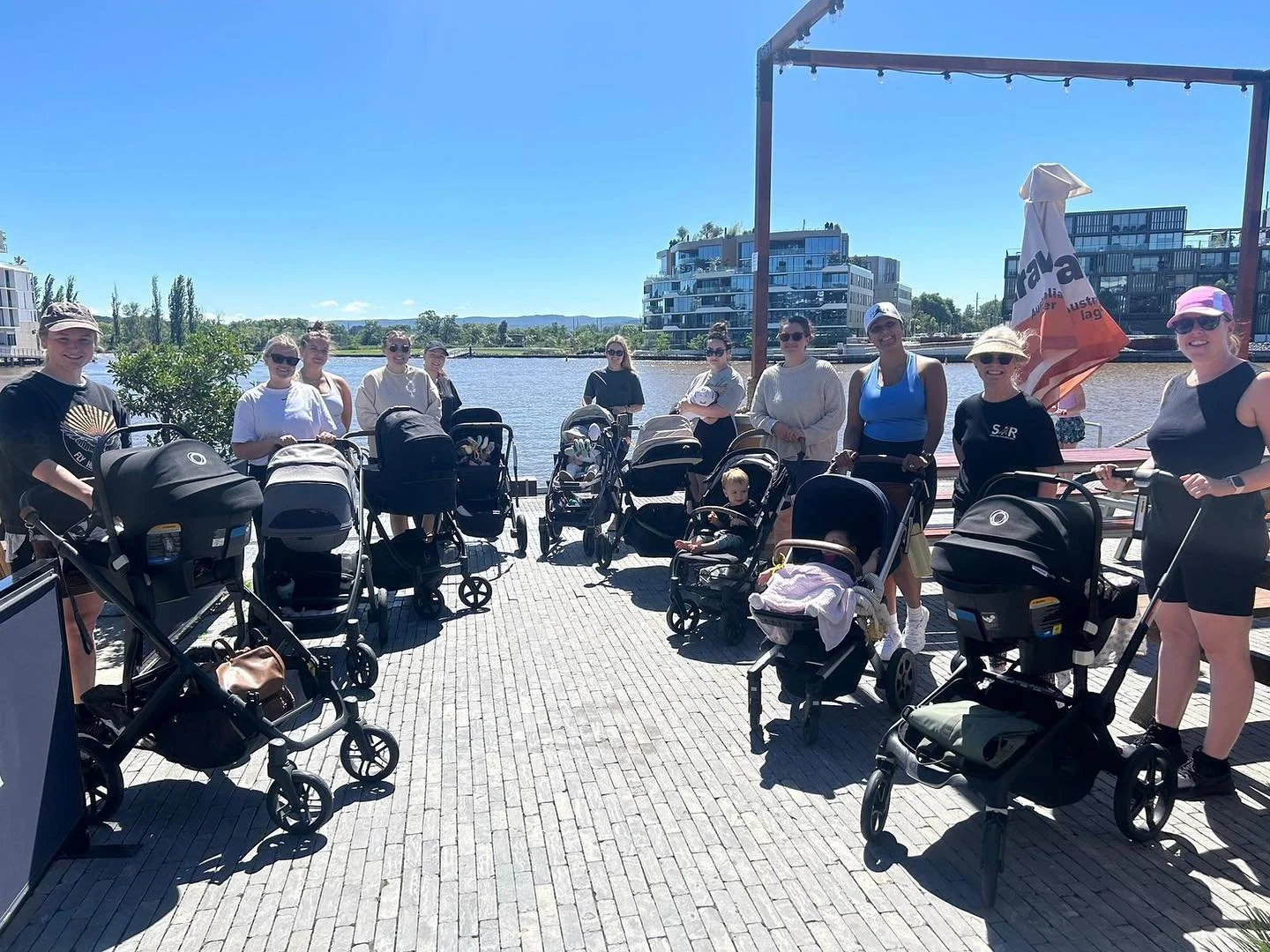
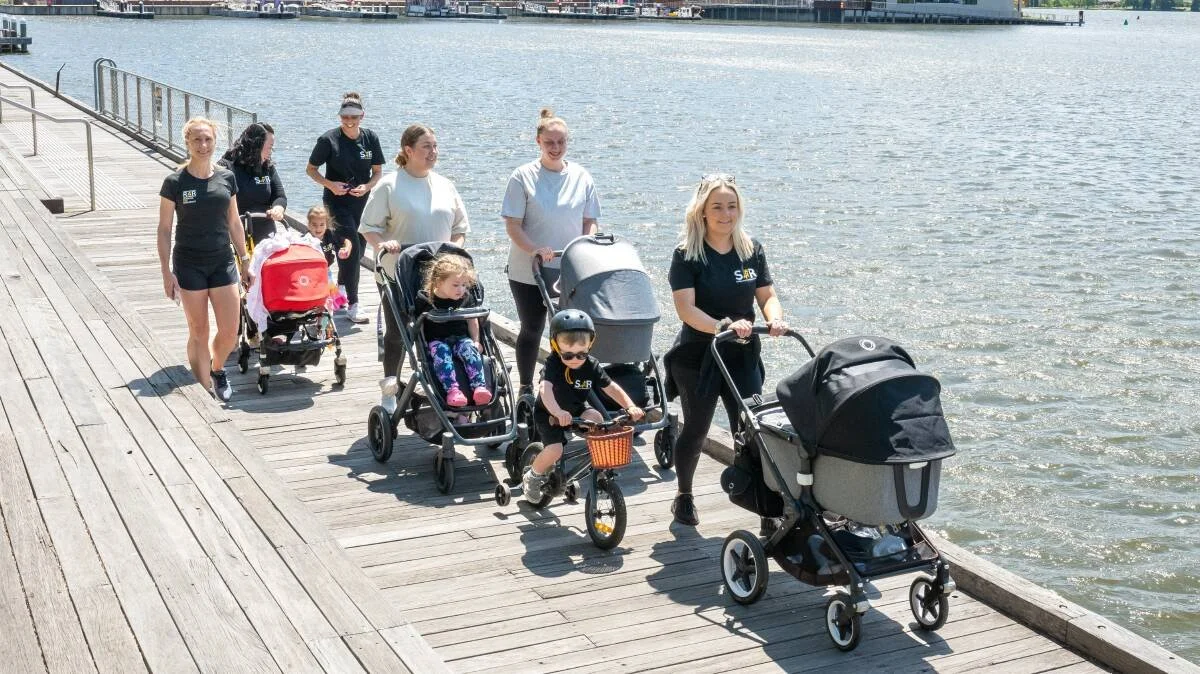
![Group of women, some with children in strollers, standing on a dock with multiple strollers, near a waterway with modern buildings in the background on a sunny day.]()
Thursday 10:30AM - Kingston Foreshore
-
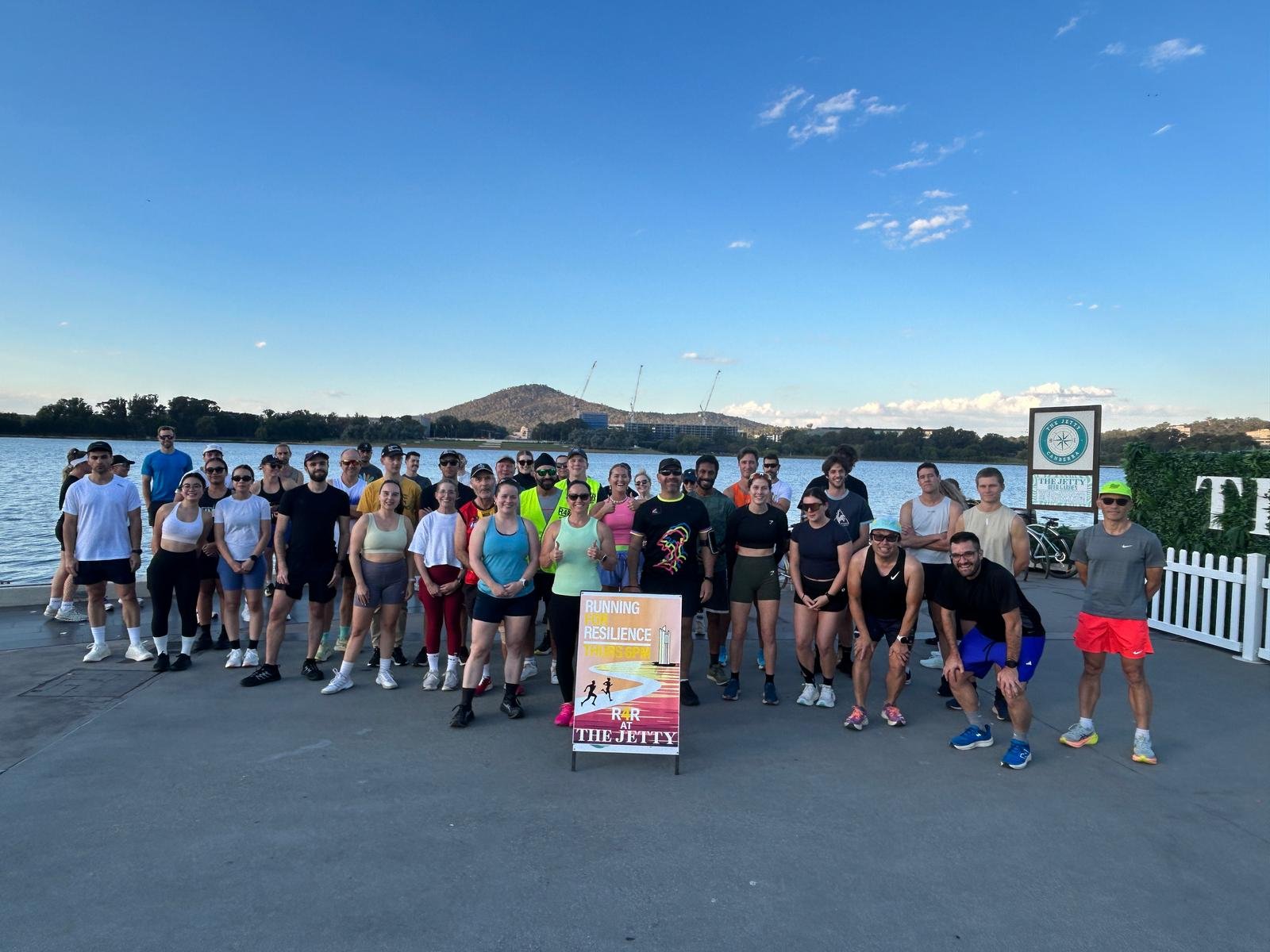
![Group of people gathered by a waterfront with a signboard that reads 'Running Resilience at The Jetty'. The sky is clear with a few clouds, and the scenery includes distant hills and construction cranes.]()
Thursday 6PM - Bridge to Bridge
-
![A group of people posing for a photo outside a brick building named Two Before Ten Roastery Urban Farm Cafes, with some dogs present.]()
Friday 6AM - Greenway
-
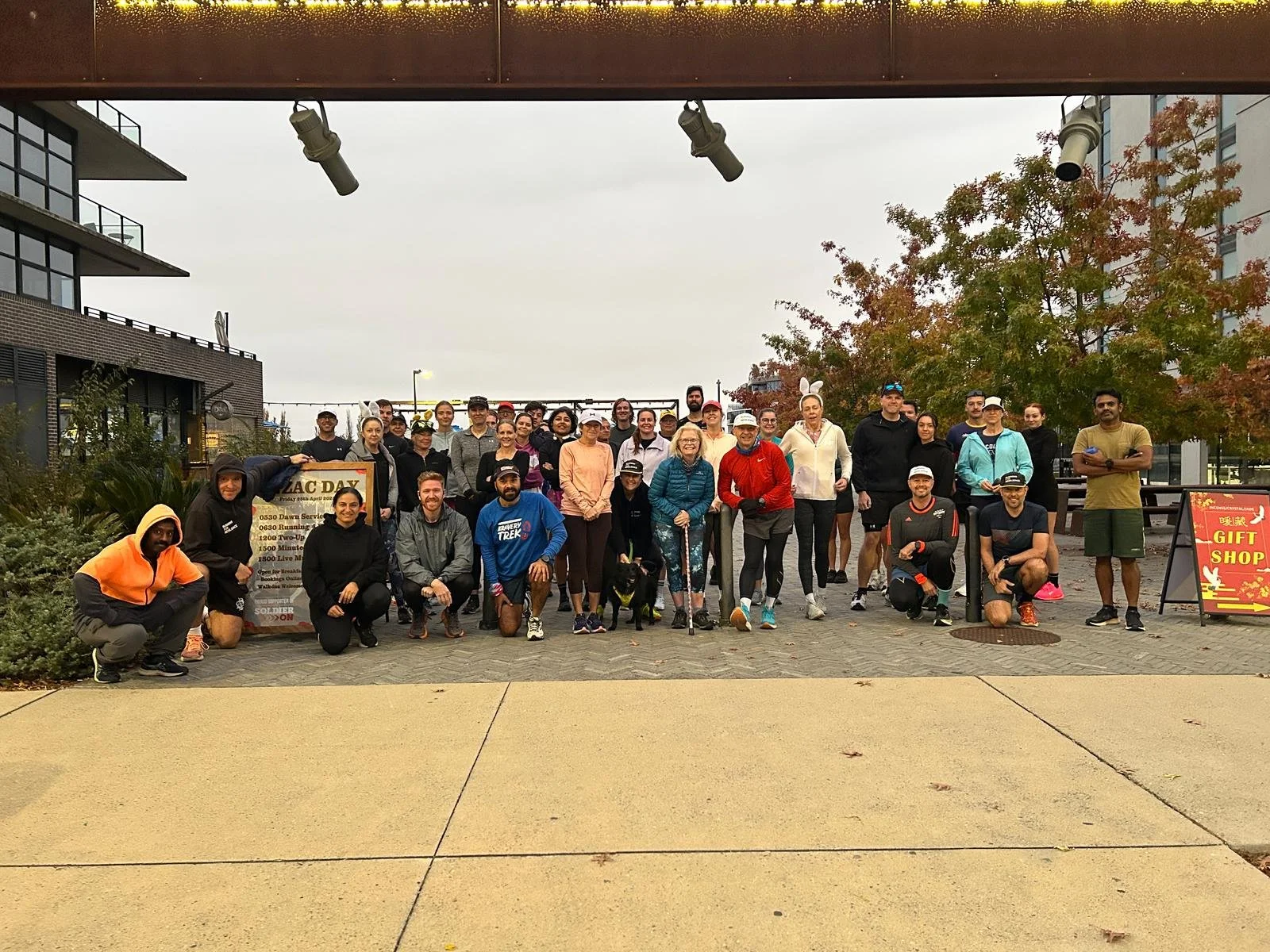
![A large group of people gathered outdoors for a group photo, some wearing athletic clothing, with a building, a tree with autumn leaves, and event signs in the background.]()
Friday 6:15AM - Kingston Foreshore
-
![Group of 13 runners dressed in athletic gear standing outdoors in a park on a misty day, smiling and posing for the photo.]()
Saturday 8AM - Parkrun
-
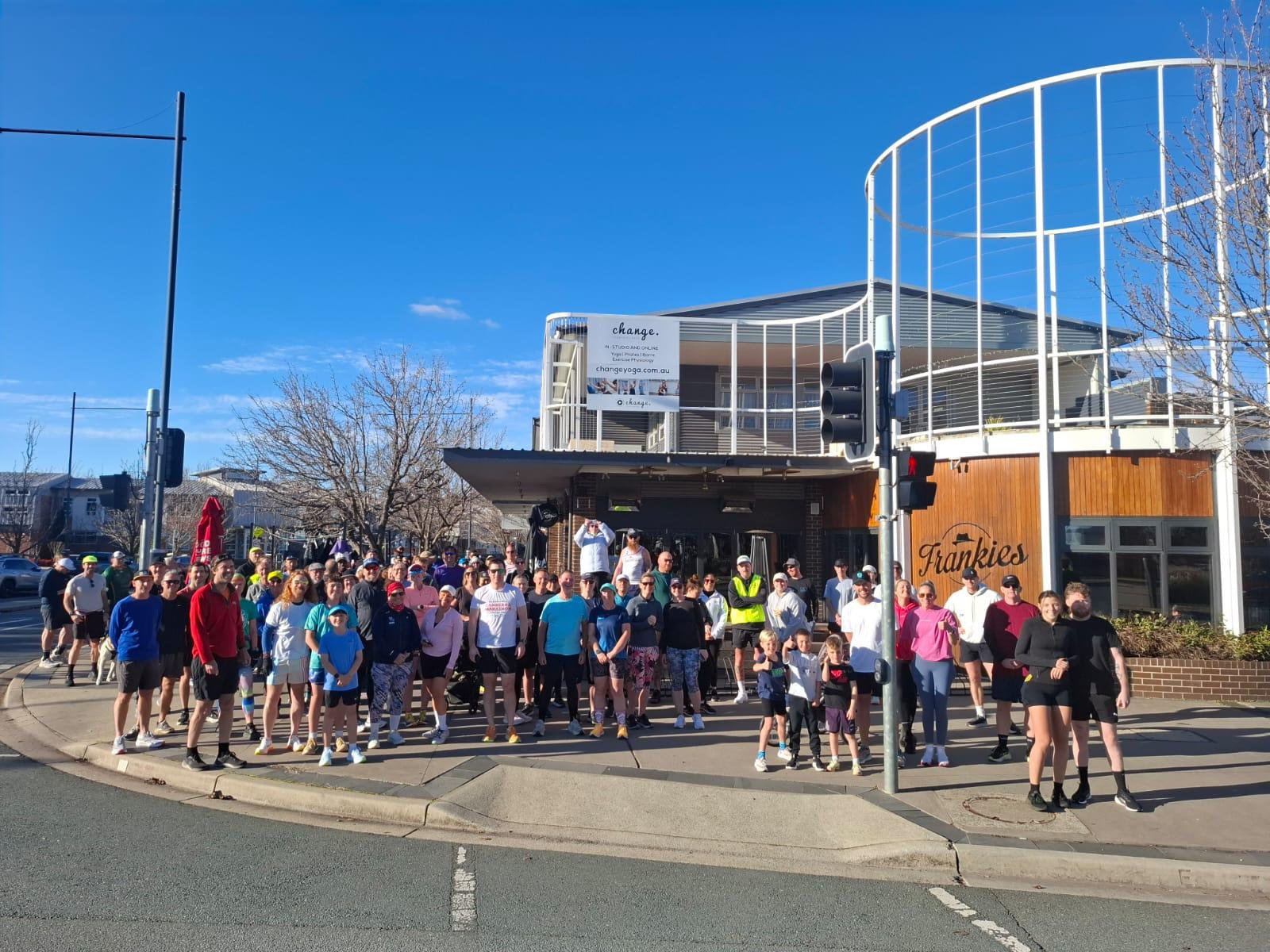
![A large group of people gathered outside a restaurant called Frankie's, sidewalk with a traffic light, and blue sky.]()
Sunday 3PM - Forde


JUST. KEEP. MOVING.
JUST. KEEP. MOVING.
Communities for Resilience
MORE THAN A RUN CLUB-
![]()
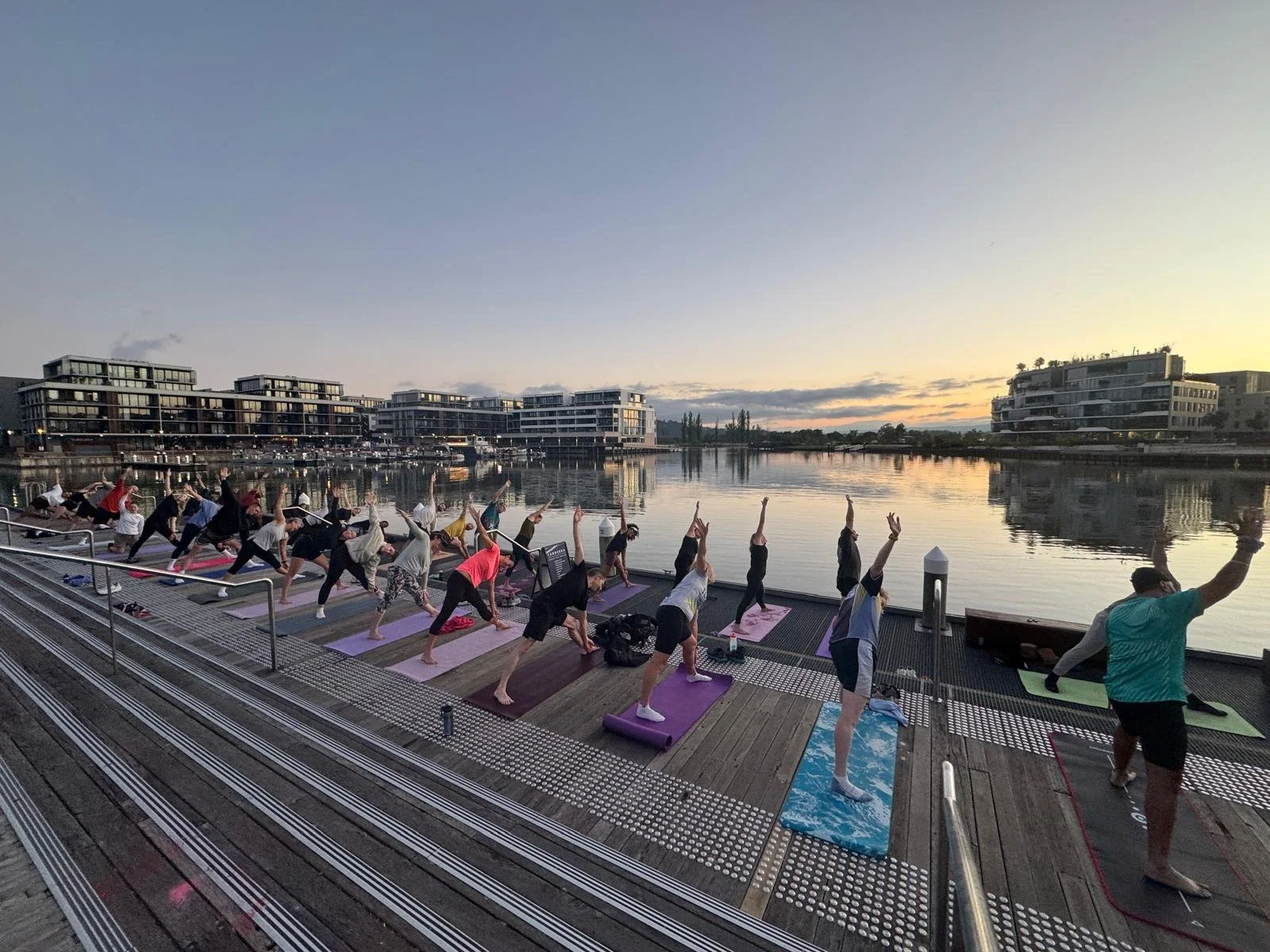
Yoga for Resilience
-
![]()
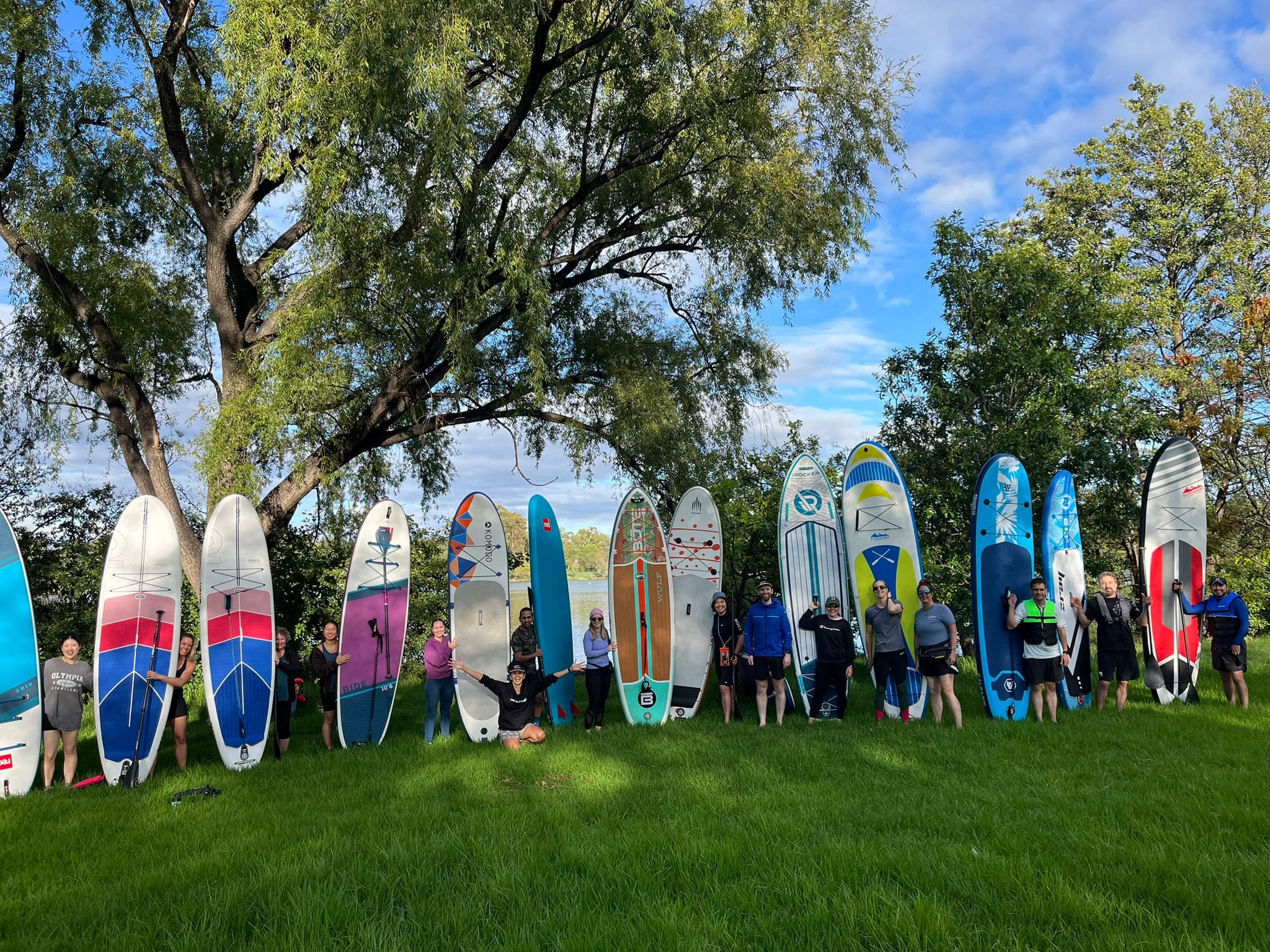
SUP for Resilience
-
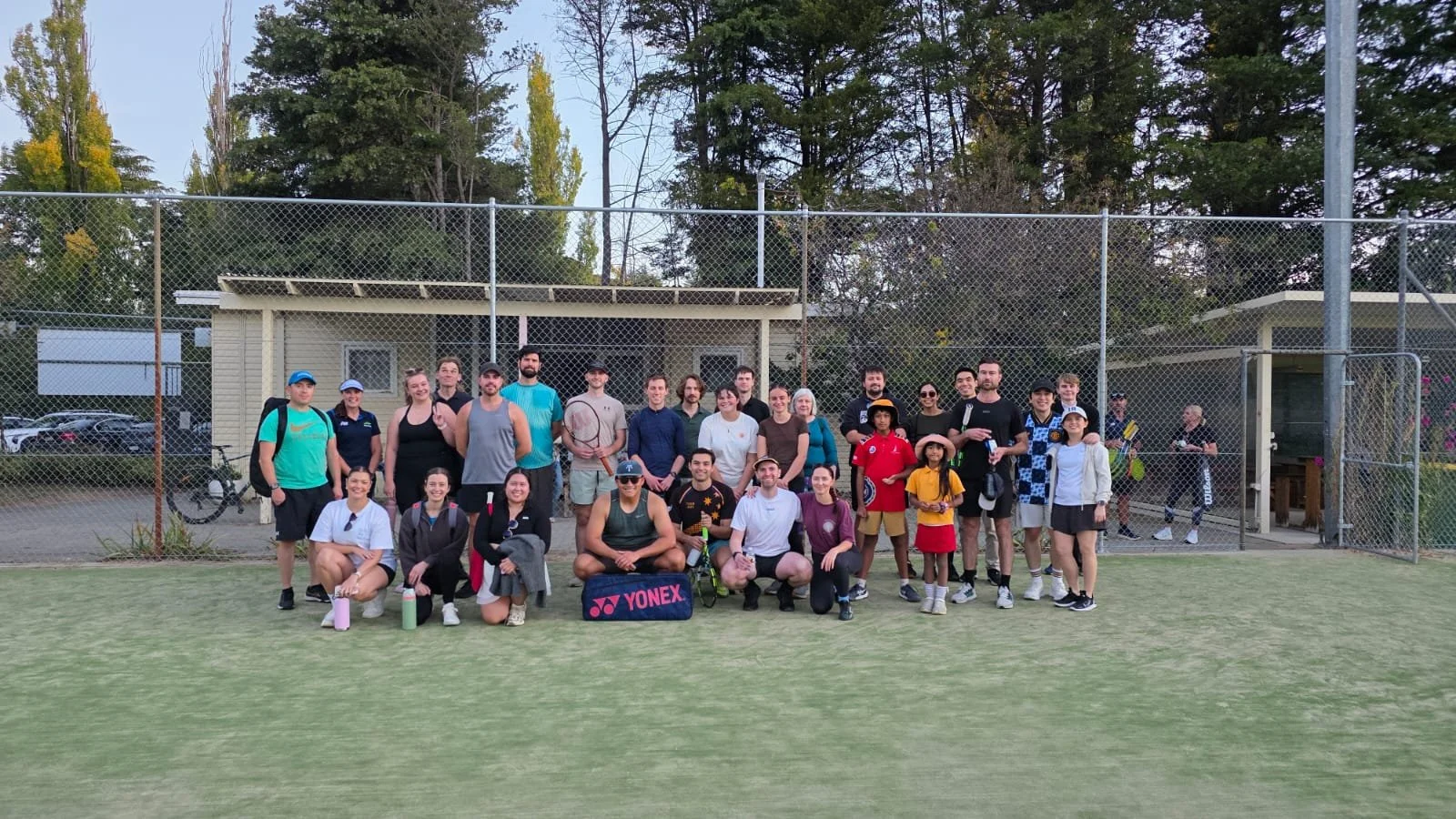
![]()
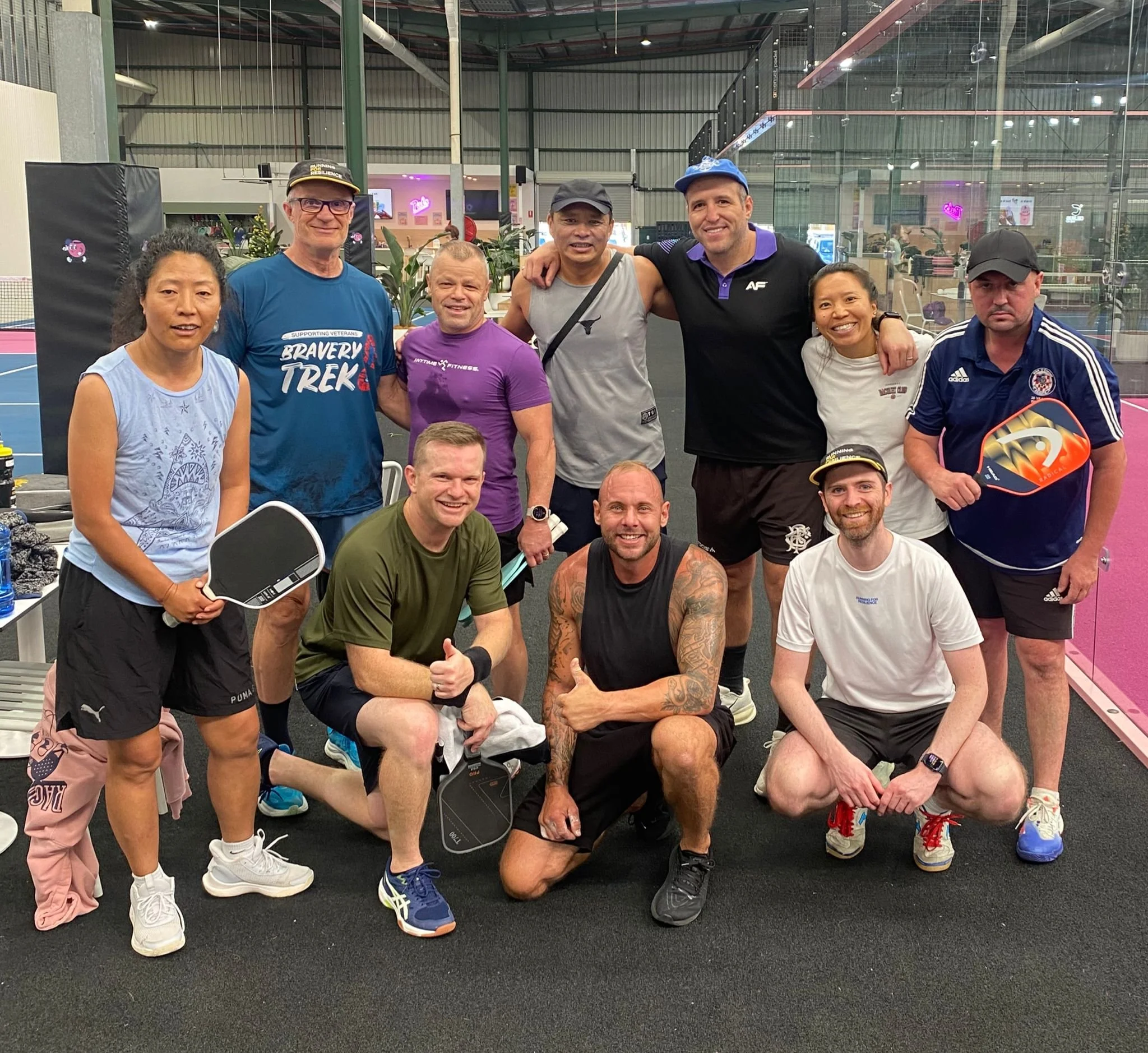
Pickleball for Resilience
-
![]()
Trails for Resilience
-
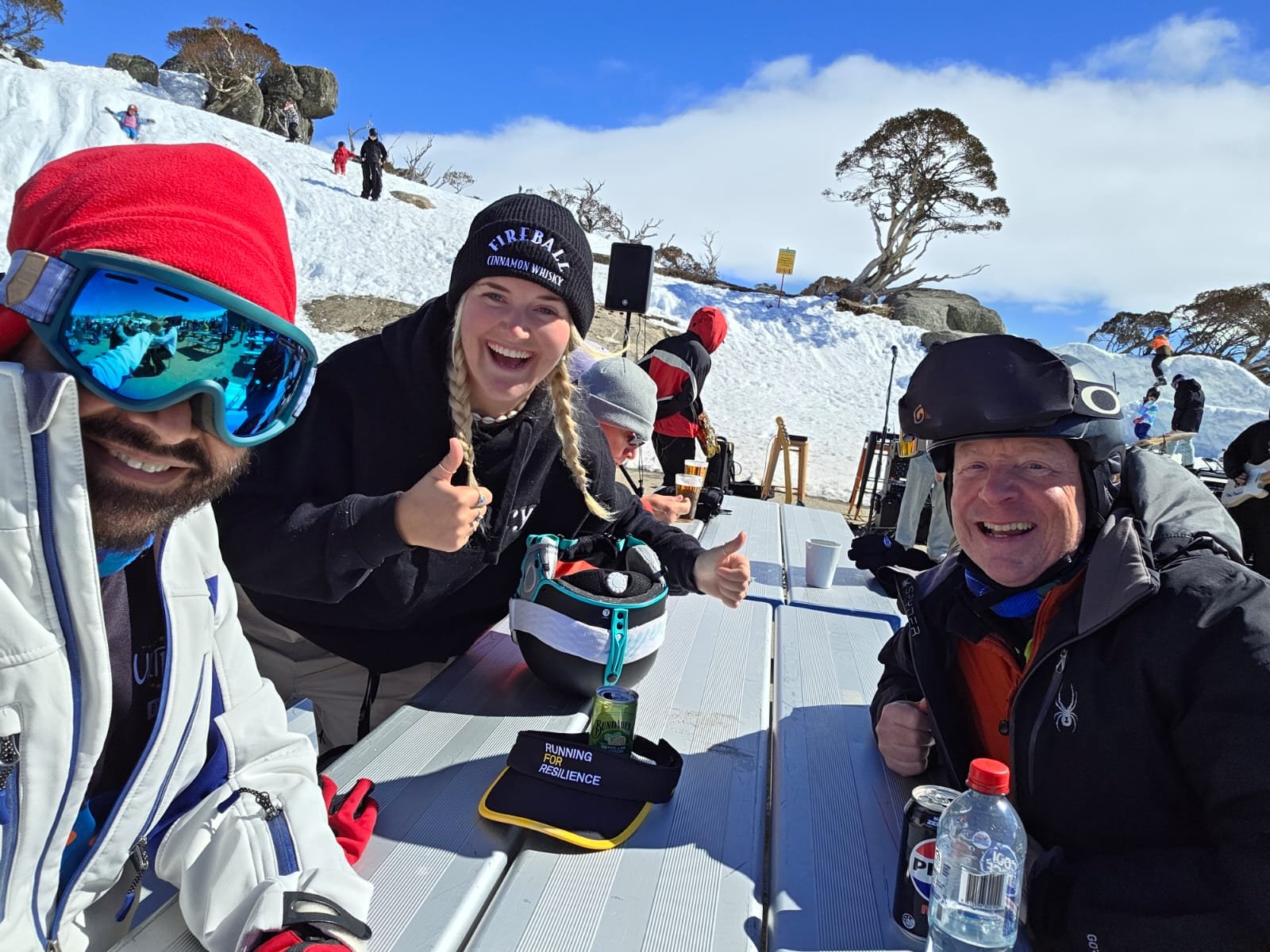
![]()
Snow for Resilience
-
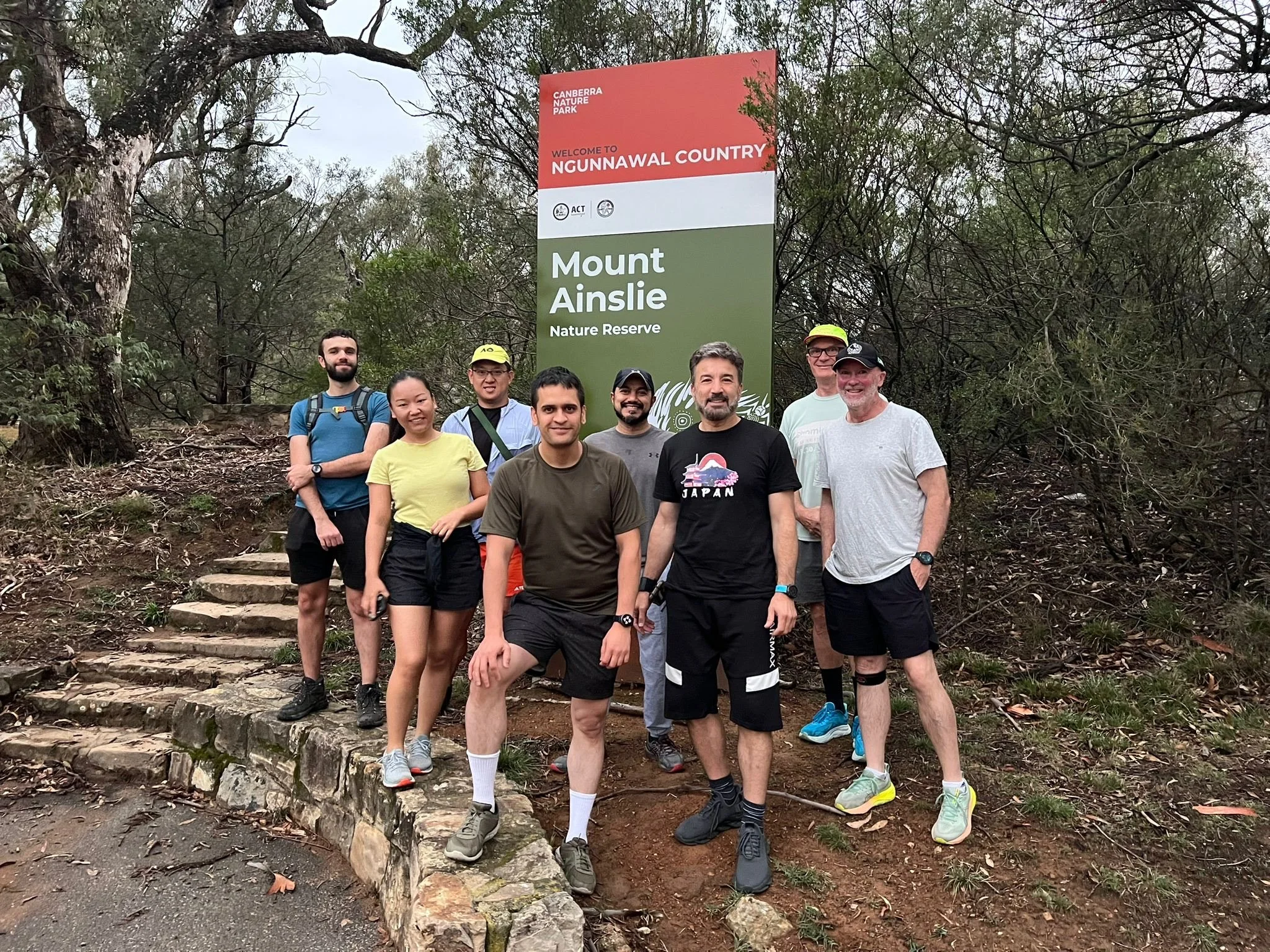
![]()
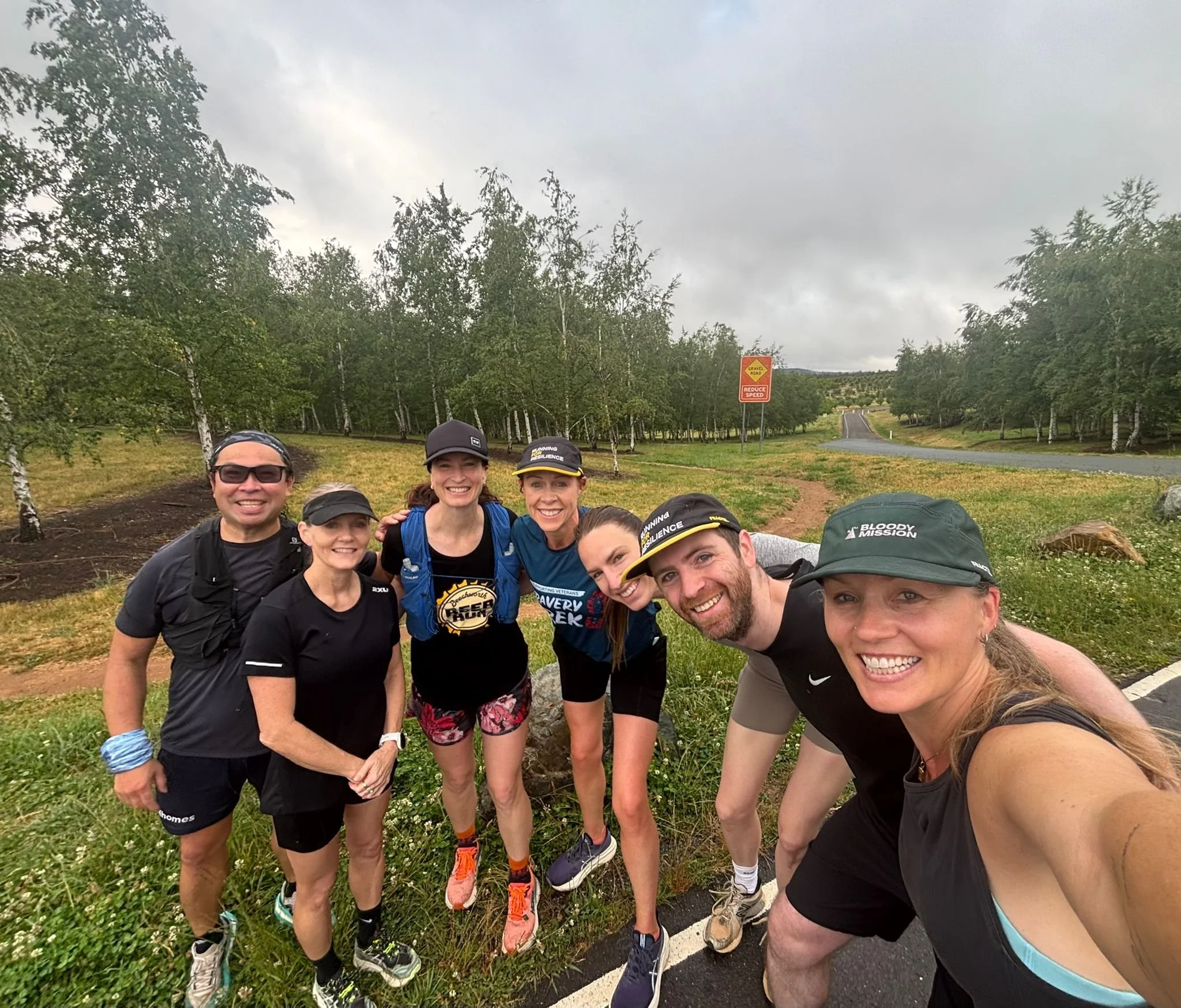
Hiking for Resilience
Special Events



Join us for a free yoga session on the first friday of every month!
Yoga, a combination of streches and breathing exercises, is incredibly benifical for overall health, as it can improve sleep, physical strength, flexibility, and mental health!
So, whether you frequent our other events or are simply a newcomer, we’d love to have you at our yoga event!
Join us for a free yoga session on the first friday of every month!
Yoga, a combination of streches and breathing exercises, is incredibly benifical for overall health, as it can improve sleep, physical strength, flexibility, and mental health!
So, whether you frequent our other events or are simply a newcomer, we’d love to have you at our yoga event!



Community Matters
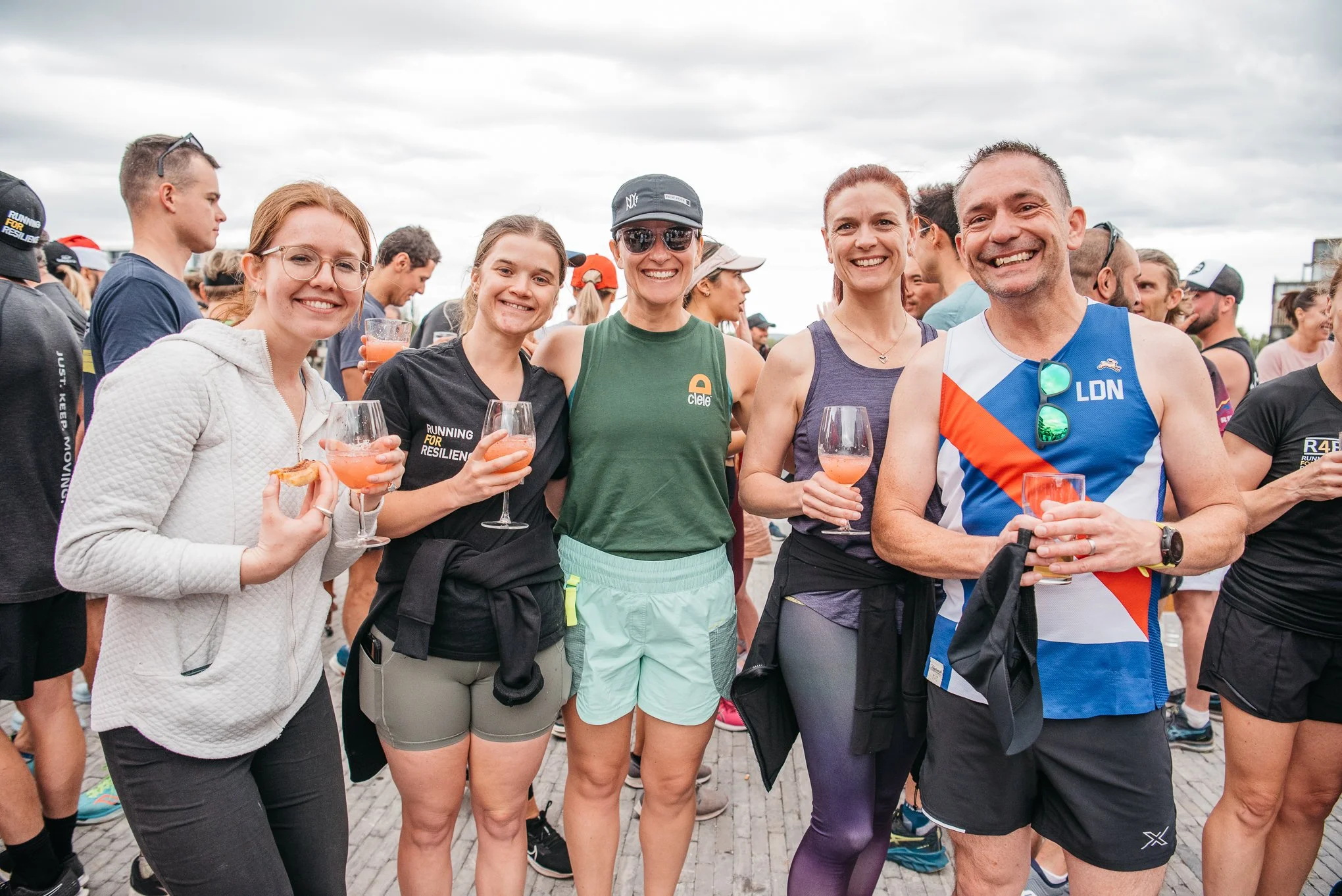
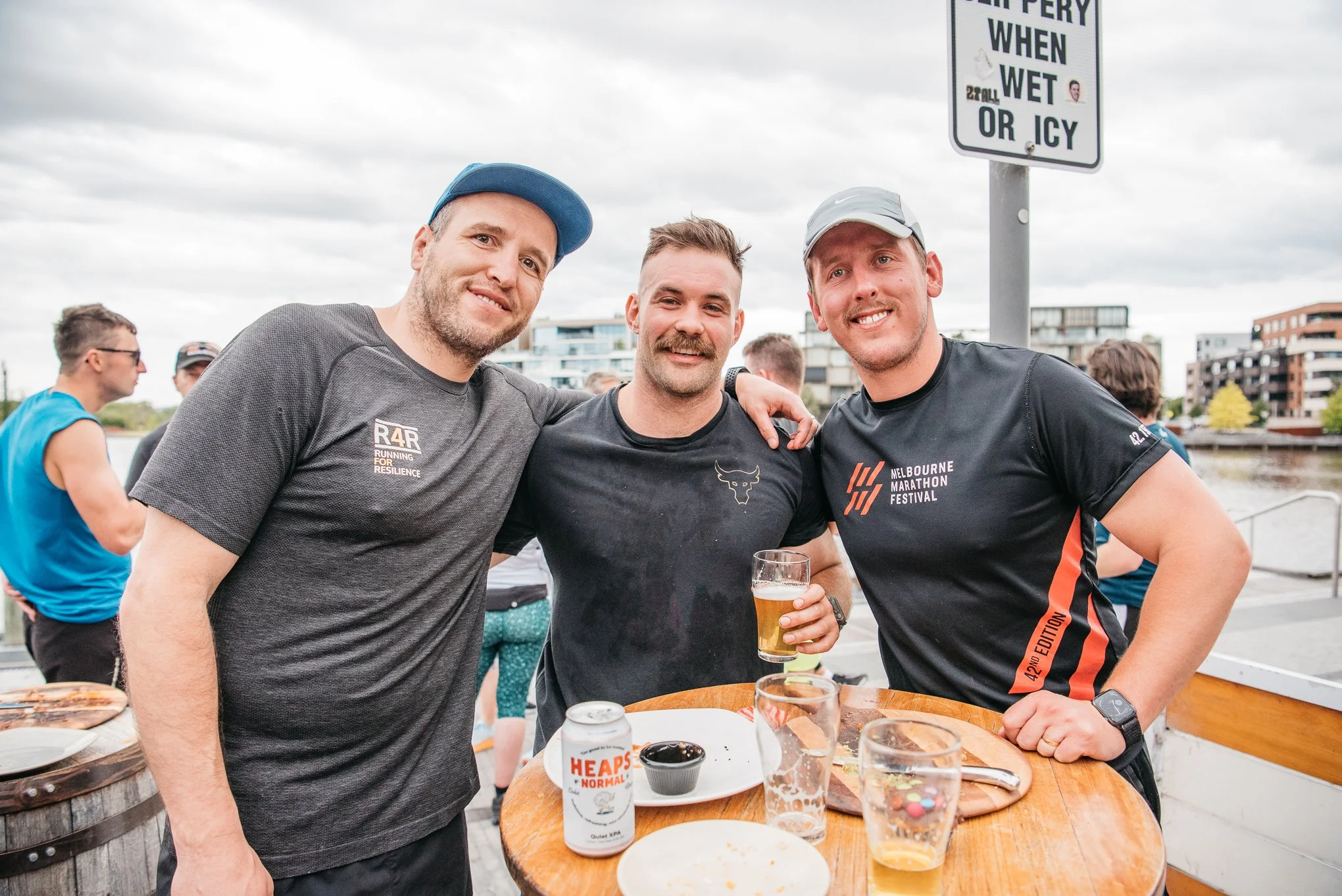
Every time we gather, we’re showing the world how many people are committed to saving lives from suicide, and our belief in resilience. We know that everyone faces challenges, and although people may appear composed, many are dealing with hidden struggles. And most importantly, we’re signalling to someone doing it tough that there's a community aware of their pain and hasn’t lost faith in their ability to recover.
The Road to Zero

Matthew Breen | TEDxCanberra
We’ve all had a tough time at some point in our lives that required us to keep moving and not give up. For Matt this moment came in 2010, when he lost his dad to suicide. Matthew Breen started Running for Resilience (R4R) in 2019 with the goal of saving one life from suicide, as many times as possible. Since joining forces with the Dock on the Kingston Foreshore and former Wallaby Ben Alexander in the early days, R4R began running each Wednesday night and catching up for a chat afterward, regularly attracting 200 runners to each run. R4R has grown into a community of more than 2,000 Canberrans who believe that community and exercise underpin a mentally healthy landscape, and with this growth, R4R now believes that saving as many lives from suicide as possible is making Canberra Suicide-Free by 2033. This talk was given at a TEDx event using the TED conference format but independently organized by a local community.

How This Canberra Club Fights for Mental Health | Sporting News Australia
Former Wallabies and Brumbies prop Ben Alexander was searching for purpose in retirement. When he helped launch the Running for Resilience Run Club, initially it was about the running, then it grew to be so much more, uniting the Canberra community in their mission to eliminate suicide in the ACT.

Ben Alexander, Stephe O'Neill, Mark Nicholson, and Adam Hall share their insights on Recess for Resilience
Ben Alexander: Welcome everyone. Welcome to the Running for Resilience podcast. We’ve got a special episode today. We’re talking about Recess for Resilience, which is Running for Resilience, but for schools.
I’ve got three of the legends who help drive it: Mr Hall, Miss O’Neill and Mr Nicho. Before we get into what Recess is, why don’t we go around the horn? Introduce yourselves, how long you’ve been teaching, a little bit of your backstory. Mr Hall, we’ll start with you.
Adam Hall: Thanks. Thanks for the opportunity to come on. I have been told multiple times that I’ve got a face for radio, so now I’m finally reaching my potential. I appreciate the opportunity.
Ben Alexander: You look good though. You look good today.
Adam Hall: It’s the light probably, bouncing off.
Ben Alexander: They put that there for me. They knew I was coming in.
Adam Hall: I’ve been a teacher for 17 years here in Canberra. I’m at Canberra Grammar at the moment, but I started at Canberra Girls Grammar, then went over to Burgmann for a little while, and now I’m at Canberra Grammar School.
I have a passion around trying to make sure that what we’re teaching is actually action. When we’re teaching something, as opposed to lecturing it or giving information to students, we actually want to see some form of action from them.
I think that’s why we’re all here today in some shape or form, because the community that you’ve set up with Running for Resilience is the action on wellbeing.
I think that’s where Recess for Resilience fits in. It’s building the habits. That side of education is really my passion. I don’t just want to teach people. I want to see them build on the knowledge they’re getting and eventually eclipse me with the knowledge they’ve gained, so they can then teach me or teach the next people around them.
It’s that society concept about stepping towards a better society as well. It’s a great profession. It has its ups and downs like every profession, but it’s something that’s enjoyable.
Ben Alexander: Before we jump to Miss O’Neill, Mr Hall, you were the person who emailed Running for Resilience about this idea. Talk us through that initial idea. Why did you email R4R about starting some sort of partnership with Running for Resilience and schools?
Adam Hall: It goes back to what I was saying about action. I’d known you for a period of time and had seen the development and the impact that you were having on the community.
Ben Alexander: Twenty years, mate. A period of time.
Adam Hall: As adults, we either learn from our teachers or we learn the hard way. We learn when we’re on a downward spiral. We know people tell us to eat right, drink well, sleep well. Sleep is coming through as one of your greatest assets at the moment. There’s a lot of research around that. We also know exercise is good, and that message has been there for us for a long period of time, whether we listen to it or not.
Running for Resilience was something I saw as an active habit that went against the trend of our physical sporting trends at the moment, where people are becoming less active.
Community sport can be hard because people don’t always want to rock up to something organised all the time. There are registration fees, logistics and all those kinds of problems. People want something they can lob into at a time that suits them, where they can connect with people, do some physical activity and get some enjoyment out of it.
At its heart, I think that’s what Running for Resilience is. If you look at the five core foundations of resilience, you’ve got connection. You’ve got physical health — am I sleeping, is my nutrition good? You’ve got self-awareness — being able to identify within myself what my emotions are. But then you also need optimism, the belief that things can get better and that I can see a better future. And you need flexibility to be able to enact those changes.
Those five foundation skills for resilience can be taught, but it’s the action that needs to build into the habit. That’s the hard bit. The knowledge is the easy bit.
Ben Alexander: Yeah.
Adam Hall: Actually taking that step and having the flexibility to make the change is the hard bit.
Running for Resilience provides that for multiple people, whether all of your participants realise it or not. It’s providing connection, movement and physical health. It’s providing self-awareness and social connection, which is really important.
The idea was to bridge the gap. Let’s be more proactive and get the next generation, as your motto says, helping make Canberra one of the healthiest cities in Australia or in the world. Let’s go back a couple of years. Not saying you’re only focusing on adults, but let’s go back to the primary years or adolescence and tackle mental health there. Let’s help build habits before anything needs to head into a professional stream of mental health support.
Ben Alexander: That’s been very important with Recess. We tell the kids that everyone knows Running for Resilience is about reducing suicide in Canberra or eliminating suicide in Canberra, but it’s been a great learning experience for us at Grammar.
When we launched, the goal the kids bought into was to make Canberra the happiest and healthiest city in the world. To do that, we think we need to exercise with friends and check in with each other.
Thank you to Grammar, Mr Hall, and everyone for what you’ve done so far, getting the ball rolling. Then we had Miss O’Neill from Torrens reach out. We know each other because we were coworkers at the great KPMG.
Steph O’Neill: We sure were. A lifetime ago.
Ben Alexander: Miss O’Neill, what made you want to get involved? Tell us your story into education. What got you into that space?
Steph O’Neill: I’ve been teaching for about seven or eight years. I did a stint over in London and I’ve been teaching in Canberra in the public system.
I did have a little bit of a break. I went into the public service, then I went into private, where I met you. Then I had a very difficult time in my life where I just needed community around me, which is how I got into Running for Resilience.
I went down there and it was such a great atmosphere. I was talking to people who had just started Recess for Resilience at Grammar. They said, “You could start it in the public schools in the ACT.” I thought that was such a great idea.
I took it to my deputy, who was very, very supportive, which made the whole thing so much easier. We just started it from there at the school.
Ben Alexander: Mr Nicho, before we go back to Adam, can you introduce yourself, your educational background, and then explain how Recess is working at Torrens? What are we doing, how are we getting the groups engaged, and how’s it going?
Mark Nicholson: Thank you so much for having us. I really appreciate the opportunity to get out of the classroom and the school and do something fancy like this. It’s very cool.
I’ve been a teacher for 25 years, and hearing these two’s numbers makes me feel really old all of a sudden. All of that has been here in the ACT, working across a number of schools — primary, high school and some of our super schools that were set up early in the 2000s.
Ben Alexander: What’s a super school?
Mark Nicholson: Your P to 10 schools. Amaroo is one of them. Very big.
I’ve always been really keen on student wellbeing, student engagement and the culture that comes from physical activity.
When I was at Amaroo as a young teacher emerging as a leader, I used to run what we called A-Fit. Every Tuesday and Thursday morning, we ran a bootcamp with 40 or 50 kids coming to school.
The school had just opened. We opened K to 5 in the first year, and then K to 8 in the second year. We inherited all these Year 8s who had been to high school and turned up to a really small high school at the time. They were like, “This isn’t what I want. This is not high school.” There was no culture. There was no connection.
The idea of A-Fit was: you guys love sport, you love fitness, let’s come in and do some boxing, stretching classes and things I enjoyed doing, and build up that culture. We got to about 100 kids by the third year coming in and doing all this physical activity.
That wellbeing part of activity has always been in the back of my mind.
I was really lucky with Recess for Resilience. Steph came to me incredibly passionate at the start of the year when I was in the acting principal role. Sometimes in schools, particularly in the public service in Canberra, we can be a big brother society of, “Do you have a plan for this? Do you have a map for this?” We make things really challenging to do.
There’s a big administrative load on teachers, and a really risk-averse nature in how we approach everything. I know we do that for safety and security reasons, but a 150-page document on swim safety doesn’t make our swim carnival safer. It’s actually the processes you put in place and the people being active.
As a leader, I’m very much a “yes, how do we make that happen?” person. So to have Steph come to me at the start of the year and say, “I’ve got an idea, and we’re going to make it happen because I’m passionate about this,” was great.
She said it would impact heaps of kids, but if it impacts one, it’s done its job. So we started ticking the boxes — risk assessments, checking policies to take kids off school grounds. We started small. We had to change some of our permissions for off-site activities with kids, so we started on site. After one term, we moved across to the field across the road.
We started Recess for Resilience inside our school gates, and we had pretty solid turnouts. I’ll be honest, it was a pretty bland sort of run, but the kids still enjoyed it and got something out of it. It was a good soft launch. We got good regulars — kids who were keen to come and exercise, keen to come and chat.
After that term, when we’d built up a bit of culture around expectations and the language we use to talk to one another, we trusted them. They were showing themselves to be responsible young adults. These kids are from Year 3 to Year 6, and we’ve even had some Year 2s come across recently.
Then we went outside the school gates to the oval across the road. That was the shot in the arm it really needed. There’s an immense pride for the kids in being able to go outside the gates to do something.
Ben Alexander: They feel trusted or something. Like they’re venturing.
Mark Nicholson: They take it seriously and they take the responsibility. One of the kids actually came to Steph earlier this week and said, “I can’t go on Thursday. I’ve got the school soccer thing. I’m so sorry I won’t be there.” It’s cool, but they really identify with and attach to that day.
It’s had a huge impact on a core group of kids. When we look at mental health, sometimes we look for big solutions to solve everyone’s problem. That’s not what mental health is always about. Sometimes it’s about making a difference for one person at a time, then doing it again and again and trying to impact as many as we can.
In schools, we can fall into the trap of saying, “There aren’t lots of kids going,” or, “It’s quite expensive to send two staff out across the oval for 30 kids,” or, “There’s a lot of admin work.” Then those things die. But the impact it’s had on the kids has been huge.
We’ve got two kids in particular I want to talk about. One little boy is struggling at school at the moment. He’s struggling with connection, changes in medication and family routines. He has an amazing family who support him immensely, but he’s going through a lot of big emotions and struggling to connect with his peers and regulate, particularly at the end of the day.
Thursdays are his highlight. He is at Recess for Resilience no matter what. He could have had a shocking few days, he could have been away, and he is away a lot, but his attendance on Thursdays is near perfect. He comes to Recess for Resilience. He bags us if he misses it.
In the first session, I think I had a chuckle with you, Ben, because we did our big circle, like the huddle or the scrum, and he said, “No, don’t touch me, don’t touch me.” That’s part of his diagnosis and challenges. But two or three weeks later, he was getting his arms in and starting to join in. He gets a bit shy when they don’t put their arms around him now.
The positive impact that has on him on a Thursday is worth all the resources and all the admin, just to impact that one child.
The second example is a new student to our school who has a number of challenges. You don’t always move schools because things are great, and she had moved states and jurisdictions. She is a selectively mute student who doesn’t talk to a lot of people and has had trouble finding friendship groups.
Steph was her class teacher for most of Term 2, and I don’t think you heard her speak until about the end of Term 2.
Steph O’Neill: Yeah.
Mark Nicholson: In Term 1, she never spoke to a single adult. She spoke to one child and would whisper in her ear. In Term 2, she had a couple of good friends and they would come across to Recess for Resilience.
By the end of Term 2 and into Term 3, we saw this pattern with her. Mondays, she’d be pretty quiet. Tuesday, she’d start to warm up and wave as she walked by my office. Wednesday was really good, and Thursday it was like, “Oh my God, can you get back in your box? You are so excitable and happy.”
I’d been away ill for a few days, and she came up and gave me a huge hug today and said, “I missed you. Where were you for Recess for Resilience?”
Her teachers have really noticed the difference across the week, building up to Thursdays. It flows into other aspects as well. Her friendship groups have expanded. Older kids ask her how she’s going and check in with her.
To impact those two students, forget all the other benefits for the other 30 or 40 kids who come on and off and love it as well, and the benefits Steph and I get from it individually — it’s totally worth it. I’d recommend any school look at it because the impact it can make in a kid’s life, you don’t know what the follow-on will be 10 or 20 years from now.
Steph O’Neill: Their confidence has shot up.
Ben Alexander: It’s crazy you said that focus on one person. That was Breeny when he started R4R. He wanted to create something that would have helped his dad in his darkest moments. There was no grand plan to help all these people. Breeny just wanted to save one life from suicide, to try to substitute losing his dad. It’s grown and rolled from there.
We’ve noticed with our new event organisers that we’re trying to tell them, no media in the early days. Just do a soft launch. Get going. Build momentum. Later down the track, pour a bit of fuel on the fire and raise attention. At the start, when you’re a small group, it forms this really tight-knit core community, and then the crowds and masses eventually build on that.
Mr Hall, what have you noticed? Are there any stories you want to share? Or Miss O’Neill, have you got any others from Torrens?
Steph O’Neill: We’ve built this at Torrens, and we really do have a core group of about 30 students who come every week. They’re super enthusiastic to be there. They’re always there. It’s almost like we don’t even need to do anything — they’ll show up because we’ve created this space that they really like.
One of the things that has made it work so well is the message that it’s completely optional. If you don’t want to come, don’t come. If you want to come, come. What that means is all of the kids who are there on the day are really excited to be there.
We’ve created this nice little community within the school community.
I was talking to some of the students, asking what they like about Recess for Resilience. They all said similar things. They said they like being part of something and feeling like they belong somewhere. They like that they can check in with their friends. Even if they’re not doing it during the week or on a daily basis, on Thursdays they are. They also like meeting other people in the school.
A lot of them said they feel more energetic afterwards.
Mark Nicholson: I love how they check in on us too. That’s something that doesn’t happen in schools anymore. The days of thanking your teacher at the end of the day and putting an apple on the desk are gone. Parents don’t even remember to give chocolates after a camp these days.
But these kids come up to you and it’s not just, “Hey, how are you doing today?” They genuinely ask, “How are you?” They do it through the week as well. They open doors for you. They smile. They notice those differences that make a change into wellbeing.
You couldn’t have forced that onto kids. You couldn’t have put a PowerPoint up. You couldn’t have done a speech. You couldn’t have made them do it. You just had to create a space, which Steph did, that allowed it to grow.
Adam Hall: Picking up on a couple of points, Mark, going back to what you said about logistics and legalities around schools and education, it’s such a heavy point for us to create opportunities that provide a space for students to find belonging, community or place.
It is a shame that it takes a driver. It takes an individual teacher who is passionate and willing to push that forward.
Early on, when Benny and I were talking about it, we wanted to set templates that eroded that work. No one owns a risk assessment template, but it could be picked up and plugged into any particular school.
For anyone listening, the Recess for Resilience webpage and Running for Resilience resources are designed to take some of that heavy lifting away from schools so they can get straight into creating the space for their community.
What I love about what we’re talking about is that when Breeny set up Running for Resilience, and when you and I were chatting about Recess for Resilience, we didn’t actually have a fixed end goal. It was something we wanted to try. From having a go at something, you start to really learn.
We learned early on from Grammar how things were working and tracking. We had big numbers, then small numbers, and some great stories. But one of the brilliant things is hearing what you’re doing at Torrens, and then coming back and changing how we operate at Grammar.
We’ve put in some of the rugby huddle you’re doing at the end, and the chant. We’ve started to look at how we get across the road. We’re fortunate to be at the base of Red Hill, but there are government permits we need to get to go onto Red Hill. That might be the shot in the arm for us too.
The concept was that we never wanted one school to own Recess for Resilience. We wanted it to spread. It’s easy enough to do for 15 or 20 minutes during recess.
There are studies from the US around recess time and increasing physical activity among students. They saw recess as downtime, but they were also looking at how students reacted to stress testing if they were active at recess versus not active.
The points you mentioned about what the kids enjoy are really interesting. When I was talking about the decline in adult participation and teenagers from 14 to 18 engaging in sport, it’s because they don’t always have those elements in sport. It’s too competitive. They want to connect with mates, hang out with mates, be active with mates and enjoy what they’re doing.
Competitive sport doesn’t always allow them to do that. So they’re losing an element that used to help a lot of kids stay active, which is one of those key components of being resilient. If you’re not active because sport is too competitive, we need to find a non-competitive space to be active.
Ben Alexander: What was the stat you told me? Something like the average kid in America stops exercising at 11. Then you told me once a kid stops exercising, what are the odds they ever get exercising again in their life?
Adam Hall: I can’t remember the exact stat, but as soon as you stop, it’s hard. It’s easier to maintain than it is to get back to where you want to be. We find that out the hard way ourselves. If I just stuck at where I was previously, I wouldn’t have to get a little bit fitter or run harder again.
The competitiveness side is what’s pushing people away from sport at the moment. This isn’t only tackling mental health. It’s starting to tackle physical health as well. We’re not trying to be too physical, but we’re getting them into the habit of thinking, “When I do this, I feel more energetic afterwards.”
That’s self-awareness. If we can get them into that, that’s unreal.
Steph O’Neill: Another thing the students said they liked is that they can choose to run or walk. It’s such a simple thing, but a lot of them said they like having the option.
Adam Hall: It’s a bit hard at Grammar in the uniforms to run. In the early days, we had some kids who felt it was a competition. They wanted to get out and blitz it, which meant they missed the concept of connecting with someone. But for a couple of kids, that might have been how they connected. They could connect at that pace, with a little bit of competition.
The other thing I like is that we’re moving away from closed questions. Even as adults, we fall into it. It’s great to pick up the phone and say, “How are you going? Are you all right?” But the tools we’re starting to teach these kids create an opportunity for a larger conversation.
If you ask, “How are you?” and someone says, “Not good,” how do you respond? It can close the conversation off. Teaching them relationship and communication skills is another level.
If we can get kids to identify those spaces and domains, and give them tools to articulate them, imagine what they’ll be like as adults.
Ben Alexander: That’s why we wanted to support Recess. It’s a preventative strategy. We’re trying to help people who are struggling with work, family and life, but what about equipping people earlier in life with the tools?
Growing up as a sports person, I thought sport was just good for my body. It kept me active and helped me manage weight. I didn’t realise how good doing it with my friends was for my mind.
Before we get to stories from Grammar, Miss O’Neill, you were talking about the benefit of going off school grounds.
Steph O’Neill: Yes. I think one of the advantages of going off school grounds is that the kids are excited about it, but also that it’s neutral ground.
Ben Alexander: In what way?
Steph O’Neill: Because it’s not the school. Obviously, we’re still the teachers, but it feels like we’re all just there together as a group.
Kids are fantastic at working together, but within a school there are spaces. There are kids who hang out on the basketball court, kids who hang out on the soccer court, kids who hang out in the sandpit. When we were running around the school, it felt a bit like stepping into someone else’s house. You’re never quite yourself.
Mark Nicholson: Whereas when we go to the neutral space, everyone’s equal.
Steph O’Neill: Exactly. Everyone’s equal. It feels more casual. We’re all going over there because we all want to be there, and we’re all going to have a run or a walk together and catch up.
Ben Alexander: That’s probably the same at Forrest Primary. Mark Robson at Forrest and Adam Buck at St Clare’s are two other legends who are doing it. At Forrest, we’re on campus when we do it. As we walk past the cricket nets, one of my daughters runs off to play cricket with her friends and we lose her. We start the first lap with a good crowd, but because they’ve got an even smaller campus, we have to do two laps, and we lose kids on the first lap.
It’s something I’ve been chatting with Mark Robson about, but as you said, there’s a big administrative burden to navigate before seeing if it’s possible to go off-site.
Let’s get into some of the stories from Grammar.
Adam Hall: One of the things I’ve enjoyed watching is the staff side. We talked about logistics and teachers having duties at recess and lunch. We needed to work out a way that teachers didn’t see this as an extra burden, because we didn’t know how many students we were going to have. Sometimes we were up around 300. Other times we were down around 30, 20 or 10. It depends on the day, and again, it’s not compulsory.
We needed a duty structure so teachers could attend without it being an extra burden. Very quickly, we noticed that even teachers who didn’t volunteer to supervise came along in small groups. We had year groups and cohorts of teachers walking together, checking in with each other and doing Recess for themselves.
Ben Alexander: That’s cool.
Adam Hall: As Mark said, the kids would check in with them as well. That interaction between staff was really nice to see. The kids checking in with them was also really nice.
It’s a great opportunity for us as educators to break down an appropriate barrier and build relationships with our students. We get the best out of people when we have a good relationship with them.
We also have a couple of neurodiverse students who are really benefiting from this. One particular student comes each week now who couldn’t go near a tree. He was terrified by trees and terrified by the concept of walking outdoors near trees. That was part of his makeup.
Now he comes every week. He has a one-to-one offsider, but to see him go along and enjoy that is fantastic.
One thing we’ve learned from Torrens is getting the students to do the initial welcome: why do we do Recess for Resilience? How do you check in with someone? Today this young gentleman got up in front and wanted to have a go at that in his own way. It was brilliant, not only for him to have a go, but to see our community welcome him in his way.
Mark Nicholson: It gives confidence to the other students too. Public speaking is scary. To see that student in a different light is huge. Some kids might have thought of him as one-dimensional — the kid with this thing who avoids trees. But when they see him take part, it builds empathy and care.
The students I talked about earlier are not always liked by their peers because of their behaviour. But by being part of this, other students see them in a different way. They build respect and care in a genuine, authentic way. That’s an awesome story.
Adam Hall: When you have a diverse community, that’s the best way people learn. If we boil education down to its heart, we want people to be successful in society after school, in whatever way they choose. We’re trying to set them up with the right tools, and that’s part of what Recess for Resilience is doing.
Another story was a student who walked along with you one day, Benny, and said, “I’m really not sleeping well. I’m struggling to sleep.” He opened up to you a little bit about that.
Having him find someone he trusted in a space where he could say, “I’m not doing too well with this,” is exactly what we’re trying to set this up for. It removes stigma around connection.
Ben Alexander: We won’t get into too many details, but it wasn’t just, “I couldn’t sleep.” This kid was in distress. I didn’t really know what to say. I said something like, “I hope you’re all right. Have you spoken to someone?” Then I went straight to the school.
That’s another thing. Getting out and walking has been great for teachers as well. I’ve loved getting to know Mr Weatherall. I went and told him and you straight away, but the school had already flagged some things.
Adam Hall: Dan oversees our pastoral care. That being flagged through you and then through to the pastoral care team meant the school was able to support him straight away.
Ben Alexander: I don’t think we had as much depth before. You guys were aware of some of the challenges, but this kid was not sleeping. Maybe an hour. It sounded like he hadn’t slept the night before.
Adam Hall: What a great position that opportunity creates, to catch that and be able to help that individual.
Ben Alexander: We haven’t seen him back, so hopefully maybe he’s sleeping better and doesn’t feel he needs to come. But Dan’s checked in with his teacher a couple of times, so I think he’s going okay.
Mark Nicholson: Opening that door to be able to speak to people is such a huge skill. We as adults are not always great at it. We send texts to mates, but they’re pretty superficial at times.
I love that Recess for Resilience and Running for Resilience aren’t about solutions either. If there was a magic wand for mental health, we’d be pretty dumb for not using it already. It’s not about a fix. It’s not about something being wrong with you. It’s just that life has tough times.
For a kid to be brave enough to talk to someone who is effectively a stranger, but part of that group, is immense. That will hold him in great stead.
Adam Hall: That’s a perfect point. We need to remove the concept that if you’re not feeling okay, you’re broken and need to be fixed. It’s definitely not about that.
Ben Alexander: I was at a lunch today where someone said exactly that. People are not broken. They just don’t have a space to be themselves and talk about what’s on their mind. They need a space where they can share it, get help and not feel judged. I think that’s what R4R and Recess are doing exceptionally well.
This year has been one big experiment. We had no idea what we were doing. What do you think have been the biggest lessons? We’ll start with Miss O’Neill. What have been a couple of the biggest lessons, and where would you like to see Recess go in the future?
Steph O’Neill: In terms of implementing it at school and getting it up and running, I started by going around to the senior side of the school to gauge interest — whether students actually wanted this at the school and whether they thought they would benefit from it. Pretty much everyone said yes.
Then I got the okay from exec, sent out a note to parents and the community to let them know what we were thinking of doing, and put it in the newsletter. I started putting posters up around the school to get the word out.
It’s funny because every Thursday, before Mark and I get out there, all the kids who want to go are already down at the gates stretching.
It really is about piloting it and seeing what works. We started in the school, then took it out. When we get to the oval, we take a photo of everyone, which makes it feel like a bit of a thing. It’s funny because I’ve taken so many photos and they all look the same because the sky is the exact same blue in every photo. We always have really nice weather, which helps.
We’ve made changes along the way. At first, Mark or I or you would do the message: “Our aim is to make Canberra the happiest and healthiest city in the world. We do this through exercising with our friends and talking with our friends.”
Now the students do that. At first, we had random students doing it, and it’s really cool because they take the message in and add their own flavour to it. They say it back in their own way.
From now on, we’re doing captains. We had the captains do it this week. We go off and do the run. It helps that Mark and I are both there, and you’re there sometimes too. We’ve got a man and a woman, which is really good because some students connect more with men and some connect more with women.
Before we head off, we talk to them about checking in. How can you check in with your friend? We use the scale of one to five: what number are you today and why? Or we use rose, thorn, banana peel: what’s something good that’s happened lately, what’s something tricky, and what’s something silly to lighten the mood?
Then we come in afterwards for a little huddle and have a chat. We do hands in, and we change the word each time. Now the captains think of what the word is. It gives them leadership opportunities.
We change captains every two weeks. The first captains we’ve got are girls in Year 3. When I told them, they were over the moon. They said, “But we’re not in Year 6.” I said, “You don’t have to be in Year 6 to be a captain for Recess for Resilience.”
They’re really jumping into that leadership role. They want to make announcements to remind everyone that Recess for Resilience is on, and they can come to us with ideas. That’s open to everyone anyway, because the students are so enthusiastic. They come up and say, “I was thinking this…”
Like Mark said before, if they can’t come, they let us know. They don’t have to do that. They do it because they really like it.
Ben Alexander: They care what you think too.
Steph O’Neill: Yeah. It’s interesting how such a simple thing can be so effective.
I asked one student the other day what she liked about Recess for Resilience and she said, “Everything.” She said she went over as a 10 out of 10 and came back as an 11. She was very happy anyway, but she got even happier.
Where we want to go now is to build on the roles the captains have and the leadership. We want to get more refined with our check-ins and what we do in that space.
One of our big goals is that we go over to one oval now, but there’s another oval near us that’s very nice looking.
Ben Alexander: The Mawson ovals across Athllon, the soccer ones? They’re green because they’re watered, not like the dead one full of golf balls.
Steph O’Neill: The one we were on the other day actually needed a mow too.
We want to head over there as a special end-of-term thing. Mark was saying maybe we could hand out icy poles as a thank you for being part of this. It has worked well at Torrens, so it’s definitely something to be proud of.
Ben Alexander: Do you have anything to add, Mr Nicho?
Mark Nicholson: Steph has really nailed it. The biggest thing I’d say to teachers taking up Recess for Resilience is that it can’t be measured in your normal quantitative ways. It has to be measured in small impacts that make a difference to each kid. You’ve got to take those wins and celebrate them.
From a personal point of view, the kids check in with us as adults. Obviously, I don’t dump my deepest and darkest secrets on them, but it’s nice as an adult to be reminded that a check-in doesn’t have to be with someone your own age.
These kids remind you that you matter. They’re checking in on you. There are insights that come out from them. They might ask, “How are you today, Mr Nicho?” and I might say, “I’m actually only a three. I’m not feeling great today.” They’ll ask, “Is anything going on?”
It makes a difference. Sometimes as adults we think we’re above it, or that a child can’t understand work, mortgages, older kids at home and all that, but they do. They understand empathy. Even if they don’t have a solution, I’m not looking for a solution. I’m looking for someone to be caring and compassionate.
As a teacher, set this program up selfishly if you need to. Set it up to enjoy the exercise for yourself. Set it up to get a little bit of time for you. You can build a connection that benefits you. But beyond that, it makes a huge difference to your kids. I can’t recommend it enough.
Ben Alexander: I couldn’t feel more selfish about the early Running for Resilience days while Shooter and I were putting it on and I was shouting the beers and pizza. It was keeping Shooter and me active and massively helping us. Everyone was saying, “Thanks for putting this on,” but I felt selfish. I was doing it for me.
Mr Hall, what have been the big learnings for you, and where do you want to see Recess go — not just at Grammar, but in general?
Adam Hall: The big learnings came early on, not really knowing how it was going to look, what the benefits would be, or how it would play out with students.
For us at Grammar, different educators had different concepts of what success was. Some may have measured success by numbers. Is Recess successful when we have 300? We had large numbers early on. We hit the 100 mark for a couple of weeks. But when that drops down, does that mean it’s not successful?
That was a learning lesson. Success isn’t in the numbers. It’s in building consistency.
The ripple effect is something we’ve started to talk about a lot in our leadership structure at school. If I cast a stone into the pond, I want it to be a positive cast, and I want the ripple effect that hits others to be positive, so they then send it on to the next person. It’s creating a space that allows that ripple effect to happen.
We talked earlier about adults saying our stress levels are about cars, mortgages and houses. But one of the other learnings is that stress is stress.
I try things with my two boys at home, whether it’s a yarning circle with a talking stick, rose, thorn, banana peel, rewind or another checking method. My five-year-old had a meltdown because the lolly packet he got wasn’t a koala, it was an emu. For him, that was the worst thing in the world.
As adults, we can laugh about that, but for him, that was heightened stress. Adults have bills or other things, but stress is still stress.
Identifying a space for people to share whatever their stress or mental health components are has been a big learning. We’re creating habits of vulnerability. We’re decreasing the stigma around how you check in.
The only way you practise and get better at this stuff is by doing it. It’s like going to the gym. You can’t just flick a switch and say, “I’m going to be the best communicator now because the teacher told me how.” You’ve actually got to do it.
So for me, success is providing an opportunity that allows anyone to talk about whatever they want to talk about. It’s creating that vulnerability space and getting them to practise the tools and habits.
We’re heading in the right direction. I haven’t sat down with my colleagues and mapped out exactly what we want this to do or how we want it to look. We did fruit one week, and that was a massive hit. The next week, kids asked, “Where’s the fruit?” Music is something I’d like to add as well.
Ben Alexander: What do you mean by fruit?
Adam Hall: We had a station at the end with cut fruit. As the kids walked in, they grabbed a slice of watermelon. Again, it came from learnings from Running for Resilience.
If we model the trajectory of Running for Resilience on Recess for Resilience, some of the lessons are probably going to be similar. At Running for Resilience, as soon as someone finishes, you get a drink in their hand — whether it’s water, coffee, beer, whatever — and they stick around for 20 minutes and chat. You get something in their hand and then they think, “I can’t go, I’ve got a drink in my hand. I better stick around and finish it.”
Your icy pole idea would be interesting. It’d be good to get some anecdotal data about how that works. Even if you promoted it beforehand, that would be an extrinsic reward. It’d be interesting to see how many people from outside the core group come once you add the icy pole. Maybe one week you don’t tell anyone. Then you’ve got some data on how to affect the ripple, how to get more people along to hear the message.
If we get them along once or twice and they start to hear it, then go home and practise it, that’s great.
Some of the messaging we’ve done to parents is that we want them to do the same. We want them to go for a walk, check in and use those tools with the students. I haven’t got stories about that happening yet, but I’ve had emails from parents saying they’re happy we’re doing something proactive and talking about this.
We’re putting it in our student diaries too. Students get a diary where they tally their timetable and notes for the week. Usually the front has the school rules and values, but we’re putting the cheat sheet there.
We haven’t mentioned Emma Hales yet. Emma has been a brilliant advocate for this space and helped massively behind the scenes. She designed the cheat sheet for teachers and did a lot of the hard work on that, which has been wonderful for teachers, even if they’re just showing it in a classroom.
We haven’t collected data on that yet. I’d encourage the school I serve to collect data on where we’re at and use that data to move forward. What does success look like? How many people are we reaching with this message, even if it’s not specifically at Recess for Resilience?
The thing I’ve really enjoyed is settling into the idea that it doesn’t matter if 10 people rock up. The habit is really nice on a Friday. Even hearing corridor chat between executives or other staff — “Are you walking today?” or “Are you doing Recess?” or “I know I’ve been off, but I’ll be there next week” — that’s another form of checking in among colleagues and students.
I think it’s great that there are a number of us really having a crack at providing a different educational space for our students.
Steph O’Neill: One more thing we’ve done at Torrens is that I’ve made a Recess for Resilience wall. It has all the information and is up permanently. The students are always looking at it.
We’ve put photos up from when we go over to the oval. We’ve got the captains up there. We’ve got Mr Nicho and me up there so students know it’s us. We’ve got the poster with all the information on it. It just makes it feel like it’s there and people can see it.
Adam Hall: One of the other things we’ve linked in is service learning at Canberra Grammar School. Service learning is the action out of charity. As opposed to just donating money, service learning is about raising awareness with different communities.
It’s not working to a person or saying, “I’m going to help you, mate, and this is how I’m going to help you.” It’s about asking, “What are your needs, and how can I work with you on that?” It’s not working to you or for you. It’s working with you.
Our approach to service learning is underpinned by that concept.
The next thing we want to do is build relationships and work with different foundations. One of the ways we’re doing that is through our house system. Our houses are linked to colours, like most schools, but also to Indigenous totems.
We’re trying to build a link between the Indigenous totems, the colours and a foundation. Gagali is the local word for kookaburra. Our Gagali house is blue, and the blue house is linked with the Blue Tree Project, which raises awareness around suicide and mental health.
What we’ve done is make our meeting point for Recess for Resilience a blue tree. The Gagali house crocheted small blue patches of wool, and we created the tree through that crochet work the kids did. The service was crocheting and raising awareness around mental health. Now it’s our meeting point for Recess for Resilience.
It ties in another foundation that is working towards the same thing we’re trying to tackle: positive mental health and tools for mental health.
Ben Alexander: I love that tree. With R4R, we’ve got the Ark, this rusty old ark that didn’t have a name and didn’t mean anything, but we started calling it the Ark of Resilience. The government let us put a plaque on it in memory of Breeny’s parents, and now it’s officially named the Ark of Resilience. If you Google it or type it into an Uber, it’ll take you there.
It’s a symbolic meeting point, which is really cool. It gives Breeny warm and fuzzies seeing his parents remembered. Down the track, we’d love to get more people putting plaques there for the people they’re running for.
To wrap up, what’s one bit of advice you’d give to a teacher thinking about bringing Recess to their school? Mr Hall, Miss O’Neill, Mr Nicho — we’ll go around.
Adam Hall: I’m going to steal Matthew McConaughey’s words. He said recently, in talking about his poem book, “If you’re going to do it, just do it. Don’t think about it. If you’re going to do it, do it. And don’t half-arse it.”
There are enough of us here in this room who will give time, templates and support to help you get over the little hurdles at the start.
Even if you start with five or four students, or just a couple of teachers, have a go at it. Take a lesson from how Running for Resilience started.
Steph O’Neill: I’d say don’t worry too much about the numbers. Even if only a few students come, it’s still really beneficial for those students and for the teachers who come. You still get a lot out of it, even with small numbers, because the people who are there want to be there.
Mark Nicholson: Not much to add to that. The biggest thing is that mental health matters. It’s a core part of our business in schools.
At the end of the day, kids don’t remember what they learned in a particular maths test. They don’t remember the day you made them rewrite something out of a book. But they remember the day you made them feel good. They remember the day you made an impact on them.
We don’t know where that impact will go. Programs like Running for Resilience are too far in between. We’re losing them in modern society and modern schooling. We have to do 90 minutes of literacy in the morning, 60 minutes of this, fit that in, do this and do that. We lose the stuff that matters.
Our goal is not just to make kids who are smart. Our goal is to make good human beings. This is a huge chunk of that. Whether you affect one, 50 or 1,000 kids, it’s worth it. Just get out and do it, and do it well.
Ben Alexander: I think we need more of us doing it. As educational institutions, we seem to value academics so much because we measure it, and often you value what you measure. Education needs a bit of a shift towards measuring mental health, character strength, wellbeing, resilience and how to pick yourself up.
That’s how we’re going to build the next generation. We want to be better than we currently are.
I’d love to see the goal of all the schools in Canberra doing Recess for Resilience because students from every school would benefit from it.
Mark Nicholson: We did something very cool at Amaroo many years ago. We used to do World Challenge, where kids would go off to Vietnam or Cambodia for a two-week tour, and they had to do something to raise money.
Two awesome kids organised an attempt to break a world record with the world’s biggest air guitar on the Amaroo oval. They invited all the schools in Gungahlin.
How cool would it be in a year or two, Ben, with your support and the other people, for Recess for Resilience to get as many schools as possible to one spot and have a world record Recess for Resilience? You’ve got the lake. You could have a Recess walk, kids all walking at the same time.
You could have a Recess for Resilience Day, like Clean Up Australia Day. You’d get so many kids there. The impact would be incredible. That’s not a pebble in a pond — that’s a boulder dropping into a little pond.
Hopefully we can get past some of the administration we get stuck in, but I still remember that air guitar day. There were 2,000 kids on the oval.
Ben Alexander: What was the song?
Mark Nicholson: I think it was an AC/DC one. Someone from the radio station came out and ran it. But it was their idea. Everyone was like, “No, that’s not possible.” But it is possible. You just have to get it in motion.
If we get enough teachers behind this sort of thing and break the barriers down into little chunks, what a cool feather in the cap of making Canberra an amazing place to be.
Ben Alexander: It’s going to take a team effort to make something like that happen.
On behalf of Running for Resilience, thank you to the three of you, and to Mr Robson and Mr Buck, and everyone else — Georgie Pye, Dan Weatherall — thank you for being part of this experiment, this first year of Recess for Resilience. Long may it continue.
We’ve been mates a long time, but Mr Nicho, I want to thank you. Getting to know you this year, I have so much respect for how you approach education. You don’t lecture kids. Watching you side by side and seeing how much those young boys look up to you, I just want to thank you for being such a great role model to those guys. It makes a difference when they grow up.
We do a lot of work with Menslink and young males who don’t always have great role models. Those young boys are lucky they’ve got you.
Mr Hall, the girls looking up to you. Miss O’Neill, thank you as well. I have so much respect for how you all go about education. Thank you for being part of this experiment.
Mark Nicholson: Thank you, mate.
Adam Hall: Thanks for being open to it and supporting it, and for putting the R4R name behind it. I think that’s given it the momentum it needed. Thank you.
Steph O’Neill: Absolutely. Thank you so much.
Mark Nicholson: Thanks, Ben, for making a difference for our kids.

Matt Breen and guests Harry, Luke and Christian on schizophrenia, anxiety, and depression
Connor Hogan was diagnosed with schizophrenia, anxiety, and depression in 2019... and in December 2022, he tragically took his own life. Since that moment, Connor's mates have honoured who Connor was, by bringing people together to raise money and awareness for schizophrenia research. What struck me most about this conversation was the amount of love I could see in these blokes eyes. It was clear that Connor was a special person and it was obvious that he continued to live on in their thoughts. Schizophrenia is a mental disorder characterised by a disconnection from reality, which affects how a person thinks, feels and behaves... and in the research I did before this episode, I was almost intimidated by the disease and how it takes hold of the people it affects. The way the boys described the impact it had on Connor, it reminded me of one reason why suicide feels like a taboo subject... because it's bloody confronting. But these conversations... these fellas sharing their stories and honouring their mates legacy... they're shaping the conversation around schizophrenia and they're giving people a blueprint they so wish they had. They're giving people a perspective they wish Connor had. This is a powerful conversation about loss, love, resilience, and creating a future with zero blue-collar suicides.
——
Matt Breen: Luke, Harry, Christian, thanks for coming in, fellas, from the Crusade for Connor.
We’ll focus on the Crusade later, but I’d like to linger a little bit on the man behind the mission, Connor. Like I said, we did a bit of research on you guys beforehand. We came across an ABC interview, and your words looped together amongst a few questions.
Connor was diagnosed with schizophrenia, depression and anxiety in 2019. In December 2022, he tragically took his life.
In that interview, Luke, you said Connor was an amazing person, a close mate to so many of us. He had a great passion for nature. He loved sport, music, and he was exceptionally good at all of those things.
Luke: Yeah. I’ve met very few people like him, where everyone liked him and he wasn’t trying to either, which was the amazing part.
I think for all of us, he connected with us in different ways. Footy with these boys, and me through music and playing sport in primary school and that sort of thing. He just fit into every crowd for a different reason. He wasn’t trying to be the cool guy or the popular guy. He was just trying to be mates with everyone.
I think that’s something people resonated with, and that’s why the Crusade for Connor has been such a big event and mission. It’s a support for us, but also so many people loved Connor and just wanted to get around him.
The fact that we’ve had so many people come out to our walks, support us and donate is a really good sign of the kind of person Connor was, and really what started this whole campaign as well.
Matt: Yeah. Who was he to you, Harry?
Harry: As Luke said, I think in discussions over the years, a good way it’s been put was that every bloke wanted to be his friend and every girl wanted to be his girlfriend. He just had that aura about him.
He was a very, very close mate through junior footy, and he was a best friend to everyone in our friend group really, all through high school. Then the years after that, when mental illness came in and he had his struggles, stuff got hard for him. It was hard to see what happened.
But deep down, he was always really sweet-natured. Always nice to everyone, right up to the end, despite anything he was struggling with.
Matt: Do you guys remember the moment he was diagnosed with schizophrenia and the other mental conditions?
Luke: I didn’t find out until he told me, probably a couple of years after. It just came up. We were playing basketball and he told me in the car.
But we saw the signs around year 12, so we were about 17 or 18. Just little things. He started to grow his hair out. He’d leave parties early and that sort of stuff. We noticed signs early, but I don’t think he really felt confident to tell people. At least he didn’t tell me for a little while.
That was a tricky part of it, just seeing him change and not knowing if it was just us being teenagers or whatever it was. Then as soon as we had that less structured contact point, going from high school into the adult world, when we couldn’t see him as often, there were often big changes between every time you saw him.
It wasn’t until he was confident reaching out to us and saying what was going on that we found out.
Matt: How did that discussion go when you were at basketball?
Luke: It was good. It didn’t come as a surprise necessarily. Like I said, we expected something was happening.
I remember we finished up and we were sitting in the car, and we spoke for about an hour and a half about it. I had no idea what schizophrenia was, and he just told me what he was experiencing.
It definitely opened my eyes up a little bit to what it could mean and what he was experiencing. We just see the outside of what we are told from him and our interactions. But it was interesting and heartbreaking to hear what it’s like on the inside for him.
He was struggling.
Matt: What was it like for him? How did he describe it?
Luke: The key things I remember him telling me about were the hallucination side of things, especially the auditory hallucinations.
I remember him saying that he would hear a lot of his close mates. He asked, “Do you hear me telling you anything?”
He said, “Yeah, I hear you in my head telling me that I’m not a good person and I’ve done things wrong.”
It really made me feel like I didn’t know what to do, because I could tell him something to his face, but then he might think I said something different behind closed doors. Those were the big things, the auditory hallucinations.
Matt: Yeah. It’s probably worth just zooming out a tiny bit and defining schizophrenia. It’s a mental disorder characterised by a disconnection from reality, which affects how a person thinks, feels and behaves.
It emerges in adolescence and young adulthood, and affects approximately one in 100 people.
When I was doing a bit of research for this, I came across a few videos of people with lived experience of schizophrenia, and it was hard, or touching, to see how it humbled people. It was quite an intimidating thing for people to face.
Luke: Yeah, definitely. I think it took the life out of him.
He was such a passionate person, so upbeat and happy, always laughing and making jokes. Then after high school, going into uni days, I remember every time I saw him, it was kind of boring. I didn’t know what to talk to him about. He just wasn’t passionate anymore.
He’d given up music. He’d stopped playing footy. He wouldn’t go out to the parties or to our hangouts anymore. It was just like, I didn’t know what to talk to him about. I don’t think he had anything he really wanted to be a part of. He isolated himself quite a lot from everything.
The biggest thing from my perspective was just the character shift. He was such a positive person, and he was still very kind and generous to people, but not to himself. That was a really tough thing to watch.
Matt: The underlying theme with this is that it’s such a tough disease to live with that it almost pushes you into yourself. That’s what I gathered from the interviews I saw, and what you’re describing to me.
It would be such a relentless force that these people have to deal with. It would be so tiring, and it would push you within yourself. Unfortunately, people with schizophrenia are, I think, 10 times more likely, or something like that. Ten percent of the deaths of people with schizophrenia are from suicide.
When did you guys find out about Connor?
Harry: Myself personally, I remember it was the start of December in 2022. I actually had the day off work, an RDO, and I’d had a pretty big weekend at a music festival, so I was happy to have the day off. I was just asleep in bed.
Both my parents were working from home with COVID. Where my mum had set up her little home office was in the room next to mine. I think I half woke up when her phone rang. She was in a meeting and didn’t answer it. It was one of our friend’s mums calling her, and when she didn’t answer, she called my dad straight away.
I remember hearing this happen, but I was half asleep. Then I remember outside my door, my mum was saying to my dad, “Something happened.”
When they opened the door, my mum was already bawling her eyes out, crying. I knew something pretty bad had happened, but I didn’t know what.
My dad said to me, “Are you awake, mate?”
I said, “Yeah, yeah.”
He said, “Are you properly awake? Because we need to talk to you about something.”
He said, “We’ve just had a phone call. This is what happened last night.”
Then my dad said to me, “Connor Hogan’s gone.”
They came and sat on the bed. I was sitting up and I didn’t really know how to process it. Then my mum gave me a cuddle, and that was when it all hit me. The waterworks came on from there.
Then I took it upon myself to call other close mates throughout the day, so they found out in the best sort of way you can. I called a few of our good friends and my brother, and just repeated that process to them. I’d say, “Are you somewhere you can have a chat?” Then, “I’ve got some pretty bad news, and this is what it is.”
It was probably the worst day of my life, going through that. But it was good for me, I found, to do that with a fair few of the boys. We had pretty quick breakdowns of how we were feeling with different people. Each one of those phone calls went for half an hour to an hour, sharing stories and all that sort of stuff.
But yeah, it was a pretty rough day. You boys obviously had a pretty different experience with how you found out.
Christian: Luke, Elliot and myself, Elliot’s another member of our Crusade for Connor crew, we were actually overseas. We were in Vietnam at the time, somewhere in Southeast Asia.
I think it was Elliot’s mum who called him. We were all just sitting around in the bedroom and he came back with the news. There weren’t a lot of words said for a long time after that. It was pretty quiet in there, and just a few quiet tears, I’m sure.
Then I think we all shared a bit of a hug after a while. Then there were a lot of stories for a long time, at least a night or two. We were going out to different places and just sitting there, sharing a drink and thinking about Connor.
One of the biggest reasons why it was really hitting home was that Elliot, Luke, Connor and myself were so close in school. He was that larrikin and that energetic person who was so fun to be around. He would have been overseas with us on that trip if he was still the same Connor that he was in year 11.
It was pretty hard to be over there and get that news. Obviously that’s hard in the first place, but just knowing that he would have been there sharing those memories with us and having a great time if the mental illness hadn’t kicked in.
Matt: He must have been a really great person. You’ve described him as such, but the emotion that you guys still have in your eyes as you’re discussing this, something that happened nearly four years ago, it’s still with you.
Christian: Yeah. I don’t think any of us have a bad word to say about him. He was so bubbly, so energetic, so happy, so fun. The larrikin, making everyone laugh all the time.
He only ever had good intentions. He was an amazing human being, and it’s a shame that he’s not here getting to experience life and share memories with us for another 80 years.
Harry: I think as well, even with what we’re doing with Crusade for Connor, the stuff that we do with the walk and getting together, that’s the Connor that we remember and that’s what he would have absolutely loved to have done.
The different challenges we did the first year, getting out in nature, the boys going up mountains, people running and playing sport and playing music, that’s why we chose those challenges. Had life gone differently and Connor was still here, he would have been the first bloke to sign up to any of those things and say, “Absolutely boys, I’ll help out.” He would have brought the vibes up. That was just who he was and what he did.
Matt: I want to get to the Crusade and all that you guys are doing, but just from hearing you guys speak, it seems quite special, the connection you and your friends have, and how you processed it immediately. Especially you, Harry, bringing everyone together in the immediate aftermath.
Harry: Yeah. It was a funny day.
I remember my first call was to my younger sister to try and see if I could get through it without crying, and I don’t think I got through a single one after that anyway.
Obviously, it wasn’t a good thing to have to do, and I definitely wouldn’t have chosen it that way, but in some way I was also grateful to share that experience with those people. I tried to be very courteous to the people that I told and put it as delicately as you can.
It was good in the sense that it probably did help me process it a little bit more, because I talked about it a lot pretty quickly. Every different one of our mates that I spoke to had a different good story or funny story. It speaks to Connor’s character that everyone you spoke to could have a new positive thing to say about him.
Matt: Yeah. And it pretty quickly shifted to you guys wanting to honour his legacy in a sense.
Christian: Yeah, it did. I think maybe we even had the thought while we were still overseas that we wanted to do something.
It was pretty shocking to us that we had pretty much no awareness of schizophrenia, especially in young people. I don’t know why, but in my head it was more of an old person thing, or something that people have from birth, not the fact that it actually kicks in during adolescence, around 18 to 26-year-olds.
Seeing the effect that it could have, completely changing someone’s life from being the bubbliest person to being someone who just had no more of the same passions and didn’t really want to be around the same group of friends, in a click of a finger, it was very shocking.
Seeing that happen to someone and not being aware that it was even a thing, I think that kickstarted us. We had a lot of chats while we were still away that we wanted to do something that helps either raise some money that can go towards finding out more about treatment or diagnosis, or spreading awareness so that more people are aware of schizophrenia, the fact that it does affect young people, what to look out for and that sort of thing.
While we were away, I think that’s when we dreamed up the idea of doing a few different events that reflect who Connor was as a person and what his interests and passions were, and seeing if we could rally a bit of support around it.
Luke: For us in particular overseas, we weren’t there for the funeral. We were on a rooftop of a hostel watching over a video call.
Very, very kindly, Connor’s mum shouted us out in her speech and made us feel like we were a part of the day. But we just felt so distant from it all. We felt like we had to do something to make it up to him.
The really cool thing about the origin of Crusade for Connor was that we all wanted to do something separately. The reason it started off with 10 of us boys doing a big challenge week was because we came home and were like, “All right, we’ve got to do something.”
Then we spoke to Harry and spoke to Dan and all the other boys as well, and they were like, “Yeah, we’re going to do a fundraiser as well.” It wasn’t like we all came together and said, “What do you reckon, boys? What should we do?” We were all going to do something anyway, and then we just said, “May as well combine them.”
It was really awesome to all be on the same page of, “We just have to do something, because this sucks. We can’t let it happen again to someone else.” For us, it was a massive part of the grieving process as well.
Harry: For sure. It was definitely helpful.
Luke: We didn’t know what to do. Seeing Connor’s decline, we were there for him, we were supportive, we were nice to him and trying to hang out with him, but I don’t think we really knew how to go about it. We’d never really experienced that at all.
Being able to feel like we could do something afterwards, as much as it felt too late, it was like, okay, this is something we can do to at least help his family, help us, and hopefully help other people going through a similar situation.
Harry: It would have felt wrong for someone who had the impact that Connor had on us for his memory and legacy to just go off with a whimper. We were so driven to say, it can’t just be the end.
Matt: That’s a credit to you guys. It’s a credit to Connor as well.
I think there’s the tragedy of suicide in that, with hindsight, it feels so preventable. If we knew then what we know now, it could have been different.
In some ways, you have to be kind to yourself. You can’t change it. You’ve got to give respect to yourself at the time. You only knew what you knew. But what you guys are doing, you’re honouring Connor, and you’re also helping somebody down the line.
Harry: Yeah, that’s definitely a big part of what we hope we’re doing.
There’s a lot of guilt that you feel internally when something like that happens to someone you love and you’re really close to. You think about all the things you could have done differently, and there are a million things you could have done. But as we’ve touched on, we just didn’t really know what we were dealing with.
Hopefully a big part of Crusade for Connor is raising awareness of what schizophrenia actually is and how common it is. It’s not this crazy person, highly stigmatised disease. It’s something lots of people have, and lots of people in society are dealing with it. This is maybe how we can, as a community, deal with it together.
I remember speaking with Connor about his schizophrenia, and he was very sheepish to tell people. He didn’t want too many people knowing. I remember he’d said to me that he’d told people, and whether it was the schizophrenia or whether this was how he interpreted it, when he would tell people he had schizophrenia, they would be a bit standoffish and think he was a bit crazy.
If you’re already a little bit unsure of yourself, people reacting like that to you is going to send you further down a spiral. So a big part of what we’re doing is hoping that when people do tell others they have schizophrenia, people aren’t as shocked by it or aren’t as standoffish, and are a bit more equipped to deal with it than certainly we were.
Christian: I think another part of that is that we’re hoping whatever we can contribute can help work towards understanding the causes of schizophrenia and, hopefully in the future, having better treatment.
Speaking to NeuRA and just from our experiences with Connor, if he wasn’t taking medication, then he was getting the voices or hallucinations. But if he was taking the medication, the medication was dampening all of his emotions. His passion would go. A lot of the reason he went inside himself and isolated himself was actually the medication he was taking, and at the moment that’s kind of all there is to try and help someone like that.
The hope is, speaking to Neuroscience Research Australia, they have a small understanding of what’s happening, but they want to expand that. They’re hoping that by understanding more, they can have better treatments and maybe future medication that doesn’t have the same side effects that are currently seen.
Matt: I think we’re going to get to that side of things later on in this conversation.
There’s one similarity with what you guys are doing, and there’s more than one, but one similarity that’s jumped to my mind is the taboo, or the stigma, or I’ve used the word before, the intimidating nature of schizophrenia. When people hear it, they go back. They have this idea of it that isn’t what it is.
Through all the stuff I looked at, it was clear that the people who had lived through it felt it was misrepresented, even in a GP setting. They thought when they got a diagnosis, the GPs would say, “Well, that’s it.” But as they got through it, it turns out that, I think, anywhere from 25 to 75 percent could be mild or asymptomatic with the right treatment.
But like you’re saying, the treatment also needs progress so it doesn’t cost so much for the person.
Christian: To be fair, I am coming at this from one experience. I’m not someone who’s seen multiple people go through schizophrenia and multiple people have the same medication. Obviously, medication can affect different people in different ways. I don’t pretend to be an expert.
I’m just speaking from my singular experience.
Matt: And that’s how the conversation around any type of stigma changes. People bring forward their experience and they say, “This is what I saw.”
I think what you guys have found, and this will lead us straight into how the Crusade has grown, is when you speak your experience and share what you’ve been through, so many people come out of the woodwork. They either want to support, or they say, “Mate, exactly the same thing. We experienced the same thing. We just didn’t know anyone else was going through it.”
Christian: One hundred percent. That’s something I’ve found, and a way we’ve connected to people in the community that we didn’t necessarily have connections to before.
I’ve had random people come up to me because I’ve put posters and flyers up at my office in the public service. They’ll say, “How can I get involved with this? I have a relative who has schizophrenia and is going through the same thing. I’d love to support your cause.”
Being able to have a common way that people can connect, and provide that outlet for people to contribute, donate or help spread awareness, we love being able to provide that platform.
Matt: So let’s get to it. Crusade for Connor started in 2023.
Luke: Yes. May 2023.
Matt: How did it look in the first year? Because it looks a little different now, but how did it look in that first year when you guys got it going?
Luke: The first year, like we talked about before, everyone wanted to do their own thing, and we combined it together.
Our big goal was more the legacy piece of Connor. We wanted to represent who Connor was through our tasks.
Harry, Aaron and Dan did the David Goggins run, so four miles every four hours for 48 hours.
Harry: Yeah, with quite a few 10K runs there as well.
Luke: Christian, Braden and Finley did the Mount Kosciuszko hike. I played tennis for 24 hours straight. Locky did busking for 12 hours straight. Elliot and Gus were doing a triathlon every day for a week.
We wanted it to be things that represented Connor and why we enjoyed hanging out with him. Then we wanted to take it to the extreme and make it a big mental challenge. The physical challenge was one part of it, but we wanted the cognitive side of things to be really challenging, to try and put ourselves in his shoes a tiny bit and push ourselves in honour of him.
The first year, in the first week of May, we scheduled it out. We all did our tasks at different stages. Some of us carried over. The boys did their run while I was playing tennis. Elliot finished his triathlon for the day and came and had a hit of tennis afterwards.
It was a big, big week. We had a trivia night as well with our old high school mates and that sort of stuff too.
Matt: And you were fundraising at the start. You tried to aim for $10,000.
Luke: Ten grand was the big goal. We were like, “I don’t know, boys. That’s a lot of money. I don’t think people are going to give us that much.”
Then we posted it. I remember being at work and I put my phone on the desk, and it didn’t stop vibrating for about three hours straight. I was like, “What is going on?”
We got 10 grand in four days, straight off the bat. Then we were like, “Okay, I guess we’ve got to change the goal a little bit.” We were like, “What do you reckon, 20 grand? Surely that’s nuts.”
Harry: We were thinking, “We don’t want to get ahead of ourselves. That could be everyone who was going to donate. They all got on early.”
Luke: That’s right. Then I think we got that in two weeks. Then it was like, “Crap. Okay, we can’t change it more than two more times.”
The next goal had to be something challenging to get, but something we could hope to get. So we set 40 grand as the goal, and ended up raising $67,000 that first year.
That first year, it just blew us away. It was that piece of support that we knew was there, but just didn’t realise to what extent. That first year was a bit of a whirlwind.
Matt: And since then, you’ve gone on to $110,000 or $111,000 now?
Luke: Yeah.
Matt: Which is massive.
You spoke a little bit about what the money is going towards. It’s NeuRA, what’s the full name?
Luke: Neuroscience Research Australia.
Matt: Neuroscience Research Australia. We’ll put the link in the bio.
They’re trying to understand how it happens, the underlying causes, and also how to manage it. I think the money that you guys are raising will hopefully make that impact. But the awareness you guys are creating, and the sense of community around schizophrenia, and making people feel like it’s achievable to live with, overcome or get through, is what speaks to me the most.
You continued from that first year into the second year. How did that look?
Luke: After that first year, we visited NeuRA.
From the start, NeuRA was selected because Carolyn, Connor’s mum, chose NeuRA. We put her in charge of that and said, “Where do you want the money to go?”
There’s a particular schizophrenia research lab we wanted to directly put the funds to because Professor Cyndi Shannon Weickert, her brother had schizophrenia and went through the same sort of story. Carolyn really resonated with that.
After we visited NeuRA, we understood a bit more of the impact we had that first year and how important the funds were. But then we also had the reflection that so many people need to be more aware of what’s happening.
So we shifted a little bit. We’re still raising funds, and trying to raise as much money as we can, but we shifted a lot more onto the awareness side of things. We transitioned from the event week to now doing a 10K run or a 5K walk, to get as many people together as we can to have these conversations and still raise those funds, but more so raise the message of what schizophrenia is and how we can support each other.
Matt: Harry, you spoke before this podcast about how all different parts of the community came out of the woodwork and got behind the cause.
Harry: Yeah, it has been pretty incredible.
The first year, we probably had about 30 people down there supporting us. Then I think about 100 the second year. Last year we had about 300. Hopefully tomorrow we’ll exceed that number again.
The community aspect of it has grown. Even local businesses, like The Dock, they probably deserve the biggest shout-out because they’ve given big financial contributions. But yourself at Running for Resilience, you guys have really helped us figure out what direction we’re going to go in and how we would actually achieve that.
Plenty of local businesses have supported us financially, thrown a bit of weight behind us and helped promote us. Queanbeyan Tigers, who Christian plays for and Connor played his junior footy for, have been instrumental in helping us grow our brand and keep going to hopefully bigger and better things this year and next year.
Luke: With you guys, with Shooter and Ben at The Dock and all these other businesses, it wasn’t just the fact that everyone helped. It was that we literally just asked, “Is there anything we can do?” and straight away it was, “Yep, let’s do this, this and this. Let’s promote you here. We’ll give you this much money.”
We had to put in such little effort from the get-go. It was less about the outcome of donating a grand or whatever it might be. It was that it was so easy, and people were just so willing to be generous from the get-go.
The reason I went to The Dock in the first year for the walk and run was because it was raining, and the park we had was an open roof over the barbecue, so we couldn’t go there. We called them up the night before and said, “Sorry, this is so late notice, but can we get 150 people at The Dock tomorrow?”
They were like, “Yeah, no worries. We’ll book it out. We’ll sort it out.”
It just made our lives so much easier. The support has been insane.
Harry: Shooter, Benny, Jane, all our guys at The Dock are incredible people. Big shout-out to The Dock.
Matt: I remember Glenn Shooter came to the Goggins run, or the 10K run, the very first year, in the rain as well.
Luke: Yeah, it was pouring down with rain.
Matt: He was there with his dog. He just rocked up and said, “Right boys, let’s do this.” He’s the man. He’s one of those special people.
Something that’s come to my mind, thinking about the 300 people you had and the crowd you might get tomorrow, is Connor’s mum. What’s the day like for her when you see her?
Luke: It’s always an interesting one. From the conversations I’ve had with her and what I’ve seen, it’s a mix of being really grateful for continuing the legacy and keeping him alive in that sense, and trying to really fight for this cause.
But I think for all of us as well, it’s another reminder of what’s happened. It’s always a conflicting day. You have these really nice conversations with people and you see your mates you haven’t seen for a long time, but there’s also still that sense of, “Oh yeah, that happened.”
Otherwise, we wouldn’t have any reason to see Connor’s family, apart from having to do these sorts of events and making an effort for it. So it’s really nice that we can connect with her still and have those conversations again.
Matt: I hope this weekend goes really well.
For those listening, this is Friday, the day before Crusade for Connor. What are you guys doing in the next couple of weeks with a certain footy club?
Christian: Queanbeyan Tigers, who have been pretty supportive right the way through, threw the idea out: can we try and get the club involved a bit more this year?
We’ve organised to have a game round where the first-grade teams wear orange socks with Crusade for Connor logos on them in support of the cause. On May 31, Queanbeyan Tigers play at their home ground versus Batemans Bay. The first-grade teams will be wearing orange socks with C4C logos.
There’ll be a marquee stand set up with Crusade for Connor stuff there, manned by a few of the boys. If people have any questions, they can come up and ask, “What is it? What are you guys doing? Who are you supporting?” We can tell them we’re involved with NeuRA, and we’re trying to raise money as well as awareness.
The boys will be there to promote what we’re trying to do. The Tigers have been good enough to go ahead with it all, so I’m pretty keen for it. It should be a good game.
Matt: Are you playing?
Christian: I’ll play, yep. As long as I’m healthy. Touch wood. I should be running out there. It’ll be a good cause. I’m keen.
Matt: It’ll be great. Local footy is always the best, and when it means something for the people, it’s special.
I think it speaks to you guys that so many people are getting behind it. It speaks to Connor.
What would he say to all this?
Harry: I think he’d be pretty pumped up about it all. Like I said, he’d be the first bloke to sign up to help out.
I think he would appreciate the direction it’s gone in. He played all his junior footy through the Tigers, so I think he would really like that. Personally, I played a bit of junior footy with Christian and Connor at Queanbeyan as well, so that’s important to me that they are involved. I do really appreciate that, and I’m sure he would certainly appreciate that as well.
I think he’d probably be a bit flattered to see all the support he’s got. Obviously, losing his life to suicide and then to see all the support that he did actually have there, it’s heartbreaking that he couldn’t see it at the time. But I find it comforting that he did mean so much to so many people.
It’s bittersweet. It’s nice to see, but you also wish he was still here to see it.
Matt: We spoke about it with Andrew on the podcast. Obviously, you’d want it different, but it’s all we’ve got. However we can keep the people we’ve lost alive, it’s all we want to do. It’s all we’ve got to do.
I want to zoom back out and bring it back to Connor when he was still alive. What do you wish you could have changed in how you behaved?
Luke: I think for me, towards the end, because I didn’t understand what was happening, I was quite frustrated.
You’d organise a plan and then 20 minutes before you were leaving, he’d send you a text and go, “Oh no, I’m not going to make it.”
It was a really frustrating process of trying to be the best friend I could be, but it just felt like he wouldn’t let me. I think I blamed him a bit for that at the time. That was something I carried across.
My last few interactions with him, I wasn’t mean, but I wasn’t as over-the-top generous and kind as I wanted to be, because I was really fed up. I was like, “Man, I just want to see you. I just want to hang out with you.”
That’s something for me I wish I could have done a little bit differently. Just really kept persisting. “Mate, let’s go to your house. Let’s sit on your couch.” Just something. That’s a big one for me.
Harry: As we’ve touched on, and a big part of today, it would have been good to have been more informed about what we could have done better.
For me personally, as Luke said, just reaching out more. For anyone listening, if anyone you know is going through it, that’s probably the one piece of advice I would want to give. Don’t be disheartened if they’re bailing on plans with you. It’s not personal.
Keep reaching out. Keep making the effort. Because when they’re gone, you do carry a lot of guilt and you do think about all the things you could have done.
There are a million times I could have gone to his house, or said, “Mate, I’m picking you up. Let’s go for a kick of the footy, or let’s go get a beer, let’s go get a coffee,” whatever it is.
Hindsight is a wonderful thing. But if I could have had my time different, that’s probably the big thing I would have done. I would have made that little bit more effort to go and see him, lock in plans and try to give him a bit more time with his mates.
You never know. Can’t do anything about that now, though.
Luke: On that too, something that has been really reassuring for me, and I think for a lot of us boys, is talking to the NeuRA guys. I really wish I could have done more for him, but also recognising now that even if I was there all the time, that’s not going to fix his schizophrenia.
We need to have the research to get the medication right. It’s the medication that’s going to actually help him through that process. We’re just there to support him, not try and fix him.
That was something for me. I was really trying to fix what was going on, but now I recognise that you can’t. You just have to be there for him. Just be a good mate.
Matt: That’s the reason I’m asking you guys. I know it’s a tough one. I can see it in your eyes, Harry, because I recognise it in myself.
You’re hard on yourself that you didn’t do differently. I was certainly the same with my dad. It’s, “Man, it could be so different by just a few different behaviours.”
But at the same time, like I said before, you’ve got to give yourself a bit of credit. At the time, you meant well. You were operating with what you knew, and that’s all you can do in life, just do your best with what you’ve got at the time.
That’s why I respect you guys so much. You’re using something that’s obviously still very raw, but you’re laying out a blueprint of, “I wanted to do things differently. I wanted to know more if I could have my time again.”
Somebody is going to listen to this, or somebody is going to come across your community and go, “I recognise this. I’m going to change my behaviour.” In many ways, that is the legacy of Connor, the lives that the Crusade is going to impact for the better.
Luke: That’s the plan.
Matt: We’ll wrap up with this. What do you hope, beyond this year, with Crusade for Connor? If you could lay out the ambitious goal, what do you guys want? It’s certainly not a whimper at the moment, but I have a feeling you guys want to honour him even more.
Christian: Personally, I’d like to see it continue to expand beyond just connections that we have. That would be an awesome thing to see.
There are people now who have come and supported us for three, four, five years. Seeing those people then extend it to their connections, and it snowballing that way, would be amazing. That’s how we’re truly going to spread awareness, and not just have it contained inside a little bubble.
It’s always something I’m trying to push on my connections. Make sure you invite people who didn’t necessarily know Connor. We’re trying to make it bigger than that.
As much as Connor is always the driving force behind this, we want the awareness for schizophrenia to spread, and we want the day to become bigger.
A few things we’re trying to do, with the AFL side of things, I’d like it to be almost a club-wide thing eventually. I think Tigers are on board with that. Having the whole weekend, where it’s not just the first-grade people wearing the socks. It’d be cool to have the whole club wearing the socks, or can we extend it somehow to AFL Canberra? There are always avenues I’m trying to chase in that route.
And I know next year, I’ll throw to Luke, we’ve got some plans to bring back the events.
Luke: Next year is year five, so we’re thinking we’ll keep the walk and run alive, because it’s working really well to bring people together. But we want to go big.
We’ll do the event week again, I think, and try to step it up from last time. Maybe I’ll do 24 hours and one minute of tennis, make it slightly bigger.
We’ll go big again and maybe find new things that represent Connor to us, and push ourselves again. It’ll be a big one next year.
Harry: You boys have touched on it perfectly there. Five years is a nice number to probably go a bit bigger on again.
It’s been a forever-evolving journey for us. Like Luke said, our first goal was $10,000 and we didn’t really have much ambition past that. For me personally, it was when we went and visited the NeuRA facility. That was quite an emotional day.
We saw Cyndi, Yasmin and Hayley, who were the girls in the lab. They were just these inspirational people who were so passionate about what they were doing. They really wanted to help people. That was a big driving factor for me personally to want it to keep going, and to keep helping these people help people. They’re the ones doing the hard work. They’ve got this impossible task on their hands, and they’re taking it on every day just to help people.
For me, that was a big driving factor in trying to keep it getting bigger and bigger. After tomorrow, we’ll see how we go and reassess the situation and see what direction and what avenues open up.
Like I said, it’s a forever-evolving process. There is a lot of hard work behind the scenes, but it is very, very rewarding.
Luke is probably the main driving factor. He probably carries the team a bit, and the rest of us help him where we can. It is exciting, but also a tough thing to organise.
Christian: One other thing I’d like to throw in there. As much as we build it as the fun run and the walk, it doesn’t have to be just that.
Thanks to The Dock for getting on board with this, but we’re trying to use The Dock as that meeting place. As much as people go out and do the walk or the run, if you don’t want to do either of those things, we still like people to turn up.
When everyone gets back at the same time, which is the goal, the walk and the run are hopefully the right distance that people are all coming back together, everyone can share a drink, maybe a meal, and it’s just a meeting place where they can talk.
If mental health comes up in the conversation, that’s a tick. But even if it’s just a time that people are rekindling friendships, that matters. There are friends that we barely see who show up. They travel back from the coast or from Sydney or Melbourne. Just having that way that everyone’s regularly catching up is something that’s important to us.
Matt: Absolutely.
It seems pretty special, what you guys have. Obviously, there’s still a strong connection with Connor in a tragic way, but I can also see you guys light up when you’re talking about how you’re going to bring new challenges in that reflect him.
There’s also quite a strong connection that you guys seem to have with each other. I admire people like you guys who do what you can, however you can, to improve the world around you.
There’s no doubt in my mind that it’s going to keep evolving, and it’s going to be fun to watch what you guys are up to next. It’s not going anywhere anytime soon. It’s great to see.
Thank you so much for coming on this podcast, because I truly believe stories like this help somebody else find their way through the unknown. It gives someone a blueprint through times of ambiguity.
I respect you guys a lot. Thank you very much for coming on.
Luke: Thank you, mate.
Harry: Thanks for having us. Really appreciate the chance to tell Connor’s story and promote what we’re trying to do. As you said, hopefully it does help guide someone through the unknown. That’s probably a good way to put it, and that’s a big part of what we’re trying to achieve.
Thanks for the chat.
Christian: Thanks, mate. Much appreciated.

Matt Breen & Andrew Logan on losing a loved one.
Matt Breen: Thank you for coming, Andrew. I appreciate it. All the way out from Orange.
I want to start this conversation with some of your words from November last year:
“We are heartbroken over the loss of our beautiful boy, but we are determined to remember him as he was: a sensitive, handsome man who was greatly loved by his family, his friends from Orange, Joeys, Souths and beyond. He touched many people in his life.”
Andrew Logan: Did I say that?
Matt: November 12. You posted it on your account.
Andrew: There’s a lot of stuff that I look back on, particularly the eulogy that I gave, and I was so shocked and stunned at that stage that the eulogy really wasn’t that great. There’s a lot of things I wish I’d said. But that, what you’ve just read, I think that encapsulates him really well.
Matt: It’s a good way to put it. Tell me about Johannes.
Andrew: Oh, wow. Well, Johannes was one of those people that you really had to know well to understand him. He was a deep pool.
On the surface, he looked like a big, strong guy who played footy. He was that guy you saw on the footy field: tough, a hard tackler, aggressive and goal-oriented, and that sort of stuff. But when you got to really know him, when you scratched the surface, you found that he was deeply sensitive.
He was very interested in other people. He was a great protector of younger kids and people who might have been weaker in some way. He was a great listener. A lot of his mates came to me after the funeral and said, “He sat with me when I was homesick,” or, “He sat with me when I was having a hard time. He talked to me, he listened to me, and he looked after me.”
That was him. He was a good writer. He had a great appreciation for art, and he was a good visual artist. So there were things about him that, on the face of it, when you saw him playing footy for Souths or playing footy for Joeys, you just wouldn’t have realised that he had those depths to him.
Matt: A contrasting personality, in a sense. How much do you remember about the day that you found out Johannes had died?
Andrew: I remember it all. I can’t shake that feeling that he slipped through my fingers a bit.
He’d come home for the weekend. He was home in Orange. The Orange Rugby Tens were on, and he came home because he had a lot of mates travelling from all over the place to play in that. He wasn’t able to play because he was contracted, but he still came home to see his mates and catch up with a whole lot of people.
He had a good time, and I saw him a couple of times over that weekend. I was meant to see him on the Sunday before he went back to Sydney, but things sort of clashed and I didn’t see him. I was going to be in Sydney anyway, so I was hoping to catch up with him on the Sunday night, but I didn’t. He was tired and he said, “I’ll catch you in the morning for a coffee.”
So we arranged to have coffee at 6:30am in Coogee before I got on a plane to go to Queensland and he went to work.
He texted me about half past four in the morning and said, “Dad, I’ve slept really badly. I’m not going to go to work today. I’m going to just try and get some more sleep, then I’ll go to training tonight and I’ll catch you later in the week.”
And I went, “Okay, no problem. That’ll be fine. I’ll catch you in a few days when I’m back from Queensland.”
So I went down to Coogee myself, had a coffee at about 6:30, and I caught a plane to Queensland.
That night I had just gone to bed in Queensland. I’d had dinner with a work colleague who’s also a massive rugby league fan. I remember saying to him at about 8:00, “Oh, Johannes hasn’t called me after training. They must have got a flogging. They must have given him a belting. He hasn’t called me.”
I went to bed in the hotel later that night. Just as I turned out the light, I literally reached out and turned out the light, and my phone rang. It was Johannes’s flatmate saying, “We haven’t seen him today. He didn’t go to work. He didn’t go to training. His keys and his wallet are here. His car’s here. We’re worried about him.”
So we rang Waverley Police. I rang Waverley Police. We got a call back about an hour later, and he had already been found earlier that day at the bottom of the cliffs at Coogee.
I suspect he may have already died by the time I was having coffee that morning in Coogee. I was literally staying in a hotel 150 metres up the road from his apartment.
So when I say I feel like he slipped through my fingers, that’s what I mean. I missed him in that way. That’s what happened on the day. Then I had to get back the next day from Townsville, which was a really long trip. It was a very, very hard day.
Matt: When I was looking back through all the work you’ve done since, and we’ll get to that later, I couldn’t help but have emotion boiling up in myself because there are similarities in a sense.
I lost my dad to suicide, and like you say, there are sliding doors moments where you wonder, what if things were just a tiny bit different? What would have happened?
But Andrew, I’ve got three kids and I’ve got a son. I can’t imagine the pain that you must have felt at that time.
Andrew: It wasn’t even pain. It wasn’t pain for a few weeks. It was just utter shock.
Footy players and boxers talk about having your bell rung, when you get a hit in the head that’s not quite enough to knock you out, but you get that vibration through your head and your body, you get that metallic taste in your mouth, and you’re swaying on your feet a bit.
It was that. It was just a hit. It was a visceral hit to the guts. I spent the next couple of weeks just trying to stay on my feet and operate. Just get through the day. Just get up and do the things that needed to be done.
Some of those things were really, really hard. I was really fortunate to have some good mates support me through some really difficult times.
He died at Coogee, and I thought it was really important to go up to the cliffs at Coogee before I got to a point where I couldn’t do that. My ex-brother-in-law came up with me, and I’ll be forever thankful for him for doing that, because that was something I needed to do in those first couple of days and I wouldn’t have had the strength to do it if he didn’t come with me.
I had a couple of mates of mine, Tim Burch and Todd Smart, who were old footy mates, who drove me out to Lidcombe to the coroner’s court where I had to go and view him after he died and identify him.
Those people in those times did things that were so valuable. If I learned one thing out of it all, there were people who just stood up for me and for us. In many cases, they weren’t the people I expected. The people I expected, in a lot of cases, didn’t turn up. And the people I didn’t expect did turn up. It was beautiful. It really made me see who was important in my life.
Matt: It’s funny, these conversations, how much they unlock memories.
My dad passed 16 years ago, and I was 18 at the time. I don’t know if I regret it, but I had the choice to see his body in the casket and I chose not to. I don’t know why.
Andrew: Tough thing to do at that age.
Matt: Yeah. I think I didn’t want it to be true, even though obviously it was.
Another thing that you reminded me of, that I’d completely forgotten, is that I went to the place where he died within the week. I don’t know what I was looking for. I think I wanted a ghost or something to come out of the trees and say everything’s all right. I just had to be there. And it was just silence.
What was it like for you to stand where you thought Johannes stood?
Andrew: It was hard. The walk up there was just, without over-egging it, it felt like walking to the gallows. It felt like Christ must have felt walking to the cross or something. They were just the hardest steps I’ve ever taken.
But getting up there, it was a huge outpouring of emotion. It was probably the first time since I got the news that I really just broke down, and I probably needed to.
It was in really stark contrast to seeing him, when I had to go and see him. I was steeling myself for that. I thought that was going to be really incredibly hard. And actually, it was very peaceful.
I think the reason it was so peaceful was that immediately when I walked into the room where he was, it was just very clear that his spirit wasn’t there. It was just a very empty feeling. It wasn’t him there.
Those were really formative experiences in the grieving process, I think. Feeling that the spirit of him was somewhere else and that spirit could still be with us in some way. The spirit of him wasn’t out at Lidcombe.
Matt: It’s funny you mention the spirit and the body.
When my mum passed, I think learning from, I use the word loosely, the mistake of not seeing my dad’s body, I sat with my mum’s body for a little bit in the hospital. Peaceful is one word for it. Bizarre is another word, because something that you have seen so many times light up, get angry at you — it’s just, there’s no other word for it really than the spirit that is no longer in there.
One thing that I’ve always found really hard to comprehend is the fact that my dad called me before he died. He was in so much pain. Obviously, you think Johannes texted you shortly before. What kind of state was he in?
Andrew: I only got a text, so it’s really difficult to put any feelings onto what was a pretty brief exchange.
If I looked at him in the days and weeks before, there was nothing really that I saw that made me worry. The only thing that probably concerned me was that I had a really big work week coming up. It had a lot of travel in it, and I’d been preparing for it for a little while, so I felt like I was pretty distracted by that. I lacked that presence that I wish I’d had to maybe pick up on something.
But he did all the things he normally would have done. On the Saturday night, when he was out, he sent me a photo of him with one of my mate’s sons that he was out drinking with. He often did that if he ever ran into somebody that I knew. He’d send me a photo. He texted me and asked me for a bit more money. There was nothing.
The only thing that made me prick my ears up a little bit was that he slept in really, really late on the Sunday, until 2:00. He had to get back to Sydney. He was staying at his mum’s place, but she was away with his sister on a water polo tournament, so he was staying there on his own.
He didn’t get up until about 2:00, and that was really unusual and unlike him. I just wondered later if maybe he knew that was the last time he was going to sleep in his own bed or something. I don’t know.
There’s a lot of speculation around it, and it’s easy to speculate about a lot of things. I try not to do that too much.
Something that people say a lot when I reflect on those things is, “You mustn’t blame yourself,” and, “Don’t beat yourself up over it.” I don’t at all. I don’t beat myself up over it. I don’t blame myself, because I know I did the best that I could at the time with what I knew.
Probably the thing that’s got me out of it is just how little I knew. That’s probably what’s been the driver for me to try and share some of what I’ve learned since with other parents, because I look back now and realise I knew nothing.
Matt: I want to get to that. One thing I find quite remarkable is how much — I went through all your stuff on your page, and we’ll put a link in the show notes for other people — and it’s amazing how you’ve processed this publicly.
Andrew: Yeah, that’s a better way to put it. I wouldn’t say I’ve healed. Healing is going to be a long road, but definitely processed.
Matt: I think it’s worth following that journey for a little bit because something that was quite profound to me is that you got onto it really quickly. You realised that not enough people ask for help.
But rather than add another beat to that drum that is continually being made, you asked for help from your network. You said, “I need you guys to text me every day,” with the quote, “Get up, you fat bastard,” and exercise.
Andrew: Yeah. I’ve still got a couple now. I asked for help in December for 30 days, and in April the next year, I still had a few who followed through.
One of my mates, a bloke called Hamish Munro, is still there every few days. God bless him. He’s just been there the whole way.
It was an amazing thing to do. I did it on the spur of the moment because I knew I needed help. My instinct told me that if I didn’t get moving, grief was just going to overwhelm me and I wouldn’t be able to get moving.
I just knew that if I got out and did something, some sort of activity or exercise, I would get through it eventually, or get through the worst of that early stage.
So I just asked people. I said, “Send me a message every day, and those of you that can, come and do Federal Falls with me,” which is a track near Orange. It’s a trail, a good loop.
People showed up, and it was amazing. One day I had five of Johannes’s mates come and do it with me. These 18-year-old, 19-year-old guys just came out and smashed it out with me. I had a mate from Queensland who was visiting his mum in Bathurst, an old footy mate. He drove over and came and did it with me one day.
People turned up. It taught me that if you ask for help, people will show up. The hardest part is asking, but once you ask, people show up for you. And people love to be asked for help. It makes them feel like they have a purpose. Everyone wants to feel they have a purpose.
Matt: Another thing, and I think the reason people help, is because almost everyone’s been through something. You found it that way too, where people would say, “Hey, I’ve been through this. I’ve been through that.”
Andrew: Yeah. I had a lot of people talk about their own grief and compare it. They’d say, “I lost my mum, so I sort of know how you feel. But it’s not the same. It’s not as bad as what you’re going through.”
What I learned is that nothing is as bad or as good. It’s not relative. The grief you feel in yourself for whatever you’re going through is real, and it’s not comparable to anything else. It doesn’t need to be. It’s relative to you.
The grief that I’m feeling is the same grief that you felt when you lost your mum, or the same grief you felt when you lost your dad. The same grief I felt when I lost my mum. The same grief somebody else feels when they lose their husband. It’s all the same, and it deserves to be treated with that sort of kindness.
Matt: I agree. Maybe something having kids taught me is watching my kids blow up at the slightest little thing and realising, hold on, relative to them, this is a big deal.
Andrew: That’s right.
Matt: The hardest moment of someone’s life is the hardest moment of their life. They only know how to deal with it with the tools they’ve got. There are objective things that are harder, in a sense, but it’s almost pointless to compare because you don’t know what you don’t know. You can only operate on what you’ve got.
Andrew: Exactly.
Matt: You kept moving. One of the things that came to my head when you said you wanted to keep moving otherwise you thought the grief would overcome you, is a story that sticks in my mind about the bulls or the cows that run away from the rain versus the bulls or cows that run towards it.
When you run away from it, you stay in the rain a bit longer because it passes over you. If you run towards it, you run through it. You still get wet, but it lingers for a little less time.
It’s a comment to you that you kind of ran towards your pain and your grief to help process it for yourself. But very quickly in the journey, you shifted your tone a little bit. It was less comprehension, less understanding, and more, “I want to help someone like Johannes. I want to help them before it’s too late.”
Andrew: That tone shift probably happened around the time I started trying to understand. I wanted to understand what took him to that place. What drove him to that feeling of having no way out? What led him to that?
I just started listening to things and reading. Audiobooks and podcasts. Then they would mention a book in a podcast, and I’d get it and read it.
It became immediately obvious to me how little I knew about the risk factors and how poorly informed I was. It really shocked me.
My immediate thought was, my God, there are other parents out there like me who have the same ticking bomb in the background that’s going to go off one day, and they are not aware of any of the circumstances around it, just like we weren’t.
I just wanted to do whatever I could. What little I could. If I could shift one or two people a couple of degrees off that path and they ended up not crashing into the wall at the end, that was success. That’s what I was after.
Matt: I loved one of the examples that you used. I said to you before we started recording, you’ve got this beautiful way of painting pictures with your words, with stories.
You mentioned it briefly on the phone, how you saw all the road signs coming, but when you turned around, they were showing something different.
Andrew: Yeah. It was an image that came to me early and it stayed with me.
I remember saying it to somebody one day. They were asking how I was and I said, “I feel like I’ve been driving down a long road and looking at the road signs going past, and now I’m at the other end and I’m looking back, and all those road signs say something different on the other side.”
It was a reference to all of those things that I observed in Johannes along the way, but I had no framework for understanding what they were. When I look back, I suddenly realised, that thing, that thing, that thing — those were all little indicators that there was something wrong. I just had no framework or knowledge to be able to make sense of them.
Matt: There’s one example you use, and I’ll introduce it with my own example.
A few months before my dad died, we had somewhat of a falling out. He’d done something. He was having an affair. I told him I was disappointed. That’s what I said to him, for almost no other reason than that it felt like the right thing to say. I think I’d watched enough TV shows and movies to feel like that is what is said in this moment.
When you’re 18, you think you know it all.
Andrew: Definitely.
Matt: I definitely regret it. Not because of the outcome, but because that’s shaped me. If I wanted him to be part of my life, I should have found a way to deal with that there and then and move forward, however we wanted to move forward.
But there was a moment where I applied a thing and I didn’t pay any attention to the pain that he was probably feeling.
At the same time, you told a story about a certain car trip, and there’s a bit of humour in this.
Andrew: Yeah. I picked him up. I always tried, and still do, wherever possible, to drive my kids back to boarding school. A couple of reasons. One, because it’s a few hours in the car that I get to spend with them. And two, because I want them to always feel like somebody cares enough to take them to school, not just chuck them on a train.
That said, my middle boy AJ was on the train on Monday because logistics didn’t work. But wherever I could, I tried to drive them back.
I picked Johannes up one day to take him back to school, and he got in the car and chucked his AirPods in and didn’t say anything. We drove out of town, and drove out of town, and got to Bathurst and still he hadn’t said a word. We kept going and got nearly to Lithgow, and still he hadn’t said anything.
I was starting to boil a bit, because you’re a parent and you’ve got all the stresses that come with parenting. You’ve got other things going on around work and all that sort of stuff. You’re under pressure. You’re taking time out of your day and you think you should be appreciated for doing what you’re doing. When they don’t talk to you, you start getting irritated.
So I said to myself, if this kid doesn’t talk to me by the time we get to Lithgow, I’m going to go to the train station and put him on a train.
He didn’t say anything. So we got to Lithgow and I turned around and drove to the train station. He had his head in his phone and didn’t realise what was happening. I got out, walked over the road and bought a ticket, came back and gave him the ticket.
He said, “What’s going on?”
I said, “Mate, you can not talk to me on the train just as easily as you can not talk to me in the car. So see you later. It saves me a two-hour round trip as well, so I’ll catch you.”
I put him on the train. At the time, I thought it was a bit of tough love that was necessary.
The further I get away from it, even before he died, I realised it was completely wrong. It was just the wrong thing to do. I realised he was struggling. The reason he wasn’t talking was not because he was being rude or arrogant or anything like that, because he just wasn’t that sort of kid. He was a good kid.
I should have been coming at it from that point of view and going, this kid’s a good kid. Why is a good kid feeling so silent? Why is he not able to speak up or engage?
The answer I would have got would have been: he’s daunted by going back to school. He’s homesick. He’s sad about leaving home. He was a real homebody. He loved being at home. It would have been obvious to me that he was struggling.
At the time, we butted heads about it for a few weeks after that, and that was probably the biggest falling out he and I ever had. We didn’t ever have anything like that again, but I regretted it.
I told that story because I felt really strongly about the realisation I’d come to: he was a good kid who was behaving badly because he was under pressure and he needed help, not because he was a bad kid behaving badly.
Matt: I think a lot of parents make that mistake. I’ve made it as recently as yesterday. My son’s five, and I feel like they’re all trying on new shoes. They’re trying on new personalities all the time.
He’s picked up a habit that I don’t think is a good one, and I was getting a bit harsh on him, as harsh as you can be on a five-year-old. But that lens of, no, hold on, Jimmy’s a good boy. He’s a good kid. This isn’t anything that needs to be nipped in the bud early. This is just a natural ebb and flow, or something that just needs to be observed from a different angle.
I think it’s a really useful angle.
Andrew: The other thing that came out of it for me was, what did I demonstrate to him?
What I demonstrated to him was: if you don’t do what I want, I’m going to punish you. I’m not present and available for you in a safe way for you to talk to me. There’s no safety here. There’s no security here. You either do what I want or you will be unhappy about the outcome.
That whole set of assumptions and practices and behaviours that I was demonstrating are just all counterproductive.
If we’re talking about suicide as the ultimate outcome, the ultimate expression of sadness and hopelessness, then those sorts of things start with showing boys that they are unsafe, that the place they are in is fundamentally not going to treat them well.
Fortunately, that example sticks with me because I only really did it the once. But that’s why I shared it.
Matt: It kind of leads into something that is part of your journey now, which is stuff that you want other parents to know. Not just about the behaviour we can have with kids, but about what their kids might be going through, where they’re at, and things to look out for.
Andrew: When I started, I wasn’t sure who I was talking to. I wasn’t sure if I was talking to boys and young men themselves, or whether I was talking to the parents. It became increasingly clear that I was talking to the parents.
There are people out there doing amazing work with boys and young men. I don’t know if you’ve come across Tommy Herschell, Find Ya Feet?
Matt: I think we have.
Andrew: Tommy’s a legend, and the stuff he does is amazing. I could never hope to connect with boys and young men on the level that he does. He does work in schools and NRL clubs and all that sort of stuff.
Matt: I think Jake Trbojevic spoke with Benny just recently.
Andrew: That’s right. Jake would have done that. Tommy’s a Northern Beaches guy, so they fly together.
There are guys like that doing incredible work with boys and relating really well to them. The contact I was getting, the feedback and the messages, was all from parents saying, “I’ve got two boys,” or, “I’ve got three boys. They’re footy players. They’re 16, 17, 18. They’re in high school. They’re at boarding school.” There were all these similarities with what we went through with Johannes.
They were saying, “We don’t know what to do. We don’t know if there are any risks present. We just don’t know. What can you tell us?”
Matt: What can you tell them? What would you tell yourself?
Andrew: As a broad brushstroke before getting into the detail, I’d say: listen to your intuition, but not necessarily your anxiety.
Every parent has anxiety. We’re all worried about our kids every minute of every day. Don’t listen to the worry that’s ever present. Scratch that away and look underneath for the intuition. If your intuition is telling you there’s something a bit off, then it’s pretty likely that there is. That’s the stuff you need to be looking at.
I look at it as a four-lane highway. Imagine you’ve got a four-lane highway heading off into the distance. On the left, you’ve got beaches and beautiful parks and it’s all lovely. On the right, you’ve got a big cliff.
Lane one is normal life. You go through life, everything’s pretty good, not too many dramas. Occasionally, you move into lane two. Something bad happens, you deal with it momentarily, and then you get back into lane one.
If things get chronically bad, you end up in lane three: anxious, depressed, feeling like a burden. You don’t come back from there very easily. You tend to spend a lot of time in lane three.
Then if something goes particularly bad, you start getting really poor sleep or, if you’re an older boy or young man, you might start drinking or using drugs or whatever, and then you’re in lane four, right next to the cliff. It only takes the smallest thing to bump you off the edge.
What you’re trying to do is see when boys get up into lane three, which is all of the stuff that leads to suicidal ideation, suicidal thoughts, and head it off before they start dipping into some of the risk factors for action.
What you’ve got to know about boys and young men is that right through to their early twenties, their frontal cortex is underdeveloped. Naturally, their appreciation of consequences, their ability to understand risk, and their ability to make quality decisions is not great anyway. From when boys are 15 to when they’re about 22, that ability is not fantastic for a lot of them, just because their brain is growing and developing.
When you combine that with things like anxiety and lack of sleep, and start piling those things up, it gets bad really quickly. They become very impulsive. They lack the ability to appreciate the consequences of their actions, and that’s dangerous.
Matt: I think you’ve laid it out really well, how to observe the different lanes someone might be in and what they can do to help push back to that left lane.
How are you going now? We are, is it six months?
Andrew: Five and a bit. It’ll be six on the 10th of May.
How the process unfolded for me — and grief is very individual, as you know, so I wouldn’t presume to say this is how it should unfold for anyone else — but for me, in the early stages, it was just pure shock. It took me a few weeks to really start feeling it.
Then every few days I was having a bit of a breakdown. I’d get through a couple of days, then I’d have a bit of a breakdown. The space between those got longer.
Now, I probably go a week or a week and a half without really feeling that sad. I can distance myself from it and be fairly logical about it. But then every now and again, somebody close to me will ask the right questions or say the right thing. I say the right thing because it’s important to feel it.
People make you cry and they go, “Oh jeez, I’m sorry,” or, “Sorry, I said the wrong thing.” And it’s like, no, no, I’m feeling what I want to feel. You’ve touched the thing I care about the most.
Last night, I was having a chat and the person I was with asked a few really insightful questions. It really got me, and I had a cry for 10 minutes.
Matt: What questions?
Andrew: About Johannes. What was he like? When certain things happened, what did he do? How did he deal with certain situations? They were just talking about him.
Talking about him is a bittersweet thing. You know it’s going to make you sad, but the payoff is he’s alive for those moments you’re talking about. So you want people to talk about him.
We always talk about him. We talk about him in the same way we always did. We laugh about him and we laugh at him. We do all the same things we used to do, and we miss him.
I think it’s an important thing for people to know. I’m touching on grief, which is not really my subject outside of lived experience.
Matt: Grief is your subject.
Andrew: What I would say to people who are around people who are grieving is: ask the questions about the person. Don’t feel like you’re going to upset somebody. We actually want to talk about the person. We want to talk about them. We want to talk about what we loved about them, what they were like, and all those things.
If we look like we’re getting upset, we’re not. We’re just in touch with the thing we care about the most.
Matt: I agree. Especially if you’re close to that person. You can ask a question. You’ve just got to go with your gut. It’ll become clear if you shouldn’t be talking about it while you’re talking about it.
But I’ve seen it too many times where people are almost waiting to be asked. When you unlock that door, it’s lovely because they get to relive something they hold so dear. It’s not even close to what we wish we could have, but it’s all we’ve got and we want to savour it and make the most of it.
At my dad’s funeral, he had a three-volley salute, and one of the blokes from the Navy came up and gave me some of the bullets. In the eulogy I gave, there was a quote: “To live in the hearts we leave behind is not to die.” I had it on my keychain. I’ve still got it around the house.
It reminds me. I think about my dad every day. I think about Mum every day, no matter what. But it’s so nice to have little things that prompt you out of the blue.
How does Johannes feature in your day-to-day at the moment?
Andrew: I think about him all the time. He’s with me all the time.
The time of year at the moment is tough because it’s early footy season, and footy season for our family and for me with my boys was always such a joyful time. We launched into footy season.
We used to have a day, early in the season, where we’d go and buy footy boots. It was a big day. Today we’re going to go buy footy boots. Even when I stopped playing, I was still just as excited to go and buy footy boots for them.
Footy season has always been a huge thing for us. When Johannes was in the Firsts at Joeys and then when he started playing at Souths, everyone in the family was so invested in what he was doing. Losing him, we didn’t only lose him, we lost all of that connection to those communities.
We still support Souths a lot, because his flatmates are still there, or one of his flatmates is still playing. Leblanc and some of his good mates — Tom Fletcher, Joey Gray and Matty Humphreys — those are all good mates of his who are playing. We try to support those guys because that makes us feel close to him. That’s just a thing we love to do and it keeps him alive for us.
It’s little things. Little things that people say and little stories that come up along the way that make us laugh about him and remember him.
Matt: I might be pulling the curtain back a bit on how silly I am, but whenever we see a feather, we call it a GG. That’s what my mum wanted to be called as a grandma.
We’ve got little quirks like that where, for the moment, we allow it to be that they’re around. You know, GG put that there to say hello.
You had something recently. You’re a big Souths supporter now, but you play Wordle, like every middle-aged man plays Wordle.
Andrew: That was just extraordinary. I was sitting with Johannes’s sister, Abby, at a cafe. I think we were in Manly, and it wasn’t very long after he died. It was in December, maybe around Christmas.
We were sitting there doing Wordle. Johannes was a rugby player who went to league and went to play for the Bunnies. For a laugh, we said, “Johannes is with us today. We should put rugby in.” So we put rugby in, and we got the U and the B and the Y.
The next word we put in was bunny. And that was it. We got it in two that day, which is one of the very few days we’ve ever got it in two. The two words were rugby, bunny. It was extraordinary to me.
We see that stuff a lot. We keep an eye out, a bit like you guys. We look out for bunnies all over the place.
Matt: I think it is what you make it. We had a fellow on before, Murray, who spoke about how his wife passed and he messages his wife on Facebook often. It’s just little things we do to keep the ones we love alive.
I chat to my parents all the time. When I want to make a decision, I’ll consult them. I’ll think about what they would have said. It’s just normal. You just want them around.
Andrew: Absolutely. Everyone’s got their own views about spirituality and that sort of thing, but I definitely feel him with me.
He had this way of answering the phone or greeting you when he opened the door. He’d say, “Hey, Dad,” but he’d sort of run the two words together. It was just this little, “Hey, Dad.” That’s what he said whenever he answered the phone or opened the door.
I hear that occasionally. I get a feel that he’s around, and I hear that little, “Hey, Dad.” Is it my mind playing tricks on me? Is he with me? I don’t know. I don’t care. It makes me feel better, and I love tuning into him from time to time.
I know he’s with us. I know that the spirit I spoke about that was absent when I went to see him at Lidcombe, that spirit didn’t disappear. It’s around us and with us. I don’t think we lose people that we care about that much, that we love that much.
Matt: It depends what you believe, but ultimately it is what you make it. In the same way that whatever you’ve been through is yours, your grief is your grief. Your relationship with whoever has passed is your relationship with them.
There’s something that jumped out to me. That bloke I spoke to before relied a lot on religion in his time, and R4R is not religious, but we try to champion everyone’s positions on how they get through things. Often, the spiritual can be such a north star for people.
I don’t know whether it is for you, but I think it connects with your journey from grief, or still grief, through grief, to trying to help others.
The quote you said was: “In our sleep, pain which cannot forget falls drop by drop upon the heart, until in our despair, against our will, comes wisdom through the awful grace of God.”
You’ve learned so much through this, haven’t you?
Andrew: Yeah. It’s been without question the most formative event of my life. The most unwanted formative event of my life also.
I’ve learned so much, not just about suicide and the thinking that leads up to that, but about people, relationships and friendships. It’s been an extraordinary period of time.
Matt: With all that knowledge, it seems like you’re really channelling it into a movement that is tasked with teaching people to say, “Hey, I’m not okay.”
Andrew: I want boys and young men to be able to say, “Hey, I’m not okay.” That phrase came out of thinking about how you give them something that is simple and easy to say.
That was early on, when I felt like maybe I was talking to boys. But when I realised I was talking to their parents, it became: how do you give parents a better understanding of how they show up so their boys can say that?
How do you, as a parent, observe the signs? How do you connect better? How do you provide a space that’s safe and quiet and allows boys to talk when they’re ready, so that when they are ready, they can say, “Hey, I’m not okay.”
Matt: You’re still early in this piece. What do you envision down the road with this goal of yours to help create that language, but also create that behaviour?
Andrew: I don’t really know. I’ve got a lot of conversations going with people who are involved in mental health in all sorts of ways. I’ve got a lot of respect for everybody who works in the space. There are amazing initiatives in the space. There’s very necessary research going on.
Black Dog has just released a really great report into teens and screens, looking at how social media use affects kids, and there are some really interesting conclusions in that. That sort of research, formal education and awareness is everywhere.
I think the risk with a lot of that is that it becomes overwhelming for people and people switch off.
I had some conversations early with a couple of rugby league journalists who asked me if I thought the NRL should have a mental health round. I said no, I don’t think they should.
They said, “Don’t you think it’s the NRL’s responsibility?” I said, “No, I don’t think it is their responsibility.” I think there’s an opportunity for organisations like the NRL, who are very influential, to do things. But having a mental health round, I think, reduces it to a slogan, and I don’t think that’s helpful.
Ultimately, the responsibility rests with parents. The really obvious dynamic that parents are asking about and saying they have difficulty with is connecting. How do we connect with our boys in a way that they feel safe and can actually talk to us?
I think maybe that comes with broadening the circle of people that boys are connected to.
Any man knows that when you are in your late teens or early twenties, you think your parents don’t know anything. I think we’re all the same. It’s a story that’s been told in various ways many times, but the first time I heard it was from a rugby league player. It was someone in the ilk of Brad Fittler. I don’t think it was Brad Fittler, but it was someone along those lines years ago.
He basically said, “When I was 16, I thought my old man was an idiot. Later on, when I was about 25, I was amazed how much he’d learned in the last nine years.”
I think that’s true.
It’s one thing for me to say to my boys, “I’m proud of you. I love you. I respect your effort. I admire your commitment.” But they expect that from me. If someone outside their circle says it — a family friend or a coach, just somebody else — and says, “Hey, I love you. I respect you. I admire your achievement. You’re an important person to me. You’re an important person in my life,” that hits hard.
That’s the sort of stuff they need to hear from a broader circle. I think our society has evolved in a way where we don’t have as many of those people around us, extended family and other people like that, as we had in the past.
Matt: A network of role models can work on the flip side as well. Like you say, in that unique window where parents don’t know anything, you’re not going to take feedback as quickly as you could. But if somebody, maybe a friend, says, “You’re being a bit of a loony at the moment. Pull your head in,” you’re much more likely to take it on board.
Andrew: That’s true. The guy who said it the other day and encapsulated it beautifully was a mate of mine, John Minto, who’s an ex-Rabbitoh himself. We were talking about it the other day, and he said, “You have to show boys how important they are to other people.”
That was the key thing: those three words, “to other people.”
You can tell boys how important they are. “Mate, you’re really important to me. I love you,” and all that sort of stuff. But they have to understand that they’re important to other people. They already know they’re important to their parents. They know that. And that actually comes with some pressure, too.
But if they feel they’re important to other people, that becomes a real safety net. It becomes a real foundation they can stand on.
Matt: It’s almost diversifying it in a way, creating layers to the safety net.
Andrew: Exactly. When I talk about the four-lane highway, what we’re trying to do as parents is set up a guardrail along that cliff edge, so there are things that stop them from going over the edge.
Matt: Andrew, I know the people listening to this right now are probably parents. Where can they go? What resource is that first rung on the ladder that sets them off on the journey to being equipped as they need to be?
Andrew: The thing that was most impactful for me was a podcast with a guy called Matthew Nock, who’s a Harvard researcher. He’s specialised in suicide for many years. He’s had lived experience himself.
He did a podcast with Jay Shetty, and the link to that is in my Instagram bio. I got the transcription of that and did a summary of the risk factors.
Think of it this way. It’s pretty straightforward. There are risk factors for suicidal ideation, suicidal thoughts. Then it becomes a progression.
People who sit with suicidal ideation for a long time, if they are then also exposed to the risk factors for suicidal action, are more likely to make an attempt.
So what parents need to be doing, if they have concerns, is familiarising themselves with those risk factors.
There are three or four risk factors for suicidal ideation: things like depression, anxiety, lack of belonging, feeling like a burden. Those are the main ones.
Then there are a dozen or so for suicidal action, and they include triggers. They’re mostly triggers: access to lethal means, chronic sleep deprivation, use of drugs and alcohol, and all these sorts of things.
What we’re saying is, people who have those risk factors for ideation, if they stay in that long enough, progress to thinking about taking action. If those risk factors for action are present, that’s when catastrophe happens.
If I talk about Johannes in practical terms, he had always had some level of anxiety. He put a lot of pressure on himself to perform, and he was very conscious of performing at a high level. He was very goal-oriented. He was a typical elite athlete, focused on performing and down on himself when he didn’t.
So the anxiety was always present. Then, judging by some of the comments he used to make to me, I think he felt to some degree like he was a bit of a burden on us. If I helped him out with a few weeks’ rent or something like that, he’d grumble and go, “Jeez, I’m really sorry, Dad. I know I shouldn’t be doing this.” And I was like, “Mate, that’s what we do. We’re parents.”
But there was some level of burdensomeness and some level of anxiety. Those are the risk factors for ideation.
Then he went to the GP for help with sleep because he was having trouble sleeping. So suddenly you’ve got anxiety and burdensomeness mixed with chronic sleep deprivation. A young fellow in the offseason, recovering from injury, having a few beers — don’t know what else — and then, in the location where he was living, access to lethal means.
Suddenly you start looking at it that way and the risk factors start piling up. This is what I mean when I say we didn’t know anything. I just had no idea.
He went to the GP. She said, “Here’s some medication to help with anxiety. Here’s some melatonin to help with sleep.” If I’d known just those two things and knew what I know now, I would have gone, “Whoa, red flags. Massive red flags.” Because anxiety mixed with chronic sleep deprivation is a huge risk.
But I just didn’t know.
Matt: Didn’t know. And that’s a lot of what you’re trying to do now.
Andrew: So what I would say to parents, back to your original question, is familiarise yourself with the risk factors. At the very least, know what you’re talking about. Know what the risks are, so that you can start to recognise that stuff.
Then, when you’re talking to the GP, you can say, “Anxiety, chronic sleep deprivation — I’m really concerned about those things. What do we do about that?”
Don’t be fobbed off with, “Here’s some, try this, try that.” You need to take those things seriously, but you can only do it if you know what they are.
Matt: We’ll definitely put the link to that podcast. Matthew Nock with Jay Shetty, and the summary you did. There’s also the PDF.
Andrew: There’s a link to that in my bio as well. I can give you the links and you can put them up.
Matt: How can people help what you’re trying to do in their everyday life? Is there anything you’re trying to do where we can send people over from our community if it resonated with them? What can we do to help?
Andrew: I don’t have a foundation or anything like that. What I’d say is not so much how can people help me, but how can they help boys?
I would say, connect with the boys. Not just your own boys, because you’re actually more influential to boys that you’re not the parent of. That’s helpful to their parents. Connect with boys and young men that you know in the community and ask how they’re going. Be one of those people that provides them with a wider circle.
The second thing I would say is definitely familiarise yourself with the risk factors.
If you really want to do something tangible, and you want to do some work for an organisation that actually makes a difference — and I know this because I’ve spoken to people who have been on the phone to them and have said that was the turning point for me — that’s Lifeline.
I’ve got endless respect for the people who run Lifeline and work for it. They’re poorly funded. They deserve much better funding than they get. The work they do is on the ground. It actually makes a difference to people who are in crisis in that moment.
I would say to people, if you want to really help, donate some money to Lifeline or volunteer for Lifeline.
As a parent myself, when I talk about parenting, please don’t ever let me appear to be an authority, because I screw it up just as much as all of us. I’ve learned through bitter, bitter experience.
But what I would say is our instinct as parents is to give advice and correction. When boys and young men are struggling, those are the two worst things we can do.
There’s another link in my bio which has some notes for connection. It talks about connecting with boys through positive contact and encouragement. No questions. No advice. No corrections. Just reminding them that you’re there for them.
Send them a text. Send them a handwritten note. Drop a note in their lunchbox or in their bag, or whatever, that says, “Mate, I’m proud of you. I’m thinking of you today. I admire the effort that you put into training, or that project, or whatever it was.”
Just simple statements that remind them that you’re there for them. You’re not judging them. You’re not advising them. You’re not correcting them. You’re just there, and you’re there when they need you.
Matt: I couldn’t agree more. From feeling it, and from being on the other side where I’ve tried to fix people’s problems, the most powerful times are when you literally just say, “Mate, I’m here for you,” and then silence.
Andrew: You’re so right. A mate asked me at lunch yesterday, “What’s the best thing I could do with my son?” I said, “Mate, I don’t want to be flippant, but shut the fuck up.”
That’s the best thing we could all do. Sit in the silence. Give them security, safety and silence, and let them talk when they’re ready.
It might take a while for them to organise their thoughts in their head to a point where they can actually say something. It’s our job to provide them with the space to do it, not to try and prod them and pull it out of them and reach down their throat and drag the words out.
One of the things I said in one of my posts, which was totally off the cuff and so many people commented on it, was: our job is to get information out, not put information in.
We spend so much time putting information in. “Here’s some advice. Here’s some correction. Did you do this? Did you do that? Here’s a question.” Shut it up.
Give them space and safety to talk when they’re ready. It might take a few goes. You might sit there in silence and get nothing. It’s not about us getting a response. That’s the other thing. We’re so wedded to getting a response.
I did it with Johannes. I used to manipulate and probably bully him in a way to talk. Eventually I would corner him into talking, and finally when he talked, I’d feel like, right, I’ve got him talking, that was the aim. It was totally not the aim at all. It was the wrong way to go about it altogether.
He might have talked, but he only talked because he was cornered into a place where he had no other option. That was my frustration, my own ego and pride, trying to get him to do what I wanted him to do, rather than allowing him to talk about what he needed to talk about.
That didn’t happen all the time, but there were times when I let my own needs get in the way of the conversation that should have been taking place.
Matt: I think this example you’ve just given is the right example to wrap up on.
You said that you admire Lifeline, as do I. Incredible organisation. Andrew, people like you are the people I admire. People who put effort in to improve the patch of grass they’re on, and you’re doing this in real time. You’re allowing people in to see you come to your conclusions and trying to help people as you go.
I’m sure you’ve had people reach out and let you know you’re making a difference, but I’m telling you, mate, there will be people following your journey one step behind you, and they will get so much out of what you’re trying to do to improve your patch of grass. I’ve just got respect for you.
Andrew: That’s very humbling, and I appreciate it. Thank you.
I’ve had a lot of people reach out and say that what they’ve seen in my content has made a difference to them, and that again is really humbling.
I don’t at all intend to be an authority. I’m not a clinician. I’m a dad who lost a son that he loved very, very dearly. I felt like the only way to make a difference in the wake of that was to share some of the experiences where I got it wrong and share what I’d learned so that other people could be better.
Matt: It’s admirable. Thank you.
Andrew: Pleasure. Thanks for having me.
Matt: No, thanks for coming.

Matt Breen & Pip Seldon on grief, tradie mental health and The Healthy Tradie Project
Matt Breen speaks with Pip Seldon from The Healthy Tradie Project about losing her brother Dale to suicide, and how that experience shaped her mission to improve mental health outcomes in the construction industry. Together, they explore grief, vulnerability, and the practical tools helping tradies build healthier, more connected lives.
Matt Breen:
We finally teed it up. We wanted to get you on, Pip, I don’t know, maybe six months ago.
Pip Seldon:
Yeah.
Matt:
Because you’ve been involved with Yoga for Resilience, which has been a big hit with our community. But there’s a lot of other stuff you do, particularly The Healthy Tradie Project.
As I now often do in these episodes, I want to take you back to a moment in time. I want to take some words from your TED Talk:
“The 5th of September, it’s 1:00am. In the darkness of my bedroom, I’m on the floor, my head buried on my knees. I’m stunned. I’m in shock. It was just after midnight that my phone rang. Private number. I didn’t answer. Not a minute later, it rang again. And this time, it was my brother, Owen. My brother never calls me in the middle of the night. And the moment that he spoke, I knew something was terribly wrong. Bravely, but in a broken voice, he said, ‘It’s Dale. Dale has died by suicide.’”
Pip:
I don’t think it matters how much time passes. I still remember the events of that day and that night like it was yesterday.
For me, it was complete shock and disbelief to even hear those words coming out of Owen’s mouth.
Dale was our eldest brother. He was 35 at the time. He was a carpenter. He’d worked in the building industry since he was 15. He left school in Year 10, went on to do an apprenticeship and became a chippy.
He was larger than life. He had this enormous group of friends. He was this really casual tradie. From the outside, and what we all saw, he was really always enjoying life.
That moment just completely shattered my world, and that of our family. It was nothing that we ever expected we would ever face.
Matt:
I remember when I first heard about my dad. I was sitting at the top of the stairway. Similar to what you’re saying, tragedy just comes out of nowhere and hits you in the face like nothing you can imagine. It just pulls the rug out from under your feet.
What happened in the moments after you received that phone call?
Pip:
I sat literally just on the floor in the bedroom, head in my hands, just in complete shock.
Then I feel like this autopilot kicked in. I was in Canberra at the time, and my family is all in Queensland. Immediately, this autopilot kicked in: I need to get back to Queensland. I need to be back in Brisbane. I need to be there with Owen.
At the time, our parents had only a couple of weeks before left on their first grey nomad trip. They were travelling around Australia with some friends. For me, it was about booking flights and getting on that first flight out of Canberra to get back home.
I think it wasn’t until I actually got up in the air on that plane that I started to cry. That’s when it really hit me, and I felt that sense of loss.
But up until that point, I was just moving on autopilot, thinking about getting home, getting in touch with Mum and Dad, and how we find them and where they are in their travels.
Landing in Brisbane, seeing Owen, my sister-in-law, my nephews — it was very much this mode of: what needs to be done right now? And talking to those who were either with him that day, or those of his mates who were around him at that time.
Matt:
I remember the first time my tears came was when I had to speak it into existence. I heard it — my mum told me that my dad had passed — and I was shattered. But it really came through when I had to tell my mates that I had to go back home. When they asked why, and I had to tell them, I just couldn’t do it without breaking into tears.
You made your TED Talk around 10 years ago, and I can still see the tears coming up in your eyes now. Dale still lives with you today.
Pip:
He does.
I don’t think it matters how long passes. I think we begin to learn how to live with a new normal. That’s the best way I can describe it.
There are still songs that come on the radio. There are still days during the year that bring up all these emotions. There are moments where I remember him, and I remember those moments.
But there’s always a void.
As a family, we were very big on coming together for birthdays and Christmas. Certainly early on, there was this void there in our family. It was noticeable. It was obvious. You could never fill it.
For me, it was important to celebrate him. It was important to acknowledge his birthday and talk about him.
I’ve got two nephews from Owen. They were six months and two years old at the time Dale died. For them, I wanted to keep that memory alive and continue those conversations.
That’s been my biggest thing throughout all of this: continuing to talk, continuing to have the conversation and honour him.
Matt:
I do want to talk later about Dale specifically, and how you remember him and honour him. But I want to linger on that immediate aftermath.
You said you went on autopilot, but at the same time there’s almost no script you can follow. When you look back on how you and your family either came together or ventured off in your own directions, how do you reflect on how you struggled with Dale’s loss?
Pip:
I think we all dealt with it in our own individual way.
For my parents, Mum and Dad, a part of them died that day. I remember my dad saying that no parent should ever have to say goodbye to their child.
I don’t think Mum ever really could understand or come to terms with the fact that she lost her son.
Dad didn’t want to talk about it. That was his way of coping. Mum did. A bit like me, I guess.
For me, my biggest struggle was not having answers. I think that’s why I wanted to talk about it. I would talk to his mates, and the overwhelming response I got was that no one saw this coming. No one had any idea that he was struggling to that point.
That, for me, was a bit of a kick in the guts at times, because I started to see that there is so much that anyone could have done had we actually known, or had we been aware that he was having those thoughts.
Talking about it for me was a way of healing.
I went on to do Applied Suicide Intervention Skills Training, and again, that was another reminder of: gosh, these are all the things that we thought were probably just part of life. They were things that we all go through and challenges that we all face.
But for him, the compound of all those challenges was obviously putting him in a place where he felt that was the only option.
While we all had our own individual way of dealing with it, I feel like it certainly brought us closer together. Even though Dad didn’t necessarily talk about it, Mum and I did. Owen and I have become closer over the years as well.
But initially, there was probably a lot of guilt that all of us carried because we didn’t know and we didn’t see it coming. Yet we would have done anything had we had the opportunity.
Matt:
I think about it all the time. The layer of tragedy with suicide is that, as you can see with your work and how you speak about Dale, there was definitely reason for him to still be here. He was loved.
I don’t know the word for it, but the amount of pain that’s left behind, and the amount of pain that caused it — there’s a shame that there couldn’t have been that meeting point that stopped pain on both sides of that coin.
I want to talk quickly about Dale. In my own journey, similar to you, I comprehended my struggle with my dad’s passing kind of out loud. I tried to figure it out and ask questions, but I didn’t do it for nine or 10 years after the fact. I kept it all inside, and in some ways it worked, but in other ways it didn’t.
Now it’s 16 years since he passed, and I kind of forgot who he was because I didn’t address it. I didn’t square it away.
So I want to ask you: who was Dale?
Pip:
Dale was the eldest, and I’m the youngest. He was my protector growing up. He was protective of his little sister.
We had this really beautiful relationship that was different to my relationship with Owen.
He was this really casual guy. If anyone talks about being authentic, it was him. He had a saying: “I’m not out to impress.” If he wanted to rock up in his footy shorts and a pair of thongs, then that’s what he would do, because that’s what he was comfortable in.
I lived with him for a little while at one point in my life, and I always remember that every afternoon there would be people at his place. He would do anything for anyone.
If someone needed something built, he’d be there. As tradies do, there’s always this thing where no money changes hands, but there’s this labour of giving and receiving between them.
He was such a real true-blue Aussie. Rough on the exterior, but with an absolute heart of gold. Absolute heart of gold.
Matt:
Is there a moment where that heart of gold came through that comes to mind?
Pip:
He didn’t hesitate in taking me in when I needed that in my life. I’d gone through a relationship breakup, and he didn’t hesitate in saying, “Come and live with me.”
Matt:
Big brother.
Pip:
Yeah.
Matt:
It’s nice to see that he still brings joy to your eyes and makes you smile.
One of the things you did after he passed was the intervention training. You mentioned in your TED Talk that you were made aware of all the things you could have noticed if you had known.
We’ve just heard what Dale was like in the eyes of everyone at the time. But what did the people around him miss?
Pip:
I think the things that we probably thought were just normal everyday challenges that we face in life.
Certainly relationship ups and downs — on again, off again — I think that had a big part to play.
Career and work. The construction industry, particularly, goes through cycles of lots of work and not enough work, which has a huge flow-on effect to financial pressures.
Often, particularly then, you start to see alcohol coming into play, gambling, all of those behaviours.
I think there was a lot of that in the mix that was impacting him at that time.
This is me piecing together my view based on the conversations I had and what I went through, and trying to come up with an answer for myself, I guess, to find peace in hindsight.
It’s all of those things combined that I feel had a big impact and a big part to play in how he was feeling at that point in time, and perhaps seeing no way out of that. Seeing no hope.
Matt:
I remember thinking about this a while back. It’s kind of like Indiana Jones — everything’s got to line up for the tomb to be unlocked.
You’re talking about all the different things: relationships, diet, work, all of those things. If they all line up at one point in time in a bad way, it can put you in a really vulnerable state.
It’s hard to imagine someone you love in that state because you just don’t want them to be in pain.
At the same time, you’ve got to be kind to yourself because you don’t know what you don’t know. The narrative is clear now, but it was certainly not clear at the time.
My experience looking back is that, yes, I can weave a narrative together that I should have seen it coming. But me sitting at the top of the stairs in that hostel, I definitely did not see it coming one bit.
One of the things I admire about you is that you’re trying to turn your family’s tragedy and pain into prevention for others, but also in a way that honours Dale.
Pip:
In those couple of years after Dale died, and in the conversations I was having, what became really clear to me was that there is so much the everyday person can be doing to support the people around them.
We don’t have to have all the training. We don’t need to be a professional. But we can have a greater awareness first and foremost, then connect with people, have those conversations and normalise this topic.
Back then, in 2009, there was a lot less conversation around mental health and suicide prevention. It was there, but it was still a bit of a taboo topic.
For me, it was just like: gosh, we’ve got to start talking about this. We can all have an impact on someone else’s life in a positive way if we simply take the time.
In this day and age, we glorify busy. We’re all proud to be busy. But if we actually stop and take the time to really listen, and when we check in with someone, listen for the answer — notice what might be going on for them and be there for people — that can have a huge impact.
Matt:
This leads nicely into the work you do with The Healthy Tradie Project.
You talk about 2009 and the culture, or the way people spoke about mental health. I remember my dad telling me one day that he thought he was depressed. I would have been 16 or 17 at the time. I remember saying to him, “Do you really think you should go and get some help?” And he said, “No, I can’t do that. It would be the end of my career.”
There are still flavours of that today, but it is way better than what it was.
You spoke about Dale having that rugged exterior. That contrast of the emotion he would have been feeling would have almost acted like a barrier. He didn’t feel like he could expose his pain.
Pip:
The mask that he wore fooled every one of us.
That’s the thing. This façade never really let any of us see what was actually going on for him.
I think back to that period of time working in residential construction. There would never have been any conversation around mental health, emotional health or how you’re actually feeling. It just wouldn’t have happened at all.
He put on this façade and wore this mask that didn’t let any of us see what was actually going on.
Matt:
Something else is coming to me as well. You spoke about him being your big brother.
Maybe it’s a male thing, but I certainly sometimes buy into it a little bit — and I mean this with a grain of salt — there’s no time for you to struggle because you want to look after others.
Do you think that was at play? That sense of, “Don’t worry about me, I need to look after others”?
Pip:
Yeah, I think so.
He was always focused on everyone else. That’s what’s so tragic about it. He would be there for any one of his mates.
You talk to any one of his mates at any given time and they would tell you a story about the time he supported them when they were going through a rough patch. He was the one who was always there.
The sad thing is that any one of those people would have been there for him had they been able to see what he was going through. They would have done exactly for him what he did for them.
Matt:
A lot of what you’re doing now is creating an environment where people like Dale feel like they can reach for help.
Pip:
Yeah.
I started in construction in 2009. It was actually two weeks before Dale took his own life. About seven years later, I’d been in the industry and I was in New Zealand doing a project over there: the Australian Memorial in Wellington for the ANZAC Centenary.
Being a part of that project, the meaning behind that project, the collaboration between the Australian team and the New Zealand team, and that act of service really lit a fire in me.
I came back to Australia knowing my story, knowing what I’d experienced, and asked: how can I be of service to the community I stand beside every day?
For me, Dale was a blue-collar worker. I work with these people every day. How can I support them?
I knew there was lots of support when it came to crisis time — phone and text counselling services — but I came back and said, “There’s got to be so much more we can be doing a long way before that to make sure we don’t get to crisis point.”
That’s when I started looking at how we create and build really healthy and well individuals, so they’re able to recognise when things are going off track and have some tools.
Tradies and blue-collar workers are very practical people. So what are the tools we can give them that are really easy and free, but will have a massive impact on their life?
For me, it all came back to this holistic view of wellbeing. It’s movement and exercise. It’s nutrition and what we’re eating. It’s recovery and sleep. It’s play — something we do great as kids and forget about as we get older, but it’s the antidote to stress. It’s time in the sun. It’s connection and social interaction.
All of those things have a huge impact on how we show up as individuals and help keep us in a healthier mindset, physically as well.
Matt:
You’re certainly speaking to someone who agrees with you.
It’s funny you mentioned working on a meaningful project in New Zealand and wanting to find that within yourself. There was a quote that almost pushed me into R4R: “When you find your weakness, you find your purpose.”
When something leaves a mark on you, you almost can’t help but find your way to it eventually. It lights a fire and you want to do something with it.
With The Healthy Tradie Project, I can’t help but see it in similar circles, like the rugby league community. There’s this hard exterior of people, and we’re talking about the pain that’s on the soft interior, and there’s a gap there.
I believe in the importance of managing the stuff that people can’t see, but how do you bridge that gap with really practical-minded people who go, “I’ve just got to get on with it”?
Pip:
We’ve used two key tools. One of those is yoga — not that we tell them we’re doing yoga until about halfway through.
The other is breath work and mindfulness.
What I’ve found is that when we actually get people to sit down and do, or stand and do, those exercises, they come away having felt the change immediately.
Often we’ll do three minutes of a body scan meditation and the change in people is visible. The shoulders relax. Most of them turn around and go, “Gosh, I feel so much more relaxed. I’m actually really tired.”
Well, it’s probably because you need more sleep.
But they get that change in their nervous system immediately.
When we do yoga, it’s an opportunity for them to drop into their body and come out of their head. They’re not thinking about work for that 10 or 15 minutes if we do a pre-start session. They’re connecting with those around them. It’s light, it’s fun, we have a laugh.
Not only are they getting the physical benefits of stretching and starting their day in a different way, but the golden nugget is the mental health benefit. They’re not thinking about anything else other than having awareness of their body and where they’re at today.
Matt:
How do you see it ripple?
Maybe I’ve seen too many sitcoms or videos, but I can’t help but imagine the comments: “You’re not doing that yoga stuff, are you?” Then it requires the person who did it to say, “Yeah, bloody oath I am.”
It’s almost like a schoolyard hierarchy. You need strong characters to bring in those new tools and show people, “No, this works.” Then they go, “Okay, maybe I’ll give it a go.”
It’s that positive peer group pressure.
Pip:
Honestly, we often start on site and maybe 80 or 90 per cent are in there going, “Okay.” Then there are a few standing back going, “I’m not having a bar of any of that yoga bit.”
But what we find is that the 10 per cent start to look like the odd ones out.
So it becomes this positive peer group pressure. Then they might get in there and do one move, then they’ll come and do another.
When we’re going back to sites on a regular basis, it becomes the constant conversation happening on site. We might be going fortnightly, and the constant conversation is, “Is it yoga this week?”
They feel those benefits.
More often than not, there are more people taking part than those who can’t. To be honest, I feel like it’s probably ego. Particularly in that environment, they just can’t let themselves do it in case they find they can’t do a particular pose.
For me, I know the benefits of yoga. I know how great it can be, not only physically but also mentally.
So it was about: let’s take this to where they are. Let’s meet them where they’re at. I know most tradies are never going to step foot in a yoga studio. So how can we take it to them? How can we keep it light and fun, and make sure they get those benefits from it as well?
It’s been met well. It’s absolutely one of the most sought-after services that we offer. Everyone loves it.
Seeing a whole bunch of tradies in hi-vis, hard hats and boots doing yoga grabs everyone’s attention.
Matt:
There’s an element of that. It’s fun to be a part of.
I want to do a thought experiment. Imagine you rock up to a work site to do The Healthy Tradie Project, and Dale is there. How do you think he would have responded all the way back in 2009?
Pip:
Am I allowed to swear?
Matt:
Yeah.
Pip:
I think he’d probably say, “I’m still not doing that stuff.”
He probably would have been one of those ones. But I think he also would have been one of those leaders who would have brought everyone along for the ride once he realised the benefits of it. He would have had everyone in there doing the same thing.
Matt:
The way you describe him, that trait of doing your own thing regardless of the abrasiveness — I’ve got three kids, and I think it’s something you’ve got to protect.
As beautiful as it is when somebody says, “I’m not doing that,” I find that quite endearing because they’re being themselves.
But at the same time, it’s that same person who, when they see it works, says, “Alright, I’m going to do it. Oi, why won’t you do it? You’re too cool for us?”
It sounds like he would have played both sides of the fence: no at the start, yes at the end, but bringing people along.
Pip:
Yeah.
Matt:
Now, nuts and bolts of The Healthy Tradie Project. Someone is struggling in life, and they’re at work, and you come in. How does it improve that person’s position? Assuming they don’t need crisis support, how does it help them?
Pip:
At an individual level, what we’re focusing on is how we have that person showing up both at work and at home as their absolute best self.
For us, we get there through the boundaries we set around the things that are really important to us.
Exercise, first and foremost. Exercise has always been my go-to, and it’s something I need to keep me in a healthy space. So we make sure people are getting a level of movement and exercise that supports them physically and mentally.
We look at nutrition — what they’re eating, and how that affects their mood, focus, attention and energy levels.
We talk about mindset. How are they dealing with the pressures and stresses of life, not just at work but at home? They’ve often got competing priorities, financial pressures, all of those things. What practices are they putting in place to help them better cope with those pressures? That’s where we use mindfulness, breath work or meditation to help support that.
We look at sleep and how important recovery is. I think we tend to put sleep last. We focus on sleep once we’ve got everything else done that we think we need to get done for the day.
I really feel like we need to flip that narrative and make sleep a priority, because it’s when we’re getting enough sleep that we’re recovered and able to perform better the next day.
Then sun and play are the two other things we talk about.
Play is social connection, engaging with people, keeping it light, no routine, no structure, no outcome — just doing whatever it is because you enjoy that activity.
Then there’s the importance of sun and vitamin D, and how that impacts our immune system, keeps us healthy and supports our mood.
We’ve focused very much to date on those elements and that individual wellbeing — how we support people to come to work and be the best version of themselves.
That also impacts how they interact with the people around them and their team. It allows them to show up at home and be the best version of themselves, whether that’s as a husband, wife, mum, dad or family member.
Matt:
I want to get to the group aspect as well, but on that individual level, something else you mentioned in your TED Talk is that you rode from Canberra to Brisbane — 1,600 kilometres — and stopped at every Lifeline office on the way.
You said something that sticks with me. Someone came up to you and said, “Is there really help out there?”
That moves you because that’s somebody in your helpless situation.
How have you seen The Healthy Tradie Project change people like that, where they’ve gone from not knowing what to do, to having just a little bit?
Pip:
One of the biggest things that sharing my story and Dale’s story does is that it gives permission for other people to share their own.
I often find that if I go into a workplace and share that story, the amount of mostly men who come and speak to me afterwards and straight up say, “I lost this person,” or “I lost that person,” or “I experienced this,” is incredible.
It’s almost like it’s giving them permission to be vulnerable. It’s giving them permission to share, drop that façade, drop those walls and just have that conversation.
That’s a big part of it.
The other part is that it allows people to sit and look inside, and look at their own life and go, “Okay, what are the things I need to change here?”
Of that whole wheel, what’s just one thing I can focus on and do differently to help me be a better person?
Matt:
What you’re doing is incredible on an individual lens. When you see people’s shoulders relax in real time and they come up and share what they’ve been through, it’s tangible.
Even though it’s little, the cathartic release it gives them is huge. It speaks it into existence. They realise they’re not crazy, for lack of a better term, and they’re not alone.
What you’re doing is also in a part of the world where, if you’re able to get what you want done, it will permeate through society. Some of these people are the ones others look to. When things get rough, they’re the strong figureheads people attach to.
If they’re also the ones saying, “Make sure you get some sleep. Make sure you do this. Make sure you do that,” it holds more weight in some people’s eyes.
Pip:
That ripple effect is huge.
That goes on to have an effect on others, on a team and on a workplace.
Construction is an industry that relies on people, and we need to look after those people if we’re going to be successful and have longevity.
For blue-collar workers, particularly, to have longevity in their career, they need to look after themselves. They need to look after their body.
If they get to a point in time where something doesn’t work, or this hurts or that hurts, it impacts their ability to earn an income. That can then have a greater impact on their mental health as well, especially if they’re a provider for their family.
These are the stories I hear from different people.
Sometimes you get the 18, 19, 20-year-olds who are straight up in the industry and feel invincible. Nothing’s ever happened to them.
Then you get the thirty-something-year-old who has a family, a mortgage, may have gone through an injury and understands the importance of keeping themselves healthy.
And you get a real mix in the older generation. Some are old school: “No, never done that. Never going to even try it.”
But I’ll never forget a gentleman at a precast concrete factory. He was probably in his late 50s. He’d been out of work for a period of time, and they gave him an opportunity.
After the session, he told me his story. He’d come back to work and he said, “You’ve just made me realise how important it is for me to be able to look after my body. Can you print all those poses so I can put them up on the factory wall so I don’t forget them?”
For him, it was: how do I stay in the best shape I can to continue doing what I love for as long as I can?
It’s a real mix within the demographic we work with. But it’s starting to change. People are starting to realise that it’s important to look after not only yourself, but those around you and the environment we create at work.
Matt:
It is a bit of a narrative twist, isn’t it? It’s trying to help people see the reason they’re doing it.
It might not be as immediate as the alternative, but if you want to look after these people, and if you want to look after your ability to do this, you need to play a longer game and a smarter game.
I know Benny, the way he talks about nervous system health, that seems to resonate quite well with people. It’s putting things in practical terms.
Mental health can be existential. It can all be there for you to question and ponder and think about. But sometimes it’s really good to go: let’s just focus on the practical stuff for the moment, and then we’ll get to the other stuff.
The Healthy Tradie Project’s mission is zero blue-collar suicides. What does that look like? How do you get there?
Pip:
From the industry, there’s a lot that needs to shift in terms of culture and focus on wellbeing.
As an industry, we do a great job of focusing on safety and the physical aspects of safety. What I want to do is shine a spotlight on health and wellbeing.
It’s WHS for a reason, but I think we forget the H in between.
For me, it’s about how we really shine a spotlight on wellbeing, and the flow-on effect that has to safety on site.
When we have people who are in a better place from a health and wellbeing perspective, it supports our industry in not only having a safer industry, but retaining people in the industry, and building a workplace, environment or industry that people feel happy and comfortable to come and work in.
But it’s a big shift.
As an industry, it’s very much: if you’re not working, you’re not being productive. If I can’t see you out there on the tools, you’re not being productive.
The six or seven-day-a-week working conditions have got to be in the past. We’ve got to start providing people time for life. We’ve got to start giving people the opportunity to focus on health and wellbeing so that we have a healthier and happier workforce.
Matt:
Got to let the concrete set.
Pip:
Yeah, that’s a good one.
Matt:
How can people help drive that? How can they help The Healthy Tradie Project, or help in their everyday lives with the same mission?
Pip:
For business owners, it’s recognising that people are your most important asset. Ensuring they’re valued, their time is valued and they’re supported from a wellbeing perspective.
As individuals, sometimes the masses can speak the loudest. So it’s about having a voice and allowing that to be heard. Speaking up and letting employers and workplaces know what it is that you need.
At an individual level, it’s just having the conversations. Being open to talk about mental health, no different to physical health, because the two go hand in hand. They blend. We can’t have one without the other.
We just need to normalise those conversations.
Matt:
I agree with you, Pip.
Before we wrap up, this just came to me, but I think it’s the right question to finish with. If somebody is still listening to this, it means your story has resonated with them for whatever reason.
If you could go back to 2009, what do you think you’d want to tell Dale?
Pip:
I love him.
And I only wish he’d let me in.
But he made the choice that he did, and I’ll always love him.
I’ll ensure that his legacy always lives on.
Matt:
You’re a special person, Pip, and you’re doing special work. I have no doubt that you’ve already helped people like Dale, and I hope you can be proud of yourself.
I know I don’t know him, but based on what you’ve told me and what I can see, there’s no other way — he couldn’t be prouder.
Thank you.
Pip:
Thank you very much. Thank you.

Ben Alexander and Mark Trbojevic are joined by Manly Sea Eagles, New South Wales Blues and Australian Rugby League legend Jake Trbojevic
R4R Podcast Transcript: Jake Trbojevic with Ben Alexander & Mark Trbojevic
Episode: In this episode of the R4R Podcast, Manly, New South Wales and Australian Rugby League legend Jake Trbojevic sits down with Ben Alexander and Mark Trbojevic.
Ben Alexander:
Welcome back to the Running for Resilience Podcast. In studio, I’m joined by the man who’s fixed my hip pain, founder of Peak Health in Canberra, back for his second episode on the pod, Mark Trbojevic. Mark, welcome.
Mark Trbojevic:
Thanks for having me back.
Ben Alexander:
Good to have you back. And joining us online is his cousin, Manly, New South Wales and Kangaroos legend, Jake Trbojevic. Jake, welcome to the pod.
Jake Trbojevic:
How are you guys? Thanks for having us.
Ben Alexander:
Mate, thank you. Thanks for fitting us in. We’ve been texting for a few months, so I’m glad we finally aligned and the stars aligned so we could do this.
Jake Trbojevic:
I know. We finally got an hour where we could all get online, so it’s worked out well.
Ben Alexander:
Get online and get aligned. Very good.
We’ll start with Mark, because you’re the one that teed this up. Why did you want to interview your cousin? You’ve obviously got some stuff you want to ask Jake, but why did you want to get him on?
Mark Trbojevic:
Obviously, in terms of Running for Resilience, it’s about the mental health side of things. I know Jakey is a bit of an emotional character when it comes to footy and just life in general.
With footy, there are many ups and downs. You go to the highest level, playing for Australia and New South Wales, and then the next week you’re getting smashed by 40.
A lot of people that Running for Resilience works with are into sport and being active. It’s just about getting a bit of insight from that elite level, and showing that everyone goes through the same thing. It doesn’t matter if you’re playing for Australia or you’re just the average Joe. Everyone’s going through the same thing, and it’s nice to see people going through it together and supporting each other.
Ben Alexander:
Awesome.
Jake, I don’t know what Mark told you about Running for Resilience, but I’ll give you the 10-second version of what we are. We are a charity trying to eliminate suicide in the ACT, and how we’re going to do that is by sharing stories that reduce stigma about talking about mental health, but also putting on as many free community events as we can.
Running events are probably what we’re best known for, but we’ve got pickleball, Yoga for Resilience and all sorts of stuff.
This podcast started as an extension from our newsletter. We started a run six years ago at The Dock, at my pub, and all these people started coming. I was saying to Brainy, the founder, “Mate, who are all these people?” They were coming up saying hello, so we started a newsletter to try and get to know people.
Now we’ve started a podcast to get to know people better and share some stories.
Jake, for the non-league fans, can you go back to your early days? What was it like being young Jake? How did you get into rugby league? Were you a sporty kid? Was rugby league the only sport you played?
Jake Trbojevic:
Firstly, I just want to say that’s unreal, what you guys are doing. Mark told me all about it, so I definitely wanted to come on here. It’s obviously a great cause, so congratulations on that.
With starting footy, when I was six my mum and dad put me into Pittwater soccer, so I played soccer for a year. I was one of those kids who was at the back playing with his shadow, never really getting involved.
Anyway, the next year, when I was seven, they put me into rugby league. I was still a little bit shy for the first few sessions. It took me a while to get into it.
Ben Alexander:
Under sevens? They tackled in under sevens?
Jake Trbojevic:
Yeah, back in the day it was tackle. Now I think they’ve changed it so they get a bit older before it becomes tackle, but back then it was.
I got into rugby league and loved it ever since.
All my brothers started playing because I was playing. They started when they were five or four or whatever. We’ve just been a rugby league family ever since. It’s been ingrained in us.
Dad was president of the Mona Vale Raiders, where we played. Mum was on the canteen. We were down there every Friday and Saturday. We loved it.
It was more than just playing your game. It was a community. That was a special part of our life, and that’s where we developed our love for rugby league.
Ben Alexander:
So you had no chance. It was league.
Jake Trbojevic:
Yeah, no chance.
Ben Alexander:
No rugby?
Jake Trbojevic:
No rugby, mate.
Ben Alexander:
What’s the Newport rugby club? The Breakers?
Jake Trbojevic:
The Warringah Rats.
Ben Alexander:
The Warringah Rats.
Jake Trbojevic:
Dad played rugby league for the Narrabeen Sharks on the Northern Beaches, and he played AFL as well for the Manly Wolves. So he tried to get us into AFL.
Tom played a little bit of AFL. It probably suited him more — tall, athletic, that sort of thing. It didn’t really suit me, all that running, so I didn’t play much AFL.
It was league and AFL, and in the summer we played cricket, but league was always our favourite. We grew up loving it. As Mark will tell you, it was literally like a religion to us.
Ben Alexander:
What was it about league that you loved?
Jake Trbojevic:
Obviously the mates you make.
When I talk about Mona Vale Raiders, it was more than the game you played. Friday night, everyone trained. The whole club trained down there. Dad was always on the barbecue, so first there, last to leave.
Then Saturday morning, we’d go down and set the field up. As we got older, our game got later. We’d play the game whenever, then watch every other game and be down there the whole day at Newport Oval.
It was really special to us. We met so many great people. Obviously you play your game and want to do well, but then you watch every other grade. It was really special and we just loved it.
Ben Alexander:
Okay, so you’re indoctrinated at a young age.
Did you play league at school? What was your path into the NRL? Did you get signed straight out of school?
Jake Trbojevic:
I went to Pittwater High, so it wasn’t a sports school, just a local high school in Mona Vale.
We didn’t really play much school sport, but I was in the Manly development squads. Through there I progressed into the Harold Matthews, which was under 16s at the time, then the SG Ball and then under 20s.
I was really lucky. We grew up in Mona Vale, played our local juniors there, played our rep juniors for Manly, and then we all played first grade for Manly.
When I say “we all”, I mean me and my brothers. It’s been a really nice, seamless journey for us. We’ve never had to leave the Northern Beaches. It’s been really special, and we’re actually very lucky.
Mark Trbojevic:
From the get-go, your tackles were insane. I remember watching grand final after grand final. You would be smashing players and winning every year for the Mona Vale Raiders.
Tommy would come on and score five tries every year. From the start, you could see you guys had talent.
Jake Trbojevic:
We loved it.
I had the same coach from under sevens right through to under 17s at Mona Vale. He was unreal. He taught us so much from a young age. He was passionate about the game and gave us a great understanding of it.
As we got older and started playing Sundays, he coached some of my younger brothers as well, like Tom, Luke and Ben. We all learned tackle technique and fundamentals from him.
Tom had the natural talent. He was scoring tries every time he touched the ball from a young age.
It gave us a really good base and we just loved it.
Ben Alexander:
What surprised you early on in the NRL when you finally made it to the big leagues?
Jake Trbojevic:
The first time I played, I’d been in under 20s all year and debuted in round 26 of 2013. Manly were already comfortably in the top four, so Geoff Toovey rested a heap of players.
Me and Clint Gutherson debuted on the same day.
I played about 10 minutes and honestly I’d never been so tired. The pace of the game, the physicality, and the nervous energy — I couldn’t believe it.
I remember waking up that morning thinking, “Oh God, it’s here. There’s no hiding now.”
Ben Alexander:
You would have been pacing back and forth.
Jake Trbojevic:
I was very anxious. Very, very anxious.
I don’t think that really changed my whole career either.
But it was a very special day at Brookie in front of all our family and friends. Looking back, the thing that shocked me most was just the pace and physicality of the game.
After about five minutes I was thinking, “I’ve got to go off. This is too hard.”
Ben Alexander:
What are some of the highs of your career?
Jake Trbojevic:
What’s been really special for me is getting to play with my brothers.
Me and Tom started playing together really young. Tom’s first game was my fifth game, so we almost took it for granted.
Then Ben debuted later on, and when all three of us finally started a game together and Ben scored two tries, that’s when it really hit me how special it was.
Seeing Ben come through, fight his own battles and make his own way into first grade made me really proud.
Captaining the Blues in 2024 was another huge one. That was really special. Very surprising, very unexpected, but a true honour.
And then there was the 2019 Origin decider when Tedesco scored on the bell. I’ve honestly never been so happy.
Queensland had done that to us so many times over the years, and then finally we did it back to them.
The 2024 series win in Queensland was really special too. It hadn’t been done in a long time.
Mark Trbojevic:
Speaking about the highs, there have obviously been lows too.
I remember the Souths semi-final where you got sin-binned and then you guys lost.
How do you get through those moments and get up for the next game?
Jake Trbojevic:
I haven’t done it well, to be honest.
That’s something I’ve struggled with throughout my career.
The NRL season is a rollercoaster. As I’ve got older, I’ve got better at handling it, but I still struggle with the ups and downs.
The biggest thing I’ve worked on is perspective.
At the end of the day, it is just a game. All you can do is go out and do your best.
Sometimes I get jealous of teams like Penrith that just seem to win every week. It would make life easier.
But footy can be draining. It’s very rewarding and very special, but when things aren’t going well it can be really tough on you mentally.
Ben Alexander:
How does Manly and the NRL approach the mental side of the game?
Jake Trbojevic:
From a performance perspective, that’s mostly club-based.
We’ve got a mental skills coach at Manly, Andrew May, and he’s been really good.
The big thing is understanding that everyone is different. One framework doesn’t fit everyone.
We work on things like pre-performance routines, trigger words, breathing, mindset shifts and how to respond when things go wrong.
We talk about low performance mindset and optimal performance mindset.
When something goes wrong in a game, it’s about how quickly you can flick the switch and move onto the next job.
Some people use breathing. Some people stomp their feet. Some people look into the crowd.
For me, I dwell on things. I don’t really have a physical reset. I just have to tell myself, “I’m filthy that happened, but I still want to finish this game well.”
Ben Alexander:
Our trigger phrase was “next job”.
Jake Trbojevic:
Exactly.
What’s happened already isn’t going to help you moving forward.
Ben Alexander:
Something I’ve noticed with Manly is after tries, the team groups together and does breathing work.
Jake Trbojevic:
I think it’s really good.
It lowers your heart rate and resets everyone.
I’m someone who gets very emotional after tries — either excited or angry — and the breathing allows you to calm down, reset, listen to the captain and focus on what’s next.
Mark Trbojevic:
It gets everyone back on the same page.
Ben Alexander:
What’s the support like for life after footy?
Jake Trbojevic:
The support is really good.
We’ve got wellbeing officers, education officers, funded courses, university support and all sorts of things.
I’ve tried studying counselling and school teaching over the years because I realised I enjoy helping people.
I didn’t manage it particularly well alongside full-time footy, but the opportunity is definitely there.
It’s just hard balancing it all.
Nothing really prepares you for the end of a long professional career. That part is scary.
Ben Alexander:
I think one of the hardest parts for athletes is separating themselves as a person from themselves as a footballer.
Jake Trbojevic:
That’s a huge one.
We’ve done a program called Find Your Feet with Tommy Herschell, and it’s been unreal.
It helps you understand people more and separate yourself as a footballer from yourself as a person.
That’s something I’ve got a lot of value out of.
For me, perspective is realising that while rugby league is really important to me, I’m also a husband, a son and a brother.
That stuff matters more.
I remember one day after a really bad loss, I came home devastated.
I walked through the door and my two Staffies went absolutely ballistic because they were so happy to see me.
I remember thinking, “You know what? Life’s all good.”
At least my dogs love me. My wife loves me. My parents love me.
That’s what’s helped me.
Mark Trbojevic:
Who helps you get through those moments?
Jake Trbojevic:
Definitely my wife Alex.
I come home devastated and we’ll talk about it, then move on.
My parents have always been supportive too.
And it’s huge having brothers who play alongside me because we go through the same highs and lows together.
I’ve also found a lot of value in seeing professionals.
The NRL gives us that support, and it’s been really important for me.
Mark Trbojevic:
You touched on social media earlier.
How do you deal with the criticism and media attention?
Jake Trbojevic:
Honestly, I don’t go on social media anymore.
I decided years ago that I just wasn’t going to do it.
If you play well, people tell you you’re great. If you play badly, people spray you.
I know I’m doing my best. I know my worth.
For me, getting off social media was one of the best things I’ve done for my mental health.
Last week there was apparently a lot of stuff in the media about me, but I genuinely had no idea because I don’t look at any of it.
And honestly, if no one had messaged me about it, I still wouldn’t have known.
Ben Alexander:
That’s the thing. People say things online they’d never say to your face.
Jake Trbojevic:
Exactly.
A lot of the time they don’t understand what you’re working on or what your role is.
And if someone’s going online just to try and make you feel bad, I think that says more about them than it does about you.
Mark Trbojevic:
You’ve had a few concussions over the last few years.
How does the club support you mentally coming back from injuries like that?
Jake Trbojevic:
They definitely support you physically.
We looked at my tackle technique and realised my feet were getting into the wrong position, which put my head in the wrong position.
I worked really hard on neck strength as well because there’s science behind stronger neck muscles potentially helping reduce the impact.
Then there’s the headgear.
Mentally, there are always people around the club who can help.
And being in a team environment helps too because the boys really get around injured players.
But long rehabs are hard. If you’re out for six months with an ACL or something, it’s a grind.
Ben Alexander:
That connection with teammates is such a huge part of sport.
When I look back on my career, the biggest memories are the people.
Jake Trbojevic:
Absolutely.
That’s what makes it special.
Ben Alexander:
What would you tell a young player coming into the NRL?
Jake Trbojevic:
Enjoy it.
Sometimes the pressure and overthinking can take over.
But when you’re mentally feeling good and enjoying yourself, that’s when you play your best footy.
We’re lucky enough to get paid to do what we love.
Go out there, have fun and enjoy it.
Mark Trbojevic:
What’s the biggest difference between the Manly team when you debuted and the current team?
Jake Trbojevic:
Those older teams were just winners.
You could see how tight they were and how much they cared about each other.
I learned a lot about what the club was built on from those guys.
Ben Alexander:
What is Manly built on?
Jake Trbojevic:
Hard work and passion.
The Manly community is really tight. Everyone backs each other.
Those old teams played by a code. They were incredibly loyal to one another and really close both on and off the field.
That’s what made them such a great side.
Ben Alexander:
We’ve got some listener questions.
Glenn from Moruya asks: “If you and all your brothers entered a ring, who would be the last man standing?”
Jake Trbojevic:
If it’s wrestling or grappling, I’d be very hard to beat.
But if it’s boxing, Luke would probably flog us all because he’s actually a bit of a boxer.
Ben Alexander:
Matt from Bermagui asks: “What’s doing with the headgear?”
Jake Trbojevic:
After last year, I was willing to try everything.
The old headgear was mainly for protecting your ears.
This newer one has actual padding and there’s research behind it about reducing force and brain acceleration.
I’m not out there trying to win a fashion contest.
I’m trying to protect my head.
And if me wearing it encourages other players to give it a go too, then that’s a good thing.
Ben Alexander:
How do players feel about the NRL’s approach to concussion?
Jake Trbojevic:
I think the NRL is doing a really good job.
There are independent doctors watching every tackle.
If there’s any sign of concussion, the player comes straight off for assessment.
If there are obvious signs of concussion, you’re ruled out immediately and miss at least 11 days.
The game has changed a lot.
Years ago, guys would get concussed and just go straight back on.
I think now they’re taking it really seriously while still trying to keep the game flowing.
Mark Trbojevic:
The research around concussion has come a long way in the last 10 or 15 years.
Ben Alexander:
Jake, last question.
Who should we get on the R4R Podcast next?
Jake Trbojevic:
Someone like Gus Worland from Gotcha4Life would be awesome.
Or Tommy Herschell from Find Your Feet.
I reckon you’d love both of those conversations.
Ben Alexander:
Done.
Mark, anything else?
Mark Trbojevic:
Hopefully you get a win next week.
Jake Trbojevic:
Tell me about it.
You know what’s good for mental health? Winning every week.
Mark Trbojevic:
And post-win beers.
Jake Trbojevic:
Exactly.
Nothing better than beers in the sheds after a win.
Ben Alexander:
Jake Trbojevic, mate, you’re a legend.
Awesome to meet you.
If you’re ever in Canberra, hit us up.
Jake Trbojevic:
Thanks for having us, guys. Appreciate it.
Ben Alexander:
Go the Eagles.
Jake Trbojevic:
Go Manly.

Matt Breen & Dr Shannon Kara on burnout, Identity & THRIVE framework
Matt Breen: Firstly, thanks for coming on.
For those that don’t know, Shannon Kara is not only part of the R4R community, but an occupational therapist, clinical director and doctoral student specialising in nature-based interventions for neurodivergent and intellectual disability populations.
Shannon Kara: That’s right.
Matt: You’ve written a book, which is good here. It’s a good book. I’ve read it, and it weaves together your personal struggle, real-world application and research.
But I want to start this interview with a question that you ask some of your clients: what has your body lived through?
Shannon: Wow. That’s a fabulous question, Matt.
My body has lived through so much physically, emotionally and spiritually. As an occupational therapist, I can talk clinically, but from a human perspective, it has lived in fight or flight for a really long time.
I guess if we wind back a little bit, I had my son very young. I was 20 and thought that a successful life meant you bought a house, you got married, you had children, and that’s A plus B equals success and happiness.
However, what I discovered was that living on eggshells and trauma really impacted the way I functioned in my life.
Matt: I want to take a quote from your book to go into this a little bit further. These are your words:
“By day, I was a web designer who loved turning messy ideas into clean, usable sites. I was the user-centred professional who could read a client’s needs before they ever found the words. At home, that same attunement kept me on high alert. I learned to read the signs, the change in his footsteps in the hallway, the way his breathing thickened, the way the air in the lounge room went heavy and still before anything was said. My nervous system was permanently tuned in.”
What followed in that chapter was nothing short of horrific. Maybe it sheds light on how you said you’ve lived through quite a bit.
Shannon: It has.
For me, coming here today, I haven’t really spoken about this to anyone out loud, because it’s something that I felt was private and you didn’t talk about.
I think we’re starting to normalise what happens at home through domestic violence, and naming it, and not being ashamed that it happened.
I became very tuned in to other people and I could detect their mood. When I say “they”, I mean my family, my husband, my son’s mood. I could almost pre-empt that I needed to clear out for the day because I didn’t cook bacon and eggs the way he wanted it.
If I was at home and that wasn’t served up in the way he expected, he would either throw it across the room or send my son to his room, and that’s when the pacing and the spitting in my face and all the other things would happen.
So that tuning in was my super talent at that point in time.
Matt: It protected you.
Shannon: Yeah, 100%.
It was really hard. You go to work and everything’s okay, but meanwhile, you might have had two hours of someone screaming at you because you served up sausages and mashed potato instead of steak and eggs for dinner, because that’s what they expected.
But at work, I still had to function. I still had to get to work. I still had to look after my son. I just became this overachiever in keeping everyone at bay, keeping everything down.
Matt: Just coping as you went on.
Shannon: Yeah, 100%.
Matt: There are two little tangents that came to mind as you were speaking. Obviously, thank you for sharing.
One tangent was that it was also a cycle, right?
Shannon: Yeah.
I was working as a web designer for a global company, doing user-centred design. Then I had a career change and became curious about helping people. So I stopped working as a web designer and I moved on to become an occupational therapist.
During that time, I worked at a women’s refuge, Karinya House, and I started to understand the cycle of power and abuse. That’s when I saw the pattern. It unfolded and I could actually see it plain as day.
We’d go through the abuse phase, then the apology, then everything would be fine, and then we’d keep on going. At that point, I kept justifying to myself, if I did this better, or if I didn’t say that, it would stop.
But I learned the hard way, or the long way, that it takes time to discover that it’s not going to stop, because I can’t change the pattern. It’s on the other person.
Matt: That was a real challenge.
I had a flashback of a stat that complicates it. I think it’s quite a high number, that 90% of people who are abused love their partner.
Shannon: Spot on.
Matt: Which means you’re trying to figure out how to make it work while it’s not working.
Shannon: Yeah.
That’s the part where I think it takes a woman, or a person in an abusive relationship, seven times to actually leave. They’re stuck between that rational thinking of, “I love this person,” but then the emotional abuse and the lack of safety is conflicting. It’s hard to understand and reason with yourself.
Matt: In these moments throughout this time, you started to stumble on coping mechanisms, like your first iteration of coping mechanisms.
You said you took yourself out of the environment sometimes. What else?
Shannon: What I discovered was that my fight-or-flight response was to go for a walk after dinner. That gave him time to decompress, but also my son and I would be out exploring together. He’d ride his BMX and I’d walk, and we’d walk up to where there were horses.
I discovered through that movement and walking that I felt safe. It took me minutes to de-stress, not hours. It just made me feel freer.
What I was understanding interoceptively, so internally, was that movement helped me feel safe and regulated. It returned me back into that regulated state.
What was really beautiful at that time was that because we weren’t looking at each other, talking at each other, my son and I were side by side, moving along. The conversations were really natural and we talked about lots of things.
I feel like that experience with him over a long time really cemented our relationship as mother and child, but also as people supporting each other through a really yucky situation.
Matt: That side-by-side thing is proven in a lot of places. I know Men’s Shed sees it. We certainly see it at R4R when people are walking with each other.
Those coping mechanisms sounded like they helped, but it also sounds like it wasn’t enough.
Shannon: Yeah.
Where I became curious was that I couldn’t think my way out of it. I didn’t need more tools. I needed to know more.
I was always outside in the garden, and then I wanted to study why this was working for me. I definitely became curious about the science behind it.
Matt: But one day, the coping mechanisms kind of stopped helping you, didn’t they? On a walk with your son.
Shannon: Yeah. I came to a moment where I felt like the only way out of this situation was if I was going to die or he was going to kill me.
I kind of froze. I became stuck in that moment.
Matt: So you had a realisation. The penny dropped. With that came, “I’ve got to change this. I can’t stay anymore.”
Shannon: Yep.
That’s when I started my plan of leaving.
Matt: I didn’t actually plan to talk about this, but I think it’s probably worth going on a tangent. What does a plan look like?
Shannon: That’s a really tricky thing.
For anyone trying to leave an abusive relationship, be it emotional, physical or financial, that’s the most risky time for a person exiting a relationship, when they’re planning to leave.
It’s about not giving the cue.
For me, because I was the sole breadwinner, I had to actually plan a longer game to leave. I had to make sure I had money. I had somewhere to go. I had to get everything organised, because if I went back, it would probably end really terribly for me physically.
I had to leave permanently.
With the help of my family, and my family are very supportive and they could see the signs, they helped me organise a house, removalists and everything, so I could just do this swift uplift and be gone.
But for people without that, it’s really hard. It’s hard to escape. It’s hard to have money. If you’ve got children, you’re thinking about their safety.
Having a plan might mean engaging with crisis supports, making sure your phone is charged so you can call for help, or having someone in your team, in your family networks, where if you send an emoji, like a pineapple, that means it’s your SOS for help and to call the police.
Having plans to that level of detail matters, because you can’t predict what the other person is going to do in that level of crisis.
Matt: It’s equal parts confronting and fascinating that it’s kind of like an operation.
Shannon: It is. It’s like a covert operation.
Matt: It just shouldn’t be that way, but it obviously is.
Where can people go to get help with this? Because some people don’t think this way. How can they get help to plan?
Shannon: I think looking at crisis centres, women’s crisis centres. I can’t think of the name off the top of my head.
Matt: We’ll put it in the show notes.
Shannon: Also contacting the police. I know places like Karinya House, and there’s another refuge in town, but they’re not crisis accommodation.
Even contacting family. It’s literally having an escape plan or a safety plan for yourself, and making sure that person doesn’t realise what you’re doing, because that’s when the control starts to happen. They’ll start to block access.
It’s really tricky. They might tug on the emotional heartstrings of, “It’ll be different from now.” Or they’ll cut your money off, block access, take away the car keys, let down your car tyres. People go to lengths to protect what they control.
Matt: Confronting.
After you had the realisation that you had to go, what happened?
Shannon: It probably took about six months to actually leave. So, treading water.
The other challenge from my experience was that we were from different cultures. I’m from a middle-class Australian Canberra local family, and my husband was from New Zealand. He was Māori. Abuse and violence was just part of the culture. It was part of that alpha male culture. I’m generalising here, this is my experience, but for him, he was entitled to have this life and I was going to provide for him. Violence was normal.
It was not uncommon for him to see his dad beat up his mum after coming home drunk from the night on the booze with his family. That was their norm.
So for us, we had this mismatch right from the beginning of what our norms were in our lives and our families.
Matt: You’ve prompted me to think, and it was very clearly articulated, but it also came through your words. You wanted that type of behaviour to stop with you and your son.
Shannon: That’s right.
I was really concerned that I couldn’t protect him from seeing all of this trauma and the ongoing impact.
While my ex-husband was very smart in doing it at times when he wasn’t home, there were periods when he was home. Even though he’d say, “Boy, go to your room,” he could still hear it.
That part of me was like, this needs to stop. I cannot have this intergenerational trauma and abuse continuing. This cycle has to stop.
It took so much effort and determination to end this relationship, because ingrained in me was, “You’ve got to be married. You had a child so young. This is what life looks like to be successful.”
So for me to say that I was this single mum, I felt like a failure. There was so much complexity to this environment, but at the end of the day, my son was my guiding light. I had to do this for him because I didn’t want him to repeat this pattern with his family.
That was the motivating factor in the end.
Matt: It’s clear as day. Kudos to you.
When you look back, are you almost amazed at yourself?
Shannon: It’s more that I’ve packed away that experience and I choose to not think about it anymore.
I wouldn’t say amazed. The way I see it, I’m a visual thinker, is I just keep moving forward. I keep propelling. If I can help one person live a better life, if I can show people that if you don’t give up on yourself, you can get through the hard stuff because you’ve been there before, then that’s okay too.
For me, it’s about acknowledging that it happened, but not dwelling on it, because I’m not my past.
Matt: Yeah, 100%. You are what you do.
You touched a little bit on it, and it would have been really hard for you, because you said one of your coping mechanisms was to become this overachiever. You did everything.
Shannon: Everything.
Matt: You also said you had these markers for what a successful life looked like. Then you have to make this decision that acknowledges that you can’t keep going. In your mind, you’re going against what your marker for success is at that time, which is married life.
I know when my mum was diagnosed with cancer, I lost a big part of my identity. Everything would be okay if you can make it so. I know what it’s like to be without a belief structure or identity.
What was it like for you?
Shannon: It was really hard because my role and my identity was, I really don’t want to say his name, but I was his wife. That was who I was. I wasn’t a person. I was his wife.
For me, not being the wife of this really staunch Māori guy who was well respected, it kind of went, “Well, who am I as a person and what is my purpose here?”
It took me a long time to figure that out. But through this interesting journey, I feel like I’ve found who I am as a person, what my role is and what my purpose is in life now.
It’s been very interesting.
Matt: I’m glad. Again, thank you for going into that, because I do believe these sorts of stories help people.
Even if they’re not similar, the idea of going through something and overcoming it and becoming a stronger version of yourself is an important narrative that we need to tell ourselves.
You spoke about it being a new beginning. What did that new beginning look like? When did you start to feel like you were walking out of this?
Shannon: I feel like I’m in my new chapter now. Honestly, I feel like it’s just now, in 2026, where I feel like everything is coming into alignment. I feel like I’m meant to be where I am.
It has taken all of that time. A decade of learning and pivoting and restructuring what I do and how I live, but also being comfortable with myself and going, “It’s okay.”
So, it’s taken a decade.
Matt: A decade. I’m not shocked. After my dad’s death, that was a decade of figuring it out.
Shannon: That’s really interesting, isn’t it?
Matt: I reckon there’s a lot of it because people don’t want to deal with hard stuff.
Shannon: Fair enough.
Matt: If we don’t have to wade into the waters to help figure out what’s going on in our heads and lives, why would we? Until we’re forced to. Then we do, and then we’re happy we did.
But I imagine it wasn’t a watershed moment where you go, “I feel good now. I felt terrible for the past 10 years.” It sounds like you built yourself up again.
Shannon: Yeah. It’s that slow burn, that build.
It was about getting my family stable. Then I looked at what brings me joy. Working for the web, or the cloud, this invisible thing, was not satisfying. I’d invest so much time into identifying information architecture for a website and then someone would go, “Let’s just put a red button and put ‘click here’,” and my brain would be exploding.
I thought, I’ve got to do something to help people.
I discovered occupational therapy because my niece was born in tachycardia with a rare genetic disorder, and every six weeks they were going to Sydney Children’s Hospital. Tumours ate her ulna in her arm, and she had to see occupational therapy for a splint.
I was like, “What is this splinting stuff? This is really interesting. I want to play with that stuff.”
I became curious. That led me to kiss goodbye to my 12 or 13-year career in public service and consulting, and go and study my master’s in occupational therapy.
That was my aha moment, where I was like, if I can help one person be able to make a cup of coffee and not spill something on themselves, or be able to get their mail because they had anxiety and couldn’t leave the house, then I feel like I’m achieving something.
When I compare that to working for the cloud and the “click here” button, it was more satisfying.
Matt: What a sliding doors moment. It’s a confluence of things, isn’t it? Exiting one chapter, and then something else happening around you that prompted you to go somewhere else.
Through your struggle, and it came to me before we went into this interview, struggle forces us to cope.
Sometimes we’re lucky where the coping mechanisms are good. I had good friends and good exercise habits, so I landed on my feet in a sense. I had other bad coping mechanisms, but that was more thinking patterns and stuff like that.
You stumbled across coping mechanisms that are going to take us into this next phase of your life. What were the first coping mechanisms, and how did they build throughout that traumatic time?
Shannon: Movement. Just getting out the door and walking with my son.
Then when I moved, I thought that was a new beginning, and I needed to fill my time, because I’m not very good, like you, with the unhelpful thinking style and being too much in my head.
So I discovered running. I felt good. Some days I really didn’t feel like running. I’d be like, “Oh God, I don’t want to do it.” But I said to myself, “Just five minutes out the door.”
That was my little mantra. The other mantra was, “Feet on the floor, out the door.”
Matt: Feet on the floor, out the door.
Shannon: Yeah. Five minutes, and if I was feeling crappy after five minutes, I could go home. But guess what? I never went home. I just kept going.
Matt: It’s a good trick.
Shannon: It was about how to get this horrible thinking style, or I like to give the unhelpful thinking styles a name. You can give the person in your head a name like Karen, or whatever name you want, and you can tell Karen to go away.
Matt: Karen’s out there.
Shannon: Sorry, Karen. They’re already getting a rough shake. We’ll have to come up with a new name.
But telling that person in your head to just go away for a minute and quieten down, that’s what I started to do.
Matt: That’s interesting. I’ve got three kids, and one of them, Jimmy, is very careful. Like his dad when he was a kid. Like his dad now, a bit risk-oriented.
I’ve started to teach him to say, “Shut up brain, I’m going to do it anyway.”
Shannon: There you go. You’ve got your own version.
Matt: It’s quite funny hearing a five-year-old say, “Shut up brain. I’m going to do it anyway.”
Shannon: I love that.
That’s what we need to instil, these tools for life, in our children and ourselves. Our brain stops us from doing so much.
As an occupational therapist, with that lens, I’m always about, “Try first, then decide.” Try a new hobby, try a new occupation, whatever it is. Give yourself a chance to try it and experience it before you just shut down an idea.
I love that phrase that you’ve got.
Matt: Have a crack, see what happens.
You just lit up when you were speaking about these things. You’re obviously passionate about it.
Shannon: Yeah, 100%.
That’s the lovely segue. When I did become an occupational therapist, I worked in an acute mental health setting. People would present in ED in crisis. You help them bed things down, but it’s just that one point in time.
I also looked after people in the community who were past the crisis stage, but they were still unwell. I saw that movement with them just changed them. They lit up too.
I’d have people presenting at ED to come and ask me to go for a walk with them, because movement, this passive way of engaging in nature and moving, made us feel good.
Matt: You made me think about something I wrote down for you. You were at a point where you started to take people out of the clinical setting and for a walk down by the river.
You said you were a little bit worried that it was unprofessional, but then those fears were immediately quelled because you could see the impact it was having in real time. Side by side, walls were coming down.
How are you finding the contrast between clinical and practical?
Shannon: That’s what I found really interesting.
I was in a rural New South Wales town, and you’d have people present, and you could see the pattern. I seem to identify patterns in people for some reason. That’s my superpower.
I noticed that by saying, “Hey, we’re going to walk down to the river,” it was almost like we became two people just going for a walk. It changed the clinician and client role, and we became just two people having a chat.
There was so much doubt that I was not being professional, you’re right, and I wrote about it in the book. What I was seeing was that people were starting to thrive. They were then going to the gym. They were meeting friends for coffee. All by me taking it out of this white clinical setting that is cognitively overbearing.
You’ve got bright lights. You’ve got hospital sounds. Then when you go into nature, you can hear the rhythmic movement of the river, you hear your footsteps, you can hear birds.
All of that brings down our nervous system. From a scientific perspective, that’s soft fascination.
I can talk about all the science, but that’s in our DNA as humans. We’ve forgotten that. We are so smart with technology and being indoors, but the simplest thing that we have, and the thing that’s always there, is nature and being outside. We’ve forgotten.
I think my job is to help people remember. With Running for Resilience, outdoors is our friend.
Matt: Well, it’s the perfect segue again.
This book is the next chapter. It’s putting in everything you’ve been through, everything you went through, into real-world application with the work that you did, and then you’ve weaved it all together from an academic setting.
What is Thrive in Nature?
Shannon: What I discovered, and I guess this is my beautiful Running for Resilience part two, was that when I left acute mental health, I discovered R4R many years ago. That was for me to switch my brain off, to be out and co-regulate with people.
Then I started social prescribing. I don’t know if anyone knows what that is, but basically, instead of giving people a prescription for a medication or to do therapies, it’s telling people, “Your script is to go out for a walk for five minutes.”
So I started recommending R4R. For the neurodiverse population I work with, they need to know: is there a toilet? What’s the sound like? What time is it? Are there places to go if it’s raining?
They need all these questions answered. The beauty of R4R is that it’s expected. The same thing happens every week. The same format. The same sort of intro. There are friendly people to greet you.
All of these worries and concerns kind of dissipated for people, and they kept turning up.
I was like, what is this secret sauce at R4R? I need to know more about it.
I had this magnet on my fridge for three years. I went to the World Federation Occupational Therapy Conference in 2022, and Boston University were doing a doctoral degree in OT. I had it on my fridge for three years. Then I got an email about an information session and thought, maybe I need to find out about R4R and study a doctorate.
So I enrolled at Boston University, got in to my surprise, and started studying why nature and people with neurodiversity and intellectual disabilities were responding. At the back of my mind, I was like, what is the sauce here? I need to find the answer.
Matt: What is the sauce?
Shannon: It’s consistency.
It’s also having the understanding of the environment. What is the flora and the fauna? It’s having an understanding of the expectation. Do I have to run? Do I have to walk? Understanding that they can choose to participate or not.
They can choose to walk or not. They have the ability to have their own autonomy but still be part of the group.
With all the clients I work with, I work with an adult population, all of my neurodiverse clients want to make friends. They just didn’t know how.
But somehow, and I still haven’t got the answer to this, that secret sauce at R4R is friendship and community. Seeing someone and just saying hello, or making eye contact. I think that’s part of it too, the community aspect.
That connection with others is so integral to the success of R4R. When you look at other running programs or communities around, it’s the friendship and the community.
Matt: I’ve got to say, living down the coast, I miss a lot about Canberra, but I also miss a lot about R4R. One of the things I miss most is that little community of neurodiverse people.
The smile on Paul’s face whenever he’s wearing his merch. He’s just rocking up. He’s great.
Maybe my favourite day was World Down Syndrome Day, where Kayla got up and spoke in front of everyone. Joe gave us a big rev. I left that evening on top of the world.
Shannon: Me too.
Kayla and I worked on what she was going to say through this natural conversation, and she was so proud to do that. The fact that she also brought her boyfriend along and he was there cheering her along, my little heart was glowing so much. I was so proud.
That inclusivity part is really important because they want the same things that all neurotypical people want. They want to feel love. They want belonging. They want to be the best they can be. They want community.
I think that’s so important.
Matt: I really like their company. Neurodiverse people, and kids as well. I think what it comes down to is it’s such a genuine, authentic, base-level operating system in a sense.
You talk about the things they want to square off before they come. Is there a toilet? Is it predictable? What’s the expectation?
They’re actually things that everyone thinks about, but a lot of us just go, “I’ll worry about it later.”
There’s a little clue in there. It’s a very, in a good way, simplistic view of R4R. The more we can make those things as simple and easy as possible, the better experience everyone is going to have.
Shannon: That’s right.
Our sensory system, or our nervous system, scans that environment for threats before our brain catches up with what’s happening. It’s always scanning: are we safe? What do I do if I’m not safe?
With R4R, you’ve got the water, so blue therapy, and there’s lots of emerging research around the benefits of being near water for humans. You’ve got the green therapy, which is being out in nature to help regulate us.
R4R is helping us to develop autonomic flexibility, our ability to come back to that regulated state over and over again through understanding the environment, but also through that beautiful rhythmic movement of walking or running.
That’s all the key elements of it. It’s just an amazing thing to have.
Matt: It’s cool to hear.
Let’s zoom out. Let’s talk about this. Thrive in Nature. Thrive isn’t just succeeding, it’s an acronym. What for?
Shannon: I developed a roadmap for people to have little bits of tools in their toolkit. I talk about this all the time. It’s not a physical toolkit. It’s tools that we need and have as humans.
I started to unpack how I was using nature to regulate myself, but also what I’ve been researching at a doctoral level.
Thrive is an acronym. We don’t all get to the same destination by following the same roadmap. We might take different ways.
Thrive is a series of moves that people can do in everyday life to help them feel good and function well. I have a whole framework that I’ve developed. You can be active in nature or you can be passive in nature.
Matt: Thrive stands for a few different things that are in the book. Tune in.
Shannon: Yes. Tune in is the first one.
Matt: Harness nature.
Shannon: Yes.
Matt: Regulate, integrate, visualise and value, and then expand.
Shannon: Yeah. You don’t have to move through all those steps in that order.
You might start when you’re looking at thriving yourself and ask, what are my values and my vision? What do I want to do?
Whether it’s, “I actually just want to be able to move and walk around outside without having a panic attack,” or my values might be that I value integrity and kindness, so I’m going to start greeting people at the supermarket.
The roadmap itself is not to work through in a circle. It’s to take elements of it and weave it into your daily life.
Just tuning into nature might be starting a new habit, like in the morning looking out the window, having a glass of water outside, or taking a phone call and walking around the block.
It’s about how we can use nature in everyday life to help us regulate and come back to that rest and digest state. If we start using our nervous system to help regulate, the more times we can come back to that safe state, the more able we are to function in our daily lives, so we’re not stuck in fight, flight or freeze.
Matt: I’m already applying these to myself, but also seeing it in your story too. Tune in. You’re obviously tuning into the environment around you, but as it was stretching out and you were getting more fatigued, you started to tune into how close to burnout you were.
Shannon: Big time.
Matt: Now you’d be able to notice the flags, which makes it easier for you to say no to a certain commitment or things like that.
Shannon: That’s a work in progress.
At the end of the day, I like people pleasing. For me to say no is really challenging. But identifying the signs of burnout, that’s what nature helps us do.
Five minutes in nature helps relieve anxiety and depression. Even if you’re feeling super tired, going for a walk can help wake you up. But I know that if I am really, really tired, I need to pay back. I need to scale back on things.
Saying no is a really active process for me.
Matt: Which is made easier by the V part of it. Values. Defining who you are as a person, or what you value.
Shannon: Yeah. Boundaries come into values as well. Being confident and competent in yourself to say, “No, that doesn’t align with what I’m working on now. Maybe it did in the past, but not right now.”
Matt: These things help you regulate, but what’s integrate?
Shannon: It’s about how you can weave little sips of nature into your daily life, which I spoke about. Integrate is really about being more active in our intentional use of nature.
We might take a walk around the block a little bit longer when we park the car, or it might be that we play with the kids a bit longer outside.
It’s about how we can weave these little moments in nature into our daily occupations.
Matt: It makes such a difference being in nature. I can see it so clearly with kids. With my kids, you can just see them light up.
I’m taking Jim fishing. Jim’s caught four fish before I’ve caught my first, so he’s doing quite well. Partly because I just love watching him. He’s just in the zone. He’s just casting. He’s just there. I’m like, that’s so cool. He’s got not a care in the world.
Shannon: He’ll be a fisherman for life.
That’s called the flow state from a scientific perspective. When you are engaged in that activity, nothing else is happening. You’re just so focused.
That’s the state that we should try to be at, being at one with ourselves and just being part of that occupation.
When you unpack fishing, you’ve got your visual input, you’ve got the sound, you’ve got your body position. There are so many sensory systems engaged, giving you all those beautiful cues to our brain, our operating system, that we are okay, safe and regulated.
Fishing as an occupation is a great de-stressor.
Matt: I’m going to have to get over my seasickness, because he’s going to love it.
I think this is a really important one: expand.
I want to use the example with the neurodiverse community, but also anyone. One of the things we’ve realised with Wednesday is that big crowds can be lonely sometimes and they can be intimidating.
It represents a behaviour I think we can all be better at. When something is up there that scares us, we need to find ways to walk towards it, but in a way that doesn’t overextend us, which is what you speak about.
Shannon: Exactly.
It’s checking in with yourself, that interoceptive awareness of, my heart’s starting to race, or I’ve got this feeling in my gut where I’m going to be sick. It’s really tuning into how we are, but also looking at the cues our brain is telling us.
When we start to wake up from sleep and we’re like, “I’m still thinking about that thing,” how do we shut that off? How do we move past that so it doesn’t hold us up and brings us back to that regulated state?
It’s really tricky.
Matt: You said earlier in this conversation that now feels like your best self, in a sense. You feel like you’re where you’re meant to be and you’re going where you want to go.
Where is this taking you? What are you doing?
Shannon: What am I doing?
I’m weeks away from becoming a doctoral graduate from Boston University.
Matt: So you’re weeks away from being doctor.
Shannon: Yeah. I’ll be Dr Nanny, thanks.
Matt: Dr Nanny, because you’re a grandma as well.
Shannon: Yeah.
Matt: Well done. Put your hand up on a plane if anyone needs help.
Shannon: No, I don’t do blood and vomit and anything else. That’s why I’m not a nurse or a real doctor. I’m a doctor of occupational therapy.
My research has been really interesting. My clinical supervisor, who’s the head of the program at Boston, has been so supportive.
I did a pilot study with a small group of participants, and that produced some of the interesting evidence. A lot of the evidence came out of COVID for people with neurodiversity, because nature was our only safe occupation. They discovered nature and walking in nature.
What the evidence shows is that it’s small groups in nature.
Matt: Small groups.
Shannon: Yeah, for neurodiverse people. Three or four people in a group is probably as big as it should be, because some people have sensory defensiveness or auditory avoiding behaviour. Loud noises can stimulate people.
I started doing a pilot study about nature. I meet with people in the community. We do a mood check-in before we go out on our walk and then a mood check-in after. This is teaching them how to understand their moods.
Generally speaking, a lot of neurodiverse people don’t really understand our moods or the moods of other people or facial expression. I’m trying to teach people how to regulate.
They might turn up and say, I’ve got one client who says, “I’m feeling neutral,” which means she’s okay.
Matt: I can hear the voice. That’s so good.
Shannon: But at the end of the walk, they feel good, happy or relaxed. Another one says, “I feel spiritual.”
What this shows is that through the walk and my program, they’re able to identify changes in their body.
My pilot study developed a little template of how we can engage in nature. As a group, we decide where we go. We do a meditation, so educating people around breathwork, because we know breathing helps with our brain and helps regulate our nervous system. We also do nature art, and then we check in.
What that really showed me was that by having these expected, regular R4R-like activities in nature, people are coming back.
That’s been my study.
I presented it at the American Aspire Conference last year in Philadelphia. I presented the research again in Australia at the Australian Occupational Therapy Conference. I’ve just come back from the World Federation Conference in Bangkok, presenting my research and nature to the world stage.
It’s exciting and nervous at the same time that someone from Canberra is looking at nature and why people with neurodiversity need it.
Matt: It’s funny you’ve just labelled those two emotions, exciting and nervous, because I remember in 2019, it was a penny drop moment. It was in the lead-up to the Canberra Raiders playing in the grand final.
I would get flutters of this sensation in my chest, and I was very clearly associating it with excitement. Then I thought, you know what? That feels almost identical to when I was going through the hardest time of my life.
That big sensation in the chest is just like this. It’s a bit of fight or flight.
I was like, isn’t that interesting? Sometimes all you need is how you interpret the information.
Shannon: Exactly.
Matt: So only excitement. And nerves mean you care.
How has the information been received?
Shannon: Really positively.
This is my ultimate goal: I want to educate other occupational therapists around the world on how they can normalise and use nature in their everyday practice.
I’m developing an online program for people to learn how to use Nature for Life, which is the program, and how to apply the Thrive framework to their clinical settings.
Matt: It’s great.
It’s not to diminish the complexities and specifics of certain types of treatment. They all have their place. We’re just trying to emphasise what we know works in tandem with the other things.
Shannon: Exactly.
Matt: Benny has been really articulate in how he speaks about the nervous system and how maybe it should be used more in tandem with mental health, at least for some conditions.
What you’re doing is bringing it back to the basics, and it seems to work.
Shannon: Before we can build resilience psychologically, we need to develop it physiologically.
Being able to go for a walk for five minutes, for 10 minutes, or go for a two-minute run, that physical resilience will help us cognitively in the long run.
That’s what we need to keep emphasising. It’s not about getting your best run or getting the best time. It’s about turning up and tuning into yourself time and time again, so we can become regulated and have that flexibility.
As humans, we experience all emotions. It’s not normal to just be flatlining all the time. We need to go up and down, but to return to safety. That’s the superpower part of how we can regulate ourselves.
That co-regulation with R4R is important.
Matt: It’s a belief that you can get back to that point where you feel good, isn’t it?
Shannon: Exactly. Homeostasis.
It might take a little bit longer, but I know that I’ll get there eventually. Then tuning into your little butterflies, like, “I’m holding my breath. Okay, relax the shoulders and breathe.”
Matt: At least it mitigates it somewhat. It might not fix it, but at least it gives you a sense of control, which is sometimes half the battle.
Shannon, I’ve got two questions for you.
One is, because it’s so good to hear that you’re thriving, to use the proper word, what would you tell yourself if you could go back to when you were in that traumatic period of life that you spoke about earlier in the podcast?
Shannon: That’s a really good question.
I would say, believe in yourself. You know it’s not right. You can do this.
Matt: That’s great. That’s a great message I think anyone can hear.
The last question is, if you could interview anyone on this podcast, or if you want someone to come on the podcast, we like chucking it out in the universe. Who would you like to see on the R4R podcast?
Shannon: Oh God, that’s a really good question.
You know who I love listening to? Robert de Castella.
Matt: Oh yeah.
Shannon: I love his metaphor when he talks about running as a metaphor for life. You’ve got to keep pushing up the hill and you’ll get there eventually, and then you can coast down. I love the way he speaks.
Matt: He’s great.
I was so shocked and so happy to realise that there was this world champion runner from Australia with just a big moustache roaming around. I was like, how is this man not more of a cultural icon? This is incredible.
Maybe we’ll get him on, because it’s definitely up his alley.
Shannon: Okay.
Matt: And he’s local too. Maybe you’ll interview him. We’ll see.
Shannon, thank you so much. Can people read this? How can they?
Shannon: Thrive in Nature is available on Amazon. If you just Google Thrive in Nature, you should find it there.
Matt: Beauty. We’ll put it in the show notes as well.
Thank you very much. It was a tough discussion, but also a very good one.
Shannon: Thank you so much for your time. I really enjoyed chatting with you.
Matt: Hooray. Hero.

Ben Alexander is joined by Dr. Joanna Wall Tweedie, Dr Andrew Flood and Dr Annaleise Naylor to discuss the research being conducted by the University of Canberra on Running for Resilience
Recorded at Lonsdale Street Studio
Host: Ben Alexander
Guests: Dr Joanna Wall Tweedie, Dr Andrew Flood and Dr Annaleise Naylor
Ben Alexander:
Welcome to the R4R pod.
A couple of years ago, when Breeny announced our goal of a suicide-free ACT by 2033, it was like a 10-year goal. A couple of months after that, a few of us did a thought exercise and we were like, “All right, so it’s a 10-year goal, but what if we had a gun to our head and we had to get it done in six months?”
And we had an idea. We thought, this exercising with friends caper is pretty good. What if we got some academic research done on it, got a bit of credibility around it, and then tried to get media on the findings? That was kind of our idea.
But anyway, fast forward a couple of years. Canberra is not suicide-free, so there is still a lot of work to go. But we have had some research done on R4R, and how that came about we’ll explain later.
To discuss Research for Resilience, I have Dr Annaleise Naylor, Dr Andrew Flood and Dr Joanna Wall Tweedie. Welcome to the R4R pod, guys.
Dr Joanna Wall Tweedie:
Thanks. Exciting to be here.
Dr Andrew Flood:
Yeah, very excited to be here.
Dr Annaleise Naylor:
Thank you.
Ben:
Awesome. So, just for the listeners, we’ll go around the horn. We’ll start with you first, Professor Jo.
Joanna:
Just Jo.
Ben:
Sorry. My dad’s a professor. He makes me call him Professor D. Just paying respect to the titles.
But yeah, Jo, what is your background? What do you normally study?
Joanna:
Sure. No problem. My expertise, my background.
Like Annaleise and Andrew, I’m a researcher at the University of Canberra’s Research Institute for Sport and Exercise. I teach into the discipline of sport and exercise. I also hold a position at Florida State University, where I supervise research and teach as well.
That’s where I got my PhD, and my PhD was actually around sports consumer psychology. So I studied fandom behaviour in sports fans and the connection that they have with sport.
But prior to that, I was actually a physiotherapist. So my research cuts across a few different areas. That background makes some sense of it. I’ll let the others introduce themselves, and I’m excited to be talking about this work.
Ben:
Andrew?
Andrew:
Thanks.
Ben:
Dr Flood. Sorry.
Andrew:
No, please. Andrew is fine.
I like how when Jo talks about Florida State, she puts a slight American accent on. Did anyone else hear that?
Ben:
The Gators?
Joanna:
What?
Ben:
Oh, Seminoles. Seminoles.
Andrew:
Yes. So, I’m at the University of Canberra Research Institute for Sport and Exercise, but also in the discipline of psychology. I teach in the undergraduate program, but my research has mostly looked at neuropsychology and pain.
We’ve looked at how people experience pain, the differences in that experience. We’ve looked a little bit at chronic pain, and we’re starting to look at endometriosis.
There are some really interesting links with R4R and physical activity as medicine, and how that can be useful not just for mental health, but also for physical health. So I’m really excited to be exploring that with R4R and seeing what’s happening.
My interests also lie in physical activity. I’ve done a lot of work with Annaleise in physical activity and how being physically active, and understanding the importance of physical activity, can be beneficial for many reasons.
So that’s why I’m here and excited to chat about the research we’ve been doing, led by these two, really.
Annaleise:
I’m Annaleise. I’m also with UC RISE and also work in the discipline of psychology alongside Andrew, teaching into the undergraduate program there.
My research area is around how we can understand and create a physical activity environment that everyone is welcome to, and that everyone gets what they want out of it.
So it’s not just showing up to exercise. It’s showing up to meet people, get the mental health benefits, learn more about a movement, a sport, whatever it might be. So really a full-circle approach to understanding physical activity and what every individual gets out of that.
It started broad, but I’m slowly starting to come into some more individual characteristics. So looking at that through R4R, but also through endometriosis populations and various other groups as well.
Ben:
Awesome. So as you can tell, bit of a dream team. Somehow we’ve managed to get a dream team together. All different backgrounds to study what we have.
For a bit of context, how this all came to be was Murray Bruce, R4R legend. Thank you, Muzza.
He met Jan Shadick, who was in the partnerships part of UC, at an event. Muzza was, as he does, promoting R4R or talking positively about R4R. One thing led to another, and through Jan, that was how we launched the run in partnership with the UC Stars Run Club, I think about 18 months ago, on campus at UC. It’s still going Tuesday and Thursday mornings. Good job to Locky and the crew.
Through Jan, she obviously really loved it and was a huge supporter, but I think she wanted to try and find a way for the uni to help R4R more than just shouting the coffees. I think she introduced us a bit over a year ago now, maybe late 2024.
I think the original idea was to have some students maybe do their honours project on it, but then you guys decided you wanted to do it instead of the students.
So, high level, Jo, what is the research you’ve done about? And why did you guys push the students aside to take the lead?
Joanna:
Thank you. First, I should say that we are so grateful to be here. This partnership has been something that we have all really enjoyed. We’re really proud of the work we’ve done, and it’s been an absolute privilege.
So we’re grateful for the trust you put in us. You, Matt, the whole R4R team and the community. Thank you.
Ben:
Thank you so much. It goes both ways.
Joanna:
The call came from Jan, I think. She reached out to UC RISE, and very quickly I ended up going to the meeting.
Angus, our research support person, said, “Oh, I think you’ll be interested in this, Jo. You should go.”
I rocked up to the cafe and said to someone I knew that I was meeting Ben Alexander. They said, “Oh, he’s over there.” And I said, “Oh, how do you know? Have you met him before?” And they said, “Oh no, I saw him play rugby.”
And I was like, “Well, that’s weird.”
I had absolutely no idea about your rugby background. I think it took me a couple of weeks to work that out.
Ben:
I am Victorian, I should qualify. I’m from there.
Joanna:
So, go Cats. But perhaps that meant it was a nice background to meet you and hear the work you were doing. I knew that it was important work and saw ways that we could service R4R through research.
Jan went to work elsewhere, but before she left I promised her that I would see this through.
Someone at UC RISE actually said, “Jo, you really care about this. You can just do it yourself.” And I thought, “Can I really?” Because I was asking all these questions about honours students.
And they said, “No, you can do it yourself.”
Then I thought, well, I need an A-team. So I got the literal A-team of Annaleise and Andrew from the discipline of psychology. They just jumped on board and said yes.
We decided that we would start off trying to understand the experiences of participants in R4R. We really approached it knowing that this was a community-led initiative.
Researchers love to measure things. We love to come in with our scales and our tools and measure things, but we didn’t want to do that. We deliberately sought to get a broad understanding of what was going on, really respecting the community, and then trying to understand what people were experiencing, their perceived benefits, and why people come to R4R.
I guess you knew that something special was going on, Ben. We thought, well, let’s try to understand that. So we went through all the normal ethics approval and got to work interviewing people.
Ben:
Do you want to quickly explain the method used, just to frame it? It was subjective? Or qualitative?
Joanna:
Yeah, qualitative research.
Qualitative research means we’re not coming in with quantitative measures to try to measure someone’s mental health, for example. We could have gone in and said, “Right, we’re going to measure mental health. We’re going to measure physical literacy. We’re going to give everyone pedometers.”
That’s more quantitative work.
With qualitative work, we’re getting a really rich picture by listening to people. So, interviews. We recruited from the community, people who wanted to talk to us about their experiences. We asked a lot of open questions, so people were using their own words and telling us about their experiences.
Of course, that means we only interview those who put their hand up to talk to us. So we definitely don’t claim that we understand the experience of every single individual who comes to R4R, or more broadly than that.
But we’ve done over 25 interviews, so 25 hours’ worth of transcripts and interviews. Annaleise and I both did the interviews, and then you really live and breathe that data.
Ben:
And you mentioned something important, which is that the data gets saturated at a certain point, where you don’t need to do more.
Joanna:
That’s it. We get to a point where we’re confident that new things are not really emerging.
Ben:
Patterns.
Joanna:
Patterns. Yeah. We’re seeing patterns. We feel like we’ve got a clear picture of what’s going on, and adding more people is not necessarily going to give us new information. Is that a fair summary?
Andrew:
Yeah, I think so.
As a bit of background for me coming into this project, it was really about understanding the what and why. What is happening in R4R? We recognise that we’re coming into this trying to understand the characteristics of R4R. For participants, what is it?
And then the why was: why are you engaging initially? What drew you to it? Why do you keep coming back? Why is it working for you? And in some cases, why not?
So I think that what and why was really what we were getting to. We continued to interview people until we felt like we understood that, and we started getting some repetition in responses and some patterns started to emerge.
It’s not about putting numbers on things. I think that just distils it down too much and generalises something that we don’t know a lot about.
You’ve spoken a lot about saying something’s happening, something’s working. I think these guys were able to extract that a little bit more, wrap it up and package it into something. There were some fascinating interviews coming out of that.
Ben:
What were some of the findings? And can we share any stories that you guys learned along the way?
Annaleise:
It’s so interesting thinking about the findings. Everyone has slightly different experiences, but a lot of common experiences as well. That’s what’s been really nice.
When you’re doing these interviews, you’re trying to figure out how you’re going to understand the data. We spent a lot of time asking, how are we unpacking this? How are we understanding this?
Of course, that comes with how Jo and I have decided to understand what’s going on. My favourite way of looking at it is that each individual is having their own journey through R4R. That can start differently for different people.
Some people do come because it’s a run club. “I get to go for a run.” Other people are starting that journey because they want to meet new people.
While that initial experience is different, a lot of them are having common experiences throughout. Knowing that it’s always there. It’s a circuit breaker.
Ben:
Circuit breaker like in their week? Or if they’re just stuck?
Annaleise:
Yeah. It’s on every Wednesday afternoon, 6pm at The Dock, rain, hail or shine. It’s there. I can go every week after work. I can talk to someone who’s not in my workplace, or at uni, or whatever it might be.
It’s that moment to step out of your everyday nine-to-five routine, if you want to say that, and do something new.
When that came through, I was like, wow. I never would have thought of something like that. I don’t know if that’s something you guys originally set out to do.
You don’t think that comes from social connection, but it does. It’s a whole new lens. A whole new group of people to connect to.
Similar story, but different. Coming to Canberra, a lot of new people came to Canberra and didn’t know how to meet people outside of a workplace or just in general. They came, met all these different people from different walks of life and with different experiences, and they were like, “How valuable that I have an entirely new community.”
That’s probably the part that stood out for me. If you go back to that journey, that’s one of those core pillars keeping people along for that ride, whatever else is going on in their life.
Joanna:
Yeah, that’s a perfect explanation of the journey.
Physical activity is still a key part of R4R, and it’s a hook that draws people in. A lot of people talk about that being their primary initial motivation.
Annaleise and I spent a lot of time coding and recoding. Coding and recoding the data is what you do to come up with codes and themes and pull out the main ideas.
Andrew is the king of distilling things and sense-making. I think that has been hugely valuable. He talks about active ingredients, and I think that’s a wonderful way to put this.
Physical activity is one of the key active ingredients. When people talk about what brings them to R4R initially, often it is that physical activity. We know that in itself is beneficial to people’s mental health. So that’s a key feature.
The other thing is social connection as another key active ingredient, which Annaleise has touched on.
People are drawn to the run club, or any other activity they might be doing, because perhaps they want to connect with people. Life transitions are huge. We heard from a lot of people who are new to Canberra, who are going through a divorce, who are having a difficult time for a host of reasons, retirement, new job, life transitions.
R4R is providing them an outlet for physical activity. It is informal, which we know Australians are looking to more and more for exercise. People are moving away from organised sport and activity and love the informality.
There’s no fee. There’s no sign-up. They just rock up and move. When you remove all those barriers for someone to get their physical activity in and be amongst people, that’s huge.
The social connection piece is the next one. People talk about that with or without conversation, which I think is a wonderful piece.
I can connect with someone just by running beside them, walking beside them, or being amongst people. Depending on where people are in their own lives and their own journey with R4R, for some people, that early engagement is just being there amongst people.
Particularly for those who are struggling, sometimes that’s enough. Just to know, I’m amongst people. That sense of social connection.
Interestingly, nobody we spoke to said the run became more important throughout their journey. Always, the social connection becomes more important.
Ben:
The whole thing about that, and we’ve been chatting for a while about it, is that the biggest pleasant surprise for me is that all of what you guys are finding maps to my own personal experience of R4R.
In the early days, we chose Wednesday night because it was the midweek break where I could get some exercise in before Parkrun on Saturday. Very selfishly, we were supporting it mostly to keep Shooter and I fit.
Then gradually, as the years rolled on, I realised, actually, this isn’t about running. It’s about the community, making friends.
Why I want to keep talking more about what you guys found is because I just want to make sure I’m not the only person who’s been feeling like there was something special brewing.
Andrew, can you explain more of the ingredients? Exercise was the big one, then community and social connection.
Andrew:
Within that can be a sense of community. Informality is another one. That’s all the way in which that’s delivered. The features of R4R deliver that easy access to physical activity and social connection.
Maybe I’d like to expand on that social connection thing, because it’s quite easy to say and it makes a lot of sense, but I think emphasising it is really important.
If you look at the research in this space, you can classify it as research on runners, and they come in many different forms, and research on running groups.
A lot of those running groups around the world have similar features to what R4R has, and some different combinations of those features.
What’s key in that research, which I think is probably the most applicable to what R4R is doing, is it’s not about runners necessarily. Although a lot of people who come to R4R are runners, they often don’t use it as part of their training. We’ve spoken about that quite a bit.
If you look at the research around similar groups with similar features combined in different ways, what is emphasised is social support. But something that I think is probably a more useful framing is peer support.
It brings people together without the pressure.
Some people refer to a sort of threat that therapy comes with, where in therapy you’re being challenged by the psychologist to think about something uncomfortable. There’s an expectation. When you go to therapy, there’s an expectation that you’re going to disclose challenges around your mental health.
R4R and other peer-support-type programs, particularly those that involve running, don’t appear to have that threat, that pressure to disclose.
It’s perfectly okay in a peer support environment, where it’s held within the context of running, that you don’t have that pressure. You can turn up and not talk to anyone if you don’t want to. You can turn up and disclose if you want to. But there’s opportunity there without the threat.
For me, that’s a really key active ingredient that I’ve seen in the work these guys have been doing, in the interviews that have come in. There isn’t that threat that often therapy comes with.
Now, I’m not saying therapy doesn’t have its place. Of course, it’s very important. But for many people, this can work really well because it’s without that threat. It’s an opportunity to disclose, but not an expectation to disclose. That’s a key difference.
Annaleise:
I think that leads into some of the stuff you’ve shifted towards really focusing on now as well.
You’ve created this environment where it is safe to talk about mental health and you can disclose what you want, when you want. There’s a lot more awareness of mental health within your group.
Your volunteers are now getting Mental Health First Aid training, and that has come through people knowing, “I can say, hey, I’m struggling. I can talk to the volunteer, and the volunteer knows where to send me to get further help.”
I know that’s something you guys have really been passionate about and working on for the last few months.
That’s come through this idea that not only can I say, “Jo was struggling today. Maybe we need to talk to this person tonight to understand how you can get more help,” but also people from the R4R community are taking that outside of R4R.
They’re going to work and saying, “This person has been distant,” or, “Something’s been going on at work and they’re not coping.” I can have a conversation and say, “Hey, you could come to R4R if you want, but also there’s support out there. You can go to these places, or I can connect you with people who know how to help you.”
There’s always going to be stigma around mental health, and I hate that. But having a group that has slowly broken that down, not only for everyone who shows up, but is then continuing to spread that message in the broader community, is something I’ve really enjoyed seeing come through the interviews.
Ben:
That’s trying to do this, sharing stories. The reason why I shared my story was maybe to help someone who was struggling themselves, but also to reduce that stigma and try to raise everyone else’s mental health IQ. That was a big part of why we started the pod and why we want to share stories.
I just want to go back to what you said, because it’s something I’ve thought about for a long time. That’s the first time someone has said something that I’d never realised, the R4R versus therapy thing.
Not that it’s a competition, but I think back to the moment that probably helped me most with my mental health. It was running with Breeny one morning.
It was a Friday morning. We ran out along the lake, and we’d gone about three kilometres, so we were into it, sweating, endorphins starting to kick in. We brought up a game that I’d lost, a really big game that, I hate saying the word, but suddenly felt pretty traumatic for me. It was the biggest game of my career. I lost. I sort of got blamed for it, and I never really got over that.
I ruminated almost daily for almost 10 years about that game.
But it was running with Breeny, and somehow the game came up. It wasn’t like, “We’re going to talk about my mental health and what I was struggling with.” We were running, and then it just naturally came up.
He was telling me where he was when he watched it, and I’m thinking, “He remembers me getting sent off.” But Breeny got every detail wrong about the game. He was like, “Yeah, I was at this bar in Singapore, and it was a close game.” And I’m thinking, “Mate, Breeny, we got flogged.”
But the whole point was that conversation made me realise that people don’t judge me for a game that happened 10 years ago. I thought everyone did. Everyone was going to be like, “It’s Ben’s sent-off game, big Lions match.”
But that moment, and I’ve told Breeny, has been the biggest one that’s helped me with my mental health in my life. He helped me come to the realisation that I was ruminating and I was being ridiculous.
Eventually, I might have got to that with my therapist. But it’s fascinating. Is there any more you can add to that? Why does that help? We’re not trying, even though we’re about mental health, something about it just lets stuff come up.
I’ve been on another run with another group, and we were going up Mount Ainslie. One of the dads started talking about divorce. It just started coming up about halfway or two-thirds of the way through the run, when he had the sweat on, and he opened up about his divorce. It helped him, and it was a big part of him moving on.
Andrew:
I think there are a lot of elements there. What you’re talking about is somewhat of a distraction effect, right? There’s a different purpose, and you can shift that focus to running up Mount Ainslie or whatever it might be.
But what’s interesting about R4R is that the clear purpose is framed around mental health. Despite that, there’s pressure off.
Ben:
It’s running and mental health, but we’re not saying you have to come.
Andrew:
Exactly. It’s a soft-touch type of approach.
Sometimes the challenge similar groups face is that there’s the opportunity for disclosure, but if something is disclosed, are people capable of responding and comfortable responding?
I think that’s what Annaleise was talking about around the Mental Health First Aid.
Ben:
That’s why we did the training. So people feel comfortable if someone did open up.
Andrew:
And I think that has flowing effects to the comfort with disclosure as well. They don’t feel like they’re passing on a burden necessarily. They feel like they’re passing it on to people who have been trained.
It’s someone who is there for that reason. Again, it’s not a therapist. It’s someone who is also disclosing back, if they’re comfortable doing so.
I think that social interaction, that give and take, is a key active ingredient of what we see in this. Creating the environment for people to speak, but then letting them speak when they’re ready.
Joanna:
It’s an opportunity, not an expectation. Psychological safety is one of the words I would use. It does get thrown around a little too much, but people talk about permission. “I’ve got permission to struggle. Maybe we’re not all doing okay.”
Some of the quotes that came through were about that.
Also, the mental health literacy piece, where people are equipped to understand mental illness. They are learning more about their own mental health and the mental health of others, and that adds to psychological safety.
Those two things go hand in hand. They know the resources available, and that is incredibly reassuring for people, even those who aren’t struggling.
That’s something that came through. We had some beautiful quotes from people saying, “I know if I’m struggling again in the future,” and they’re in a great place at the moment, “I won’t be alone.”
I think that is such a valuable thing. Very difficult to quantify. How do you quantify what that means to someone?
But going through your life knowing that things outside may cause you distress, and just having the idea that week in, week out, I can rock up to this place. I’ve probably formed some really close friendships through repeated encounters at R4R. Knowing that if I needed support, it’s there, or if a friend was struggling, I could bring them to R4R or point them to Lifeline. Those skills are just incredibly valuable.
Some of those interviews, full disclosure, I’ve been in tears reading back over them and listening, just thinking of that profound effect that has on someone’s life. I think it is remarkable.
The mission that is very clearly and explicitly communicated at the beginning of each run is incredibly important and holds the whole thing together.
This is something, when we were going through the data, we wrestled with a bit. People talk about the mission. We have this big mission of a suicide-free ACT, and people are aware of that. Even if they come to the first run and don’t know, they eventually become aware of that.
But those people who are coming, it’s the meaning they ascribe to the mission that I think is the magic.
I know you’re uncomfortable with the term mental health advocate. You maybe feel some discomfort there. A lot of athletes have loud advocacy, and expertise is another thing.
I don’t think that is the type of mental health advocate that you are. I don’t want to embarrass you here.
Ben:
I’m pretty good at embarrassing myself.
Joanna:
But the amount of people who mention you and the core R4R group, and that behaviour that you model, I think that is what true advocacy looks like.
A lofty goal like a suicide-free ACT is one thing, but what does that mean for me as an individual and the person next to me? Each of you in the R4R group really demonstrates that concern for the person right in front of you, and that is definitely taken through the community.
That’s where psychological safety comes from. People are safe because they know they’ve seen that behaviour modelled again and again and again by those around them.
Ben:
That was always “save one life from suicide.” Just one life. Then try and do that again and again.
Annaleise:
And they talk about that, right? It’s showing up, interacting with different groups. You’re not interacting with the 600 people who are there on a Wednesday night. You’re talking to smaller groups and different people.
We’ve also spoken about the importance, because you don’t see everyone every single week, of the newsletter and the RAG and things like that. They touch base and you see what that person’s experience or story was, and you know, “Actually, that’s quite similar to what I have gone through, and maybe I’m in that now, but I can get through it.”
That’s another part of this advocacy. I don’t know what the reasoning behind creating that was, and if you knew how beneficial that has been, but it has come through. It’s another medium for me to think about things, see things differently, and grow that confidence.
We’ve spoken a lot about developing mental health literacy and knowing where to send someone when they’re struggling. That 100% came through. But I think you touched on it as well. It’s growing our own mental health literacy to sit back and say, “It’s okay for me to just sit and listen to you talk right now. That’s okay. I can be somewhat comfortable with that, and I’m comfortable with you sharing that as well.”
I think that’s been really nice to see from a community group.
Ben:
That’s something I think I learned. I used to think you’d have to say the right things to help the person. No, it’s actually to shut up and listen.
Annaleise:
Listen.
Ben:
Yeah.
Annaleise:
But I guess you freak out, right? When R U OK? Day started, you were like, “Okay, I’m going to be this person who asks, are you okay?” Usually the first thing that comes with that is, “What if they say no? How do I respond to that?”
I feel like R4R is giving people the permission and the skills to sit back and say, “Okay, I’m just going to listen to why you might not be okay right now.”
That’s just as beneficial as being able to say, “Here you go. Let’s go to Lifeline,” or whatever it is.
Ben:
This all just makes me not feel crazy, hearing that you guys are finding this in the research.
Joanna:
It’s something Andrew touched on, that reciprocity. That comes through in the data.
You’re not just showing up for your own mental health. You’re showing up for the community. That is very clear through the interviews. People will sometimes be showing up because of the benefits they’ve received in the past. I think that’s also a strength in holding the community together.
Ben:
For sure. It’s, “I don’t need to go anymore, but I’ll come for everyone else that does need me to go.”
That quote you said before about that person feeling like they’re in a good place, but knowing that it’s there. I know I didn’t do any of the interviews, but I almost felt like I wrote that.
I was in a bad way when R4R started initially, and had one really bad patch probably two or three years into it. But now that I’m in a great place, just knowing that I’ve got that fallback safety net if stuff isn’t going great, and eventually something bad will happen, just knowing I’ve got it there makes me feel very relaxed. I’m ready to take whatever curveball is coming.
Annaleise:
That’s something we’ve talked about as well. We had a few participants who don’t go every week. They’re kind of in and out of R4R, to that premise that they know it’s there, either for themselves or for someone else.
We’ve also spoken about this idea that maybe the data is biased because we haven’t caught the people who aren’t going to R4R. We’ve grappled with what that means.
But we also had to sit back and say, it doesn’t mean R4R is not for them. It could mean they’ve gotten what they need and they don’t need R4R anymore. They can come back to it.
That’s been a really interesting thing for us to try and unpack.
Joanna:
Non-attendance is not failure.
Ben:
Non-attendance is not failure. Yes, exactly.
Can we unpack that first-timer experience? What came through there? What were the key things that helped people get to a point where maybe they didn’t need it anymore, or helped them really feel part of the community?
Annaleise:
They were different to begin with.
The thing we’ve landed on is that the first time can matter, but sometimes you might get caught up thinking that’s going to make or break it. It doesn’t necessarily.
We had drastically different first-time experiences. People came along, started chatting straight away and were like, “This is it,” straight away. Other people came along, maybe were a bit more anxious, a bit more introverted, didn’t talk to anyone at all and still came along.
There are a lot of differences there, but the thing that stood out is that whatever they’re doing, either engaging straight away or standing back, seeing people stay behind at the end is the biggest difference.
We get that a lot compared to other groups. Yes, you can stay and have a chat if you want, but participants used the word that it’s kind of expected of you, even though it’s not expected of you. Because so many people are doing it, and you can see that whether you’re engaged or not, it builds this idea that this is bigger than a run. This could be a community. Let me keep seeing what this offers for me.
Ben:
That subtle social pressure that they’ve got to stick around afterwards.
Joanna:
There’s place and opportunity to do it. There’s time and space to hang out, and that is different to other runs, in addition to the mission.
If we were looking to contrast this to another running group, that time and space and permission to stay back, permission to share if you need, and that really clear expectation-setting at the front end with the mission, and that being clearly communicated and demonstrated, all comes together.
That’s a good point Annaleise made. The first time can be really powerful. A lot of people will remember who spoke to them the first time.
This is something we’ve seen you navigate as R4R has gotten bigger and bigger. It can be hard. One of the quotes we have is that it can be the loneliest place in a crowded room.
When you are struggling and you’re in a room full of people and no one is speaking to you, that can be really hard and confronting. You could be focusing on the fact that no one is talking to you. “What’s wrong with me?”
Ben:
“Talk to me.”
Joanna:
Exactly.
But the fact that R4R has other events is also helpful. The smaller events can be more comfortable for some people. Your volunteers are huge. The volunteers being there to look out for first-timers and create those subtle connections.
But again, there is an informality to that, because no one wants to be asked, “So what’s your name? What are you here for?” There’s none of that at R4R, and that’s really important.
People do talk about the first person who talked to them, but for some, they don’t need that. They just want to be around other people.
Ben:
We’ve had stories of people not saying a word for three months, showing up every week and not speaking to one person for three months, but still showing up. Then eventually, “No, I’m going to talk to someone.”
Joanna:
I like the story of having the earphones in and running, and then deciding, actually, “I’m going to walk because I’m going to talk to people.” That’s a shift in thinking.
Ben:
Amazing.
What we’ve spoken about isn’t out there in the world already, in terms of literature and knowledge around community and exercise and how that’s related to mental health?
Is there anything that we uncovered that the world doesn’t already know? Because if we’re getting all this amazing feedback that it’s working, or working to a degree, is it already out there in the global academic understanding of human behaviour?
Back to the whole six-month thought exercise, how do we make Canberra suicide-free in six months? What is the key message out of the findings? Obviously, it doesn’t just prove that we’re not a running club, although that would help.
What is the key finding from the research that the world didn’t already know, that could really, if we managed to get some media on this and the paper, help the most amount of people struggling?
Joanna:
One thing I would jump in with is implementation.
A lot of these active ingredients, in their own right, have been researched. There is a lot of research around physical activity. Annaleise brought this up. We were at a conference presenting this work, and it was a physical activity conference. So there was a lot of talk about different types of physical activity that can help different outcomes.
Then everyone gets to, “Well, how do we implement this?”
Then there is similar research going on around groups and social identity, the connection you get from a group. But again, how do we implement this?
I think perhaps the biggest key message from R4R is what implementation can look like by combining all these different forces that are greater than the sum of their parts. That’s what I think we learn.
Ben:
The recipe.
Joanna:
The recipe. The combination.
Ben:
I know you sent me a long email about all the different conferences. Can you give everyone a little summary of where these findings are going to be presented?
Joanna:
We’ve been to physical activity conferences and some sport management conferences. Newcastle was a physical activity conference.
We’re looking at some local events, which is really important to us, to connect with local clinicians as well and get people in Canberra thinking about what that could mean for their patients. There are a few conferences coming up locally that we’re looking at putting abstracts in for.
The one in the US that’s coming up is a sport management conference. My ties to Florida State make me want to head there for that. But in particular, I want to talk at Florida State with the university. There are a lot of folks there interested in this topic.
If I can just get a couple of people thinking about what R4R are doing and how that could be implemented in their own community, then that’s hugely valuable.
Andrew:
Going to your question about what is different maybe, or what is an extension of what we know. What I find really interesting, and I haven’t spoken to you guys about this, so correct me if I’m wrong.
Ben:
Andrew is going off script. We love it.
Andrew:
What I have found interesting is that it’s been raised a few times, but not as much as I expected based on what other studies have found. No one seems to be talking about a sense of accomplishment by coming to R4R.
That is always the top one from a run club, from other social running groups. It gives me a sense of achievement or accomplishment.
That might sound like a good thing, and in many ways it is. But I’m starting to wonder whether that might lead to some of the negative consequences associated with running.
We know that training for a marathon or a big event like that can actually cause stress and anxiety. If you injure yourself and can’t continue training, that is stress.
Ben:
That is a failure.
Andrew:
Exactly. That’s really challenging, particularly if you’re drawing your sense of achievement and accomplishment from that.
I wonder whether the fact that that isn’t occurring at R4R is actually a good thing. People are building this into their everyday. It’s not an accomplishment to turn up to R4R. It’s something I just do, and I enjoy doing it. I’m not ticking it off my weekly list. It’s not my New Year’s resolution that I have to come to R4R.
I’m here because I want to be.
Ben:
Not forcing myself to do it.
Andrew:
Exactly. I wonder whether that’s something that is different to what we see in other groups.
Ben:
It certainly feels like that for me.
As a general exercise thing, being an elite athlete, it was all about running. Especially when I first got into it, it was all about Parkrun, my PBs and pushing myself.
Now it’s just about ageing well and doing things I enjoy. There’s so much less pressure on myself when I’m actually doing the exercise. It’s a lot more enjoyable without that voice in the back of my mind saying, “Come on, Ben, you’ve got to be pushing it to the limit.”
Relax.
Annaleise:
I think that’s been a perk of seeing you expand to all of the different activities. Someone can show up and still do Running for Resilience, but then they can do pickleball, they can go to the snow, they can go surfing, whatever it might be.
There are all these different activities, and people say, “I’m just going to jump into it and see if I like it.” For me, that’s what all my research is about, so I love to hear that coming through.
We’ve had conversations about the psychological safety just to rip in and have a go. You don’t need to be hitting aces.
Joanna:
I think underpinning all this, the purpose and meaning that people get isn’t coming from their own sense of personal achievement. For those who really see themselves as part of the R4R community, it becomes part of who they are.
That’s the social identity piece, group identification. The purpose and meaning they get is from contributing to something bigger than themselves, which isn’t the same as what you would get training for a marathon.
There’s a lot of self-efficacy, a sense of accomplishment and achievement if I’m training. But at R4R, I am part of something bigger than myself here.
Ben:
Can we double click on that for a second?
Are you saying that when someone is able to give back to R4R, or help someone, or do something that makes them feel like they’re part of something bigger than themselves, is that when they start identifying with that group? Is that the turning point?
Joanna:
They can, and it becomes part of who they are.
There’s a sense of identity. I belong in this group. This is part of my family. I’m part of something bigger than myself.
That meaning and purpose distinguishes some really powerful groups in our community. Religious organisations, for example, are about something bigger than yourself. R4R is about something bigger than ourselves, and it’s even bigger than my own mental health.
I think that’s key.
All of those ingredients we pointed to before are leading people away from focusing on their own achievements, their own self-efficacy, running faster.
Andrew:
If you want the crossover point, once you start saying “we”, that’s where group identity comes in. It’s about us.
Ben:
Before we go to what’s next, I was rude and cut you off. Did you have anything else?
Andrew:
No.
Ben:
That was very rude. I got a bit excited because that really cleared something up for me.
What next? Where could this lead? We want to shine some light on what we’ve discovered and how R4R has stumbled across a recipe that seems to be working.
What next? What do we all think, research-wise or doubling down?
Annaleise:
There are a lot of different ways to look at it, and that’s the part we’re struggling with, which is great because there are so many different ways.
Two we’re focusing on are looking at this in different subsets of populations. Are there unique advantages at the UC or ANU group, or groups that you haven’t potentially engaged in yet? Is there something where we can transfer the ingredients to create something for people?
Then also, how are we getting people to that “we” stage? What does that look like? How different is that for each person?
There are so many ideas, so I’m sure these two have some as well.
Andrew:
Before we even get to the ideas, I think this study in itself has been really valuable for us to understand what’s going on.
What we continue to talk about, and Jo started by talking about this, is just how lucky we feel. We feel very privileged to have access to people’s thoughts around what R4R is and how it works for them. We want to give back to that.
We continue to talk to Ben, and your thoughts around what should happen next with R4R and how our findings might contribute to that story and that refinement.
We’re really excited to do that. It’s very rare in research that you get to have this sort of immediate impact. I feel like we’re already having that, and this data is already having that impact. That’s super exciting.
There are all the academic outputs and the pathways we’re going to go down, but to have this impact in the Canberra community is what UC is about, and it’s what we’re excited about mostly.
Joanna:
Andrew, I don’t want to say too much more. I might tear up.
This work has just been a dream to do. On one level, three amazing people to work with. I’ve loved every minute. There is not a second I’ve begrudged this work.
To feel like we have had the trust of the community, and that in any way we can add just a little bit of snow to the R4R snowball, is very wonderful and rewarding.
Anything we do research-wise, we want it to be in service of that. We’re a team. We’ll keep working with you and Matt and anyone else, and help however we can lend our learnings.
Ben:
You’re adding plenty of snow. There’s plenty more snow to the snowball to come.
On behalf of our community, we could not be more grateful that you guys are giving your professional careers and that time to helping further our cause.
The Research for Resilience team, I like that buzz around it. With Dr David here, Susie, we’ll get you on as well at some point.
Imagine if we were able to contribute something to the world’s knowledge bank and understanding about a best practice, or a better practice, for helping people in your community with mental health. Or just helping people live better, really. Not just about health. Maybe that’s why I feel a bit funny about the mental health advocate label. It’s more about living better.
I can’t be grateful enough. We’re grateful to have you guys involved, and I know the whole community feels the same too.
Guys, thank you so much for your time today. Is there anything else you want to say? Any other plugs? Any other research coming up you want to share, or where everyone can follow you? Obviously LinkedIn, and stay in touch with any of your other research.
Joanna:
I think I would just emphasise the thank you.
As researchers, we sometimes feel a need to be a little detached. You always care about your research, but this is work that we’ve really deeply cared about.
If life can mirror research, I think it’s given us a real sense of purpose and achievement as well. Huge thanks. It’s a privilege, and we feel a great responsibility. We’ll keep doing our best in service of you all. Thanks.
Ben:
Thank you.
We stumbled across this, and it’s great to have some smart people verify that we might have actually stumbled across something that can help a lot of people.
Thank you, guys. We’ll have you back. Plenty more time to talk about future stuff.
Joanna, Andrew and Annaleise:
Thank you.

Lili, John & James from The Sunday Sippers on endurance, community and doing hard things
In this episode of the R4R Podcast, Lili sits down with John and James from The Sunday Sippers. In this chat, the team cover everything from 100km efforts to how the Sunday Sippers started.
Lili:
Hey, welcome to the Running for Resilience podcast. My name is Lili, and this is my first time hosting.
I’ve been assured that I have full creative control over today’s episode, which — I don’t know — we’ll see how that goes.
I’m very excited to be here today. For the listeners who tune in regularly, you may recall that a few months ago I did my own podcast with Matt. When he asked me who I’d like to interview on this podcast, I was very quick to say Kim Kardashian.
So when I got the call-up to host, you can imagine my excitement. I started preparing questions on Skims, the Met Gala and Keeping Up with the Kardashians.
Anyway, it’s safe to say that all those questions are probably very irrelevant, because our guests today are none other than The Sunday Sippers boys, John and James.
Welcome to the podcast.
James:
Thank you very much.
John:
You can’t get any further than Kim Kardashian and us, I think.
Lili:
That’s better than Kim Kardashian, really. Hopefully.
John:
I hope so. I’m very honoured to be on the podcast. Thank you so much. Thanks for choosing us.
Lili:
For the listeners who don’t know who you are, would you like to introduce yourselves and explain a bit about what The Sunday Sippers is?
James:
My name’s James, firstly.
John:
I’m John. John Vlados.
James:
And yeah, we’re The Sunday Sippers, apparently.
John:
We are The Sunday Sippers.
James:
John’s not too happy that I didn’t wear any Sunday Sippers gear today.
John:
He’s full rep. Full ambassador role here, mate.
James:
I have the colours on.
John:
You’ve got the colours right, at least.
James:
But yeah, The Sunday Sippers — I guess we are a podcast slash community-led brand, is probably the best way to describe it.
John:
We’re laughing because we don’t really know what we are, honestly.
Lili:
What inspired you to start it, and how long ago was that?
James:
The backstory is that John and I have known each other for a while. We went to school together in different grades, but we probably didn’t like each other for a long time there.
Lili:
That’s how all good friendships start, though.
James:
Yeah. We were in two different friendship groups. My mates had younger brothers in his year, so we always knew of each other, but never really got along. Never really liked each other.
For some reason, we had a lot of the same interests. We followed a brand called YKTR, who created content, and we really liked the idea of creating content. We weren’t really sure how to do that, but something clicked between us.
I remember it was at a house party — a New Year’s Eve house party — and I pulled John aside. You know when you’re going around to your friends saying that you love them and good luck for next year? I said to John, “Look, I don’t know what you’re going to be doing, mate, but I know you’ve got something big in store for you. Really rip in and take it with both hands.”
From that point, we started talking more and diving into different stuff. Then we had this idea to create a podcast called The Sunday Sippers.
John:
I remember it was a Sunday afternoon, and James was actually driving back from Victoria. He’s got family there, and he sent me a long voice message saying, “Look, I don’t know what’s clicked with me right now, but it’s a Sunday morning, I’m having my coffee, and I’m driving back home. Why don’t we just start a podcast named Sunday Sippers? We can get together on a Sunday, sip our coffees and talk about whatever we want to talk about.”
That’s essentially how it was created.
At the time, we had no idea what we were going to talk about or what we were going to do, but we always wanted to document our journey. That journey has turned into fitness and endurance now, but at the time it was just kind of whatever and everything.
James:
Bacon and egg roll reviews.
John:
Yeah, we went through that.
It was a pretty funny beginning. I think the best thing about it was that we always had good intentions behind it. We just wanted to do it because it was fun, and it’s always been fun. It’s never been a chore.
That’s how it started, and now we’ve ended up here.
I was saying to James on the way here, we started Sunday Sippers when we were 23 and 21. Now James is 26, turning 27, and I’m 25. So I feel like there’s been a lot of growth in that time, and a lot of time as well.
Lili:
Absolutely. And now you’re both obviously quite into fitness, and that’s what The Sunday Sippers has evolved into. How do you think that transition came about — from the bacon and egg roll reviews to doing Ironman?
James:
I was looking back on our Instagram in preparation for this, and it’s actually pretty good to look back on the growth of us as individuals and the podcast.
For me, I started running because I had a shoulder reconstruction. That basically got me out of footy and into running.
One of the first things I did, just before we started Sunday Sippers, was the 4x4x48 challenge. That really clicked something in me. I thought, “There’s something more to this than just going about your training. There’s something in really trying to push yourself.”
John resonates with that a lot as well.
When we started Sunday Sippers, there was a lot of different stuff going on in those first few years, but there was always that pillar of having something. We did the 4x4x48 together as well, and we found a lot in setting these challenges and achieving them. I think that’s been a massive catalyst for who The Sunday Sippers are.
John:
When you did that first challenge, you raised money as well.
James:
Yeah, I think the first one was for Cancer Council.
John:
That was definitely our first introduction to doing something hard, but also doing something bigger than yourself.
When we did it together, we raised money for Lifeline. I guess we always just kind of band those two things together: doing something difficult because we think it’s a good thing to do for ourselves, but also using that as a platform to raise funds or awareness for a cause.
The foundation of Sunday Sippers has always been doing something difficult or pushing yourself for the betterment of yourself and others.
I think a big year for us was 2023. That would have been probably the second year of Sunday Sippers. At the start of that year, we signed up to a bunch of events. James had done his first marathon on his birthday, just randomly around the lake.
James:
Yeah, I just ran from my house down to the lake. Dad was following me on a bike, and my brothers were there for a little bit as well. It was quite funny.
John:
When James did that first 4x4x48 challenge, I think I joined in for maybe six of the runs and I found it quite difficult. Seeing James get up at 4am and 8am and all those crazy times, it clicked for me that this was something we really enjoyed doing.
We signed up to a lot of events at the start of 2023. James did a few triathlons. We did the Canberra Marathon. Then, stupidly enough, I think a week after the Canberra Marathon, James and I created our own Three Peaks Marathon, where we ran up Mount Majura, Mount Ainslie and Black Mountain across the night.
James:
Even tougher.
John:
It was Anzac Day Eve. The idea was that we wanted to roll into the dawn service, which we did. It was probably the hardest thing I’ve ever done. I was so underprepared and my body wasn’t really up for it.
But that was the momentum we were building.
Then we went on a Europe trip together that year for about four months. I think we both had a good feeling that we’d started the year really well, we were building something with Sunday Sippers, and we wanted to come back from Europe and build on that momentum.
We got back from Europe, and then we both did Ironman for the first time, and then the 100K, and so on. I feel like it’s always been a massive ball of momentum.
James:
There’s always been something more. We’d complete something and then go, “What’s next?” It’s great that we both have that mindset. That’s probably the pillar behind how we’ve built it into doing a few Ironmans and things like that.
Lili:
I was just saying before, if you run around the lake on a weekend, there are a lot of Sunday Sippers hats and shirts getting around. The community has obviously grown heaps. Do you think it’s because of that momentum — that people want to get involved and push themselves and realise they’re stronger than they think?
James:
I was down there this morning and I saw six or seven hats.
Lili:
They would have been very excited to see the founding father there.
James:
It was good. I was in the hurt locker, so they probably weren’t that excited to see me.
Those early challenges were huge. We did the fundraisers and everyone jumped on the back of us — our family and friends, people we knew, and people we sort of didn’t know. They got behind us.
I think it probably comes down to the fact that we’re pretty open and honest. If you go through all the podcasts, we’re very true to ourselves. People resonate with that.
We’re two very average footy players — one average, one above average — who started with a 5K and slowly chipped away. That’s something I really hang my hat on. I haven’t just gone straight to the hardest thing. It’s always been slowly chipping away. I think people get a lot from seeing that slow build.
John:
It’s similar to R4R, and probably why we have such a strong connection with R4R. The foundation is that good people attract good people.
As James said, all our friends and family have got behind us. We both feel very lucky to have the friends and family we do. Even though a lot of our closest friends might think some of the things we’re doing are a little bit silly and they don’t really understand it, they still get behind us and support us. That’s a really special thing.
The broader Canberra community has seen what we’re doing. We’re never trying to do anything that’s not ourselves. We’re just doing things we enjoy and believe in.
We’re thankful that people around Canberra have really got behind it. It’s been such an awesome thing because we’ve made so many more friendships and connections with people that we probably wouldn’t have if we didn’t start this.
We’re actually only doing our first ever social run tomorrow, which we probably should have done in the past, but the events we’ve done together or with Sippers have been such a good opportunity to connect with new people.
I think people who believe in community and getting behind people who are doing good things are attracted to that. It’s a similar vibe to R4R.
Lili:
That’s it. The running community in Canberra is full of so many groups that are quite like-minded. It’s about community. That’s obviously what Running for Resilience is all about — coming together, getting a bit of exercise in, but mainly about the connection you can make with people, either during or afterwards.
It’s amazing to see how the communities can help each other and build. There’s really something for everyone.
John:
There are never too many communities or groups doing good things. A rising tide raises all ships.
It’s good seeing other people doing things. R4R has grown exponentially. When we first started going, there might have been 50 people on a Wednesday night. Now it’s crazy how that group has grown.
The R4R mission of making the ACT suicide free by 2033 is built on banding together and making sure the message is known. There are more people and groups that you can rely on and connect with.
What James and I love most about Sippers is that we’re part of that. We’ve created our own community that people can be part of. There are so many little subgroups and connections that have formed because of it. It’s the same with R4R — so many little communities and running groups coming together for the same purpose: to get out there, be active, support positive mental health and feel connected to people.
Lili:
Moving your body is something that only recently clicked for me, which sounds silly because I’ve run pretty much my whole life. I did it for physical health. You think running is good to keep you fit and healthy, but it’s so good for your mind.
It doesn’t have to be running — any kind of movement can really clear the mind if you’re going through a tough patch. That’s what Running for Resilience is trying to do. They’re branching out to yoga and boot camps and racket sports, paddleboarding — everything. It doesn’t have to be running. Moving your body is good for your mind as well as your physical health.
James:
Definitely. Since we started training more in the triathlon space, as soon as I finish an event and have a couple of weeks off, when I’m not training as much, you get a bit itchy.
John:
Yeah, you do.
James:
You get a bit down. It’s confusing because you’ve completed something, but not being active all the time definitely weighs down on you.
That’s why I love the toughness of Ironman training. There’s always something to do. Every afternoon you can get out and go for a swim, a ride or a run. It takes your mind off other things and gets you thinking about each session.
John:
In your 20s, you create so many good memories with your friends doing all sorts of things, but some of the best memories I have are from when James and I were doing our first Ironman prep.
Every Sunday morning we would do our long ride. Usually in an Ironman prep you do the ride on Saturday and the run on Sunday, but James would always work on Saturdays as a sparky. So we swapped the days around and did the long ride on Sunday.
There was usually a group of three to six of us, depending on who was coming. James has to wake up at 5am every day during the week because he’s working as a tradie, but then he has to get up and train as well.
Those Sunday morning long rides with our mates were really hard, but they are probably the best memories I have of training. You’d connect with people for five hours at some points.
Exercise is good for your mind and body, but the social aspect — which R4R is massive on — is such a key component of movement and exercise.
Lili:
Absolutely. I thought I had an injury a few weeks ago, so I didn’t run for a few mornings. Running with friends is the absolute best way to start the day for me. If I sleep in, I always don’t feel as good as if I’d got up and seen some mates.
That week — and I’m being dramatic because it was three days — really showed me how much better my mood is and how much better my day is set up if I’ve got out with some friends, had a chat and had a laugh before carrying on with the day.
John:
I was thinking about R4R in that sense as well. I used to think about footy training. Benny has talked about this too — never wanting to go to footy training, especially in a Canberra winter. But you’d always come home feeling really good because you had that social aspect and you’d worked hard with like-minded people.
R4R is the same. You might not always want to go, but you come back from it and it’s the highlight of your week.
Lili:
That’s it. Sometimes you finish work and, if you don’t work near Kingston, you think, “I could just run at home, it would be so much quicker.” But you always leave in a much better mood than when you started.
John:
How do you do it? You run nearly every morning, right? Are you pretty good at not sleeping in? I’ve been in such a rut of waking up so tired and just sleeping in, then regretting it all day.
Lili:
We were laughing with some friends the other day because you set the alarm, it goes off, then you send the message saying, “Sorry, not coming,” and then you just lie in bed not sleeping for an hour, regretting that you didn’t get to sleep in and you also didn’t get out.
I’m a lot better when I’m going to meet someone because there’s that accountability. Having said that, people do receive messages from me at 5:45 saying, “Guys, not coming.” But I try. I just remember how I feel when I do get up, and the fact that I’m probably not going to go back to sleep anyway, so I may as well.
John:
That’s a good point. It’s just hard in Canberra winters. It’s been particularly cold this year. Tomorrow it’s meant to be minus five or something, so that’s good for the social run.
Lili:
You mentioned that you both do these really long endurance events. For listeners who don’t know, John ran 100Ks around the lake last year and raised money for Running for Resilience.
First of all, thank you. That was incredible. I love running, but the thought of 100K — I don’t know about that.
What inspired you to do 100K and link up with Running for Resilience?
John:
The bloke next to me inspired me to run 100K.
James:
Yeah.
John:
Because he did it the year beforehand, in December 2023.
Lili:
Side note, you picked a bad time of year to do it because it was really hot.
James:
Yeah, it was a tough day. I think it was the 23rd of December.
Lili:
I did a little bit of looking at your Instagram yesterday and thought, good on you, but 23rd of December, heavy cotton T-shirts…
James:
We really had no idea.
John:
That’s what I love about Sippers. It’s very cowboy. We never have the best plan, but we just make it work.
James:
As we were saying before, 2023 was a big year for us. The first half of the year was really busy. We had that Europe trip planned as well. I had a self-proclaimed world tour, where I basically travelled nearly everywhere.
I did a 70K run before I left.
John:
What was the point of that?
James:
To sleep on the plane.
Running for me slowly built up. I did my first marathon, then I did a 50K, and then I knew I was going to Europe. I thought, “I’m probably not ready for 100 yet, so I’ll just go do a 70 and see how we go.”
I ticked it off. When I came back, we got in touch with our coach to start the Ironman prep, but I wanted to tick off the 100K before I started doing Ironman training.
I think it was eight weeks after coming back from Europe. It was a little bit sloppy, but I was ready for it.
I wanted to raise money for the Mark Hughes Foundation. I lost my uncle to brain cancer, so that was close to my heart. Like we said, with all the other challenges we’d done, the Sippers community really got behind us. They did so tenfold with this announcement as well.
It was about pushing myself, but it was also about showing people in my family, my friends and our close community that if you set out to do something, you can achieve it.
Running 100Ks would have felt so far-fetched a few years ago, but it was just slowly chipping away. Once you set a task and say you’re going to do something, following that through takes you on to the next challenge as well.
I’m glad it ticked something in Johnny’s brain to take it on.
Lili:
You’ve almost ticked something in my brain.
Do you think announcing it publicly gives you that level of accountability? Not that it would matter if you didn’t complete the 100K, but once you say publicly that you’re going to do it, do you think that makes you do the work to make sure you can?
James:
Yeah. I think that’s the biggest step.
I remember in Ned Brockmann’s book he talked about announcing he was going to do the 50 marathons. That was one of the biggest steps, because as soon as you announce it, it’s a lot on your character. You’re going to go out there and try to achieve it, no holds barred. You’re going to do everything in your power to get it done, especially when you’re fundraising and people are backing you.
John:
I think Ned is like this, and we’ve probably adopted it from him a little bit. Once you say you’re going to do it, you’re just going to do it regardless. There’s no way out.
I definitely felt that when I committed to doing the 100K with R4R. There was a massive focus for me not just to raise funds, but to spread awareness about what R4R is.
Once you put it out there, in my mind there was no way it wasn’t getting done.
James did his 100K in December. We did Ironman halfway through the year in May, which was really awesome. I had a bit of time off, and the 100K was always in the back of my mind.
I wasn’t sure how it would work with raising money for R4R. I think I’d inquired about it around the same time someone else was doing something similar, but at the time R4R wasn’t a charity, so they couldn’t take funds.
Then at the start of 2024, R4R became a formal charity and it worked out really well. I reached out to Breeny, Benny and Shooter and said, “This is what I want to do in November. I’d love to raise funds and make it a big R4R event.”
The community had grown so much, and James and I had been part of it for a few years. We decided on 100K because it was the same thing James had done.
My running journey has been very similar to James’s. I stopped playing footy and wanted something to keep myself fit.
The first time I ever ran a 5K — and I’m real OCD with my Strava, I don’t want to finish on .9 or anything like that — I think it was pretty much my first ever proper run. Anything before that was just footy conditioning on an oval.
My first kilometre was like 3:55 or something for a 5K.
Lili:
Pretty impressive.
John:
I’ll tell you what, I was hot. Then after that it was like 5:30, 6:00, 6:30.
James:
That’s a long way home.
John:
It was the classic lake bridge-to-bridge run, and my ankles were swollen afterwards because I had these massive Asics that were probably not even built for running.
It was a different build back then. I’d come from playing footy. I found it really difficult, but there was a part of me that loved the challenge of it.
So I kept at it. I did three 5Ks a week, slowly building. Then I did a half marathon, then a marathon, then locked into the 100K. I had a good 16-week build for that after Ironman.
Lili:
So you did it properly.
John:
Yeah. Luckily, by that point we had our coach Gav. Shout out Gav — one of the greats.
I’m not a naturally gifted runner, so I wanted to make sure I gave it enough respect. James and I are quite different. James is very cowboy and just gets things done no matter what. I’m a bit more precious, you could say. I feel like I need to have the perfect plan to do everything.
The whole eight weeks prior, after we announced it, was really good. Working with R4R, promoting it on our channels and creating the content and production around it was awesome.
Lili:
You had a massive community come out on the day. I know you did for your run as well the year before. It’s amazing that people wanted to support you.
Did having people around you help you keep going? Because I’ve never done 100K, but I imagine it would get tough at several points.
John:
It was incredibly special. Most of the community is our really good friends, alongside the people who have joined in and the connections we’ve made.
If I was doing that by myself, I don’t even know if I would finish it, honestly. I’ve spoken to Matthew Breen about it — it really felt like I was being lifted by everyone that day.
I wasn’t giving anyone much. I wasn’t really talking.
Lili:
That’s all right. You’re allowed to not give people much when you’re doing 100K.
John:
Yeah, blinkers. But I definitely felt it. There was something a bit more spiritual about it, or just the energy. I definitely felt lifted by everyone.
James:
It was probably one of the most special things I’ve been part of, even just witnessing it. I was riding around on the bike most of the day, but the last 10K, when lots of people from R4R came down and joined in, was amazing.
Johnny was trotting in at the front, and there was this massive line of people going back 50 to 100 metres. It was a very special day.
Those are the moments where you take it in and go, “How cool is this community, that this many people will come out and support one individual trying to make a difference?”
We both feel very lucky that we started Sippers and can do things like that. We didn’t set out to do it because of those moments, but the fact that we’ve had them — James’s 100K, my 100K and everything in between — those are things you’ll hold with you for the rest of your life.
Running 100Ks, or completing any kind of endurance event, is something to be really proud of. You have to dig deep, not only in the training but on the day.
Lili:
Now that you’ve done quite a few of those big events, do you think in other areas of your life you can look back and say, “I can get through this because I’ve run for 10 and a half hours”?
John:
It’s funny because when we say we’ve done an Ironman, it probably sounds better if it took longer. Like if you say it took 16 hours, people think, “That’s amazing — 16 hours of moving.”
But yes, for sure. It’s slowly chipping away and becoming more resilient.
I still look back and laugh. My goal in running years ago was to run a 20-minute 5K. There were five or six attempts in a row where I would stop at 3K and have to walk home.
To look back on that now, it’s all about slowly chipping away and building resilience.
There are so many parts of my life where that transfers. Work-wise, I’ve just started an electrical business, and you need to be resilient. You need to not crumble or let things get to you.
R4R, and training for endurance events, is about showing up. For R4R, it’s once a week. For endurance training, it’s just getting to the pool. Once you’re at the pool, you’ll get in and do the session.
That transfers into life. You just have to be willing to show up, and then you’ll either get things done or work out a way.
Lili:
Running and endurance have become a lot more popular over the last few years. I’ve been a running nerd forever, and I remember when I was a teenager having to sneak into Rebel Sport because that’s where I got my shoes, and I didn’t want anyone to see me going in there because it wasn’t cool.
Now it’s so fun that it is popular and people can see how beneficial it is.
I think maybe COVID kickstarted a lot of people, but there’s also a growing value placed on health and making sure we are resilient and can take on life’s challenges.
John:
It sounds a bit cheesy or cliché, but running — a marathon, for example — is such a good metaphor for life.
You start off feeling amazing. You feel really fit because you’ve done the prep. Then halfway through, you have a few little doubts because you’re feeling worse than you thought you would. Then you hit the wall at 30K and you’re really struggling. Then you’re only 3K out and you can see the end.
It’s such a rollercoaster, no matter how fit you are. Whether it’s your first marathon or your 10th, you’re always experiencing that rollercoaster.
It’s such a representation of life. So much is out of our control, so you can only control your response and how you feel.
That’s truly why I like doing endurance. Having a good time is great and improving is great, but it’s more about the rollercoaster it takes you on and how that helps you take on life’s challenges.
It’s very important to do hard things in life.
James:
If we always took the easy route, it probably wouldn’t be as sweet. Doing a hard prep for a marathon or Ironman is difficult at the time, but when you cross the finish line, it’s very rewarding.
John:
I’m laughing because pretty much every time James and I have had an event — the 4x4x48s, the marathons, the 100Ks — the week before always seems to be the most chaotic week of our lives.
James is moving house. I have final uni exams. There are so many different things going on, and we always laugh and say, “Why are we doing this?”
James:
It’s almost like getting to the start of the race is the relaxing part. All the chaos is done.
There have been a lot of voice messages between us saying, “I just can’t wait until I’m 60K deep and in that much pain.”
Lili:
That sentence in itself is quite unique.
James:
It’s a bit sick, isn’t it?
Lili:
It’s like we do all these endurance events, and at the end of the day, we’re not professional athletes. We’re doing it for ourselves and for what it teaches us and how it helps us move forward in life.
How many marathons have you done?
Lili:
I think Sydney Marathon will be my eighth.
James:
Have they always been events?
Lili:
No. I did a couple during COVID because there was nothing else to do.
The marathon is a tough one. I’ve had some stinkers where you think, “Why am I doing this?” But you keep coming back.
James:
It’s very addictive.
Lili:
It is. It’s a weird, addictive thing to keep doing.
James:
It’s the greatest distance, the marathon. It’s so hard, no matter what level you’re on. If it’s your first marathon, it’s probably the hardest thing you’ve ever done. Even as you progress and get quicker, it’s still that distance where you’re sitting right on a hard level for three or four hours.
Are you guys doing Sydney?
John:
I’m not.
James:
No. There’s a potential ticket I could get. If I could get my hands on one, I would do it, because that’s what I did last year. But we don’t have tickets.
Lili:
Even though I was told I had to time this, and I was given one very clear job, I haven’t done it. I’m not sure how long we’ve been going, but I think we might be ready to wrap it up.
I just want to finish by asking: obviously, I put it out into the world that I would like to interview Kim Kardashian. It hasn’t happened yet. Who would you like to see on this podcast?
James:
Great question.
John:
With Sydney in two weeks, probably Kipchoge.
James:
That would be huge. Get him on the mic.
John:
We’ll see what we can do.
James:
It’d be cool to get Rocky on.
John:
Yeah, I was going to say that. Or Ned Brockmann. That would be really cool.
James:
We’ve been lucky enough to have him on ours twice.
Lili:
Well, we might have to go through you.
John:
Yeah. Brocky would be a good one for R4R. He’s been such a massive inspiration to both of us, so that would be cool.
Lili:
It would be very cool.
John:
But thank you very much for having us on. We’re both very honoured to be on the R4R podcast. It’s a much more professional setup than what we have.
We’ve done about 160 episodes, I think, and this is the most serious we’ve ever had. We’re very grateful for the opportunity.
Lili:
Massive thanks, and thanks for making the time this weekend. We might see you at the start line at Sydney.
James:
Thank you.
John:
Thank you.

Jess Peil & Mark Trbojevic on movement, chronic pain and the mind-body connection
R4R Podcast: Jess Peil with Mark Trbojevic
Recorded at Lonsdale Street Studio.
At Lonsdale Street Studio, we believe in the power of storytelling to connect people and create change. That’s why we’re proud to be the production partner for the Running for Resilience podcast.
Transcript
Jess Peil: Here we are, another R4R podcast. And you know what? I feel really bad. I don’t actually know what number podcast we’re at, but that’s all part of the fun of it all.
Today we are here with my friend Mark Trbojevic, who is from Peak Health Canberra, who is an amazing, amazing, amazing chiropractor and, as some of my friends would call him — and you’re going to hate me saying this, aren’t you? — we call him the Chiro God. He doesn’t let that go to his head though. Not at all.
Obviously, Mark’s got some amazing tips and tricks to stay healthy for running and also mental health as well. So welcome, Mark.
Mark Trbojevic: Thanks for having me. It’s good to be here.
Jess: Thank you for being here. So Mark, I know obviously we want to know a little bit more about you and what you do and where you come from. I know that you were a sprinter growing up. So tell us a bit about that. What was your favourite distance? We need PBs because we’re runners, let’s be real.
Mark: So yeah, I was a sprinter growing up. I did Little A’s up on the Northern Beaches. I started under eights, and then I went away and did a few other sports and came back in under 12s. From there, I was running for the next 10 or 15 years or so.
I did 100s, 200s and 400s. I also, during Little A’s, did long jump and that sort of stuff. But my main focus was the 400 metres. I did 200s and 100s as well, just to balance it out with the 400s. In terms of the 400, I was competing at a state and national level. For the 200 and 100, I was more a state-level runner.
In terms of PBs, it’s always the fun stuff.
Jess: We like stats.
Mark: Yeah. So I was under 11 seconds for 100 metres. I couldn’t get under the 10 like Usain Bolt. He’s a machine. In terms of 400s, I was in the high 47s.
Jess: Ooh. I watched a friend’s son race 400 just a couple of weeks ago. It’s insane. You guys are full gas for 47 seconds. He clocked in at about 47 seconds for that one as well. I was impressed.
Mark: Yeah. The last 100, you’re just holding on for dear life, hoping for the best. The amount of times at training I’d be in the gutter vomiting after training, just trying to get through it all.
Jess: Bloody hell. That’s crazy. I sit there because the amount of times that I’ve said about sprinters, “Oh yeah, run 400 metres and you’re exhausted at the end of it. That’s cute.” But you can see it. Obviously being a distance person myself, we go for a lot longer, a lot slower, and it’s a very, very different feeling.
Mark: Yeah, absolutely. Completely different energy system. With long-distance running, it’s mainly aerobic, whereas it’s lactic threshold when you’re doing that sprinting, particularly over 10 seconds.
For 10 seconds, you can get through it easily. But as soon as you get that lactic threshold, that’s when it hurts.
Jess: Oh my goodness, that’s crazy. Did you find when you were running, and when you were at the more national level, that there was a lot of assistance with mental health as well? Or was that sort of not really around?
Mark: No, not really. That wasn’t really around when I was coming through. It was more that you would learn about how to be on point on the day — strategies to perform — but not in terms of the mental health side of things. No.
Jess: Wow. A lot of, basically, “When you finish, that’s it. See you later,” kind of thing.
Mark: Yeah. A lot of sports have had that. But there’s so much more focus on that now and realising that you really have to look after people at the end of a career. Half the time, people don’t know what they’re doing now, where they’re going and stuff too.
For those elite athletes playing footy, or those sorts of sports, that’s their every day. They’re doing that every day for 10 or 15 years, and then they step away from it. What now? There’s no one telling me what to do every day. There’s no nutritionist, dieticians, strength and conditioners. It’s like, what’s next? I’m in charge now. And that’s when they start to unravel.
Jess: Yeah, that makes so much sense. It’s so good now to see that there are so many more facilities and avenues out there for people to feel good, maintain themselves and move forward, as opposed to what they were back in the — what, five years ago?
I wish. I can say that because I’m older than you.
So, what took you into chiropractic, as opposed to physio or osteopathy? Did I say that right?
Mark: You did, yeah.
Jess: Oh, yay.
Mark: It goes back to my sprinting days. I had a few issues with hamstring injuries. I was doing surf lifesaving as well, so beach sprinting and athletics. Most of my hamstring injuries happened on the beach when I was sprinting on the beach compared to track.
Jess: Damn sand.
Mark: Yeah. And there’s a reason for that, but I can go into that later if you’re interested.
In terms of injuries to the hamstring, we as a family would see chiros instead of physios growing up. Obviously, the chiro got me going again, got me back sprinting on the track and on the beach.
Unless you’re in the top few in the world in athletics, you’re not going to make a living out of it. So I was thinking, what else can I do? I enjoy health. I enjoy fitness. How can I make a difference?
I saw chiros, as I already said, so coming towards the end of school, I said, “What can I do at uni?” I looked at the course and thought, “I’ll do chiro, see how I go.” Then it just steamrolled from there. I got into uni and loved it.
Initially, I went over to Scotland and worked as a chiro there. I was there for around 18 months. Then I came to Canberra straight after, worked as an associate, then started out my own thing out of a gym. We’ve been open in Farrer for about two and a half years now.
Jess: Yeah, that’s cool. Why Canberra?
Mark: That’s because my wife — when I was living in Scotland, she already had her work set up in Canberra. I didn’t have any work or anything lined up, so I said, “I’ll come down to Canberra and go from there.” I’ve been here for coming up to 10 years now.
Jess: Oh my goodness. It’s almost like — what is it called when you’ve been working somewhere for 10 years and you get your long service leave?
Mark: Yeah. Canberra long service leave. That’d be good.
Jess: Exactly. I think the practice would almost fall apart without you there. I know Caitlin is amazing as well.
Mark: She’ll keep it going.
Jess: She’s incredible.
There are obviously so many people who do have a fear, I would say, of chiropractors. They think they’re going to go in there and they’re going to get their neck cracked, and they’re going to get that cracked and stuff. Can you dispel that a little bit?
Mark: Yep. In terms of what we do, for our initial consultation, we do an hour-long consult. The focus is really on assessment. Obviously, history is key, and then we get into examination.
We do a mixture of neural assessment, so looking at the parts of the brain that relate to movement. We look at full-body functional movement as well, so not just the area of concern, but how the whole body interrelates and what could be contributing to the pain that someone’s coming in with.
We also do strength testing. If there’s a runner, for example, we’ll be testing all the lower limbs — quad strength, hamstring strength, calf strength, foot intrinsic muscles.
From there, we explain what we’ve picked up and what needs working on. Then we’ll do a mixture of different things, from mobilisation and manipulation to soft tissue work and rehab exercises.
People think chiros are just going to adjust the neck. With a lot of people, I don’t even touch the neck in terms of adjustments. It just depends what’s going on with the individual. It’s very specific to each person, and what I do on one person, I’ll do something completely different to the next person.
Jess: I still remember having that first appointment when I came in and saw you. I think that first assessment is about an hour to an hour and a half.
Mark: Yeah.
Jess: And I was there for — I think I was there for longer.
Mark: I think you were.
Jess: I think I needed a lot of help because I was pretty broken. It blew me away.
Before I came in, I’d said to my husband, Rich, and he was like, “Why are you going to a chiropractor for your foot? That’s ridiculous.” And I said, “Look, it’s 10 months that this thing’s been going on for. I need to go and just throw everything at it.” I thought, why the hell not?
I went in, and I think when I left, I called him on the way home. The drive home’s only 10 or 15 minutes. I’m like, “Get on the phone, get in, see this guy.” It’ll blow you away. And he hasn’t looked back since either. He comes in to see you too when he’s in the country.
Do you find that most people come to see you initially because they have a pre-existing injury, or do you find there are some people who come in just because they want a check-up, so to speak?
Mark: For me, it’s a real mixture. Some people will have a pre-existing injury that they want to try and address. Some people just want to come in to improve their performance because I work with a lot of people in terms of the sporting side of things.
I see a lot of weightlifters as well, and some of them just want to be able to lift and move better. It’s not, “I’m coming in for this to reduce injury.” It’s, “I just want to perform better.”
That’s when we’re assessing to see how the body’s moving, checking neurological stuff, checking strength and seeing how we can make them move and function better so they can perform better on the day.
Jess: That’s good. It’s such a good mixture.
Mark: It is a nice mixture. Pain’s a whole topic, which we might get into today, but I love improving performance and making people function and move better as well.
Jess: Can you make me faster?
Mark: I’m not sure about that. You run long distance.
Jess: Damn. I can’t do that 400-metre thing. That’s not even a warm-up.
So, running-specific — with R4R being focused on running, and the majority of our people obviously running and supplementing with other sports — what do you find is one of the most common injuries that a runner will present with?
Mark: The most common ones I see for runners are probably Achilles tendinopathies or plantar fasciitis. Then you’ve got stress responses at the bone, particularly the lunatics who are running the 100 miles and the multi-day events.
Jess: Who are you talking about?
Mark: There are a few of those around.
Jess: I don’t know those people. Maybe I need to meet those people.
Mark: But that would be the most common I see for runners. Then it’s working out where the mechanical breakdown is and what’s overloading that structure, and then giving the appropriate treatment from there.
Jess: Very cool. Because every time I come in, I’ve got something different.
Mark: Even going back to you, obviously you presented with plantar fascia pain initially. I think it was on the left side?
Jess: Yeah.
Mark: And we picked up a lot of deficiencies in strength on the right-hand side. If you’ve got deficiency on the right-hand side, you’re going to be loading up that left side more. As soon as we got you stronger on that right-hand side, things improved and got better.
Jess: Oh, so much.
Mark: A lot of people will be like, “The pain’s there, let’s focus on that.” But if you’re not fixing the cause of what’s happening, you’re only going to get so far.
Jess: Yeah. I don’t think you even looked at my foot that first appointment. My foot was like, “I’m here. Hello. I’m the thing that hurts.” And you were like, “Not you. Back off. You’re later.”
Obviously, everyone realises the body is connected — the hip bone’s connected to the leg bone. That really took me a minute then. But there hasn’t been as much focus on the body-to-mind connection. I know you do a lot of that work now too. Go into that a little bit, because it’s interesting.
Mark: It’s interesting. I guess my knowledge in this area has come a lot from a guy in Melbourne named Brett Jarosz. He’s a chiro, but he’s done a lot of functional neurology stuff, and he’s big in the concussion field and space down in Melbourne.
What we’re assessing is basically how the brain is functioning. There are a variety of tests that we can do to give us an idea of whether there’s a deficiency in different parts of the brain.
A lot of the testing I do is cerebellar testing, which relates to movement. Joint proprioception is, for example, if your arm’s up here, it’s giving feedback back to your brain to say, “That’s where my joint is.” But when there’s a mix-up, sometimes the brain thinks it’s over here when it’s actually there.
So that’s cerebellar testing. We’re doing quick movements, eyes closed, eyes open, that sort of stuff.
Then there’s another part of the brain called your frontal lobe. A lot of people know that in men it probably develops later, around 25 years of age.
Jess: Twenty-five, maybe 50 for some.
Mark: What that part of the brain does is decision-making. It relates to memory as well, and sequencing of movement — what muscles are contracting to be there.
There are simple tests you can do, like making a sequence: fist, edge, flat, and doing it as quick as you can.
Jess: That was so hard. I remember doing that one once.
Mark: So that gives insight into whether that frontal lobe is working. You do it left versus right.
From there, we get into eye movements. There’s a thing called VOMS, which is different reflexive eye movements that everyone has, and we’re looking at how well they’re functioning. That gives us, again, an insight potentially into the frontal lobe.
We’ll do quick movements. For example, someone’s looking at that thumb and then the next one as quick as they can. If there’s slowness in that movement, it could relate to that frontal lobe being down. If the accuracy is off, it could be relating back to the cerebellum.
Then there are more specific parts of the brain that we’re looking at, which I won’t get into because that’s a bit complex for this.
Jess: Complex for me.
Mark: But that’s giving us an insight into how well their brain is functioning at the moment. How well is that mind-body connection going?
If, for example, you have a lot of injuries and it continually is on the left-hand side of the body — say your left shoulder, your left Achilles, your left knee — potentially they have a deficiency in that cerebellar function on that left-hand side. Even though those are the structures getting impacted, it’s not them that’s so much the issue. If we fix up what’s happening at the brain, then a lot of those functions clear up.
Jess: That is really cool. It has fascinated me because when we did the big run last year, the Trip 7, you and I were trying to high-five and I couldn’t connect. I still remember coming up and being like, “What?” Like trying to swat flies, basically. We just couldn’t connect at all. It was really bizarre.
You said exactly that — that I had cooked myself, I was in fight or flight that entire week, and I was a mess from that. Then it was just those few simple little things. I think you got me to do the months of the year backwards from September backwards. You did all this stuff to make my brain work better, gave it some meat basically, and then I could do the exercise. It blew me away how quickly the brain resets so that the body can function.
Mark: Yeah. And that’s the thing with any neural stuff. You know if you made it better straight away or you know if you made it worse. Sometimes you’re like, “Oh, that didn’t work. We need to do something else.”
For it to be that quick of a change is awesome, but you need to reinforce it. There’s no point doing it once and then saying, “Yeah, it’s good.” You need to actually work it.
The research is showing up to 20 minutes a day at a time working it. If you can do that twice a day, even better. What this is called is neuroplasticity, and that’s how the nervous system adapts. It can adapt in a good way, or it can adapt in a poor way.
In terms of reinforcing that, the research is a bit unknown in terms of how long you have to work on it. It could be days, could be weeks, could be months. Everyone’s different, and that’s why it’s important we come back and retest. How’s it looking now?
Sometimes the testing will completely change. You’re working on the left side, now we need to work on the right side, because things adapt and things change.
Jess: Oh yeah. So it strengthens up on one side and then the other side says, “No, it’s my holiday time,” so to speak. Then you have to balance it back out.
Mark: Yeah, basically.
You touched on that sympathetic state. That’s that fight or flight state.
Jess: Which pretty much everyone’s in these days. That is the world now.
Mark: Yeah. We’re all working too much, with schedules, kids, everything. We’re all stressed out of our heads.
Then the other part of the nervous system is the parasympathetic, which is that rest and digest. Because people are stressed out, they’re in that fight or flight state. What happens is your cortisol levels increase and skyrocket. That’s okay for a short period. That’s normal. For prolonged periods, that’s when issues get created.
That’s when sensitivities in the body start to come on. That’s when sicknesses can come on.
Jess: My stomach is sore all the time.
Mark: Yeah. How many people go on holidays and they get sick straight away?
Jess: Get sick straight away.
Mark: Because what happens when you go on that holiday? You de-stress, cortisol levels drop, you get sick. The body says, “Yeah, exactly.”
Some of what I need to do with a lot of people — when they’re in that sympathetic state, it’s common that people will have anxiety and that sort of stuff going on as well. With this neural stuff that we do, we can target that parasympathetic nervous system to unwind some of that anxiety and de-stress that fight or flight state.
Simple things: breathing’s a big one. I’m sure a lot of people have heard about the vagal nerve, because it seems to be the buzzword at the moment.
Jess: Is that the one where you’re doing the breathing and the nostril closing stuff?
Mark: No. So the vagal nerve goes down to the diaphragm.
Jess: Oh, okay.
Mark: If you’re doing diaphragmatic breathing, which is to stimulate the diaphragm, you actually need to breathe in through the nose. If you’re breathing through the mouth, you’re not going to stimulate the diaphragm as much.
A simple way to stimulate the vagal nerve is through diaphragm breathing. I like to use an app called Breathe. What it is, it has a little circle on it, and the circle expands out and contracts in. You’re doing diaphragmatic breathing to a timer. You’re looking at that, breathing in slowly, breathing out through the mouth slowly. That’s a nice way you can stimulate the parasympathetics.
Jess: You don’t have to do it for long either, do you? You could just take a three or four-minute break, have a cup of tea and a breathing session, and then back to it.
Mark: Yeah, exactly. Some other nice, real simple ways — you can do gargling, humming.
Jess: You’ve got a good voice to hum, don’t you?
Mark: Right now, no. But because of the vibrations that are created from that, it again stimulates that vagal nerve.
Jess: Get out. And that’s why there’s so much stuff about mouth taping at the moment. Would that be it?
Mark: Yeah. Well, that’s obviously encouraging nasal breathing, which should be encouraging that diaphragmatic breathing. So that’s why that’s become a big thing as well. Obviously you’ve got to be careful with that, because if you’re not breathing through the nose — whoops, not so good. Make sure you get advice on that one.
The other thing, going back to the eye movements earlier. Say, for example, we’re assessing eye movements up and down, and then we’ve got eye movements side to side. When your movements are going up and down, you’re stimulating the fight or flight state of the nervous system. Any ones that are across, you’re stimulating that rest and digest, parasympathetic part of your nervous system.
Someone that’s in that anxiety state, for example, we’re not going to be stimulating that up and down. We want to go side to side.
Think about someone who’s at an office all day, sitting at a computer. What are they doing? Scrolling up and down on our phones.
Jess: Up and down. Well, unless people are on a dating app, they’re scrolling left or right.
Mark: There could be a few of those as well.
Jess: Yeah, they should be scrolling up. Get out of it.
Mark: Well, at least they’re getting in that parasympathetic state.
Jess: Maybe that’s why they feel so calm about getting in contact with people.
Mark: But yeah, we’re on it all day. We’re not just stressed with schedules. We’re looking at computers. We’re looking at phones. All of that is contributing to putting us in that fight or flight state as well.
Jess: We’re not giving our brains a rest. I know so often we’re on the computer all day doing emails, work things, and then the first thing we think of is, “Okay, it’s rest time now.”
Doom scrolling. And again, like you said, it’s up and down. So you’re not giving your brain any break at all. But what does that give us?
Mark: Dopamine hit.
Jess: Dopamine.
Mark: We want to get on that because it makes you feel better, because you’re getting the dopamine hit. Even though you’re dead, you’re just scrolling up and down. It’s giving a dopamine hit.
Jess: That is true. But as we know, we can get dopamine hits in many different ways.
Mark: So many different ways.
Jess: Running.
Mark: Run through. Exactly.
Jess: Community exercising. Just going around the block, even if you need to have a complete break and that means no communication with people — just five minutes, just go around the block.
Mark: Yeah. And going back to what I do, there are a lot of people who come in with chronic pain. Chronic pain leads to them not doing much. They’re not walking, they’re not running, they’re not doing any of this. They’re in pain, injured, and a big thing is breaking that cycle.
When they’re in that pain, they lose motivation. They don’t want to do things, then they withdraw socially. A lot of people I see in that chronic state get in more of a depressive state as well.
Jess: It’s such a downward spiral, isn’t it?
Mark: Exactly. Even if we can get them out walking around the block for five minutes, even if they used to do an hour run, that’s okay. We’re getting them out there moving. It’s an endorphin hit for them. It is a big spiral for people.
It was a few years ago now, but I actually had a patient who was in chronic pain. He had some cancer stuff and all this stuff going on. He actually asked me how he could end things.
Jess: Oh gosh. Far out.
Mark: Obviously I’d never had that happen to me during a session before. As health practitioners, they entrust so much in you. Obviously, I didn’t want him to do that. I reached out to the people as I should. Unfortunately, he did end up ending things. That’s what chronic pain can do to people.
That’s why Running for Resilience resonates with me so much. It’s people’s health, it’s people’s wellbeing, and trying to make the ACT suicide free is massive. I love it.
Jess: Oh, it’s so good, isn’t it? And it’s great too, having the connection with Running for Resilience and the Medicare mental health system as well now. We do have an avenue to be able to point people in the right direction.
David Smith opened up the Tuggeranong one, or helped open up the Tuggeranong one, just recently. It is so good to have something accessible for people. I think so often it has been, if you need professional services for stuff like that, you’ve got to go to Sydney. By the time Sydney’s there, it’s too late. You can’t get into places.
You really have to appreciate that the more we can expand in the ACT, the better.
Mark: We had a friend a few years ago who had mental health issues, and he was trying to get that looked after and addressed in Canberra, and he didn’t get the help that he needed. He’s no longer with us. I think that’s sad, that just because we don’t have the facilities for people to be able to go there and get looked after, we’re losing people as a result of that.
Jess: It’s too common a story now, isn’t it? At least the ACT, for mental health and suicide rates, has dropped dramatically as opposed to a lot of other states now. Obviously, we like to say that we’re a part of that, but I think Canberra having communities, and being a much more tight-knit community, tends to assist in that regard. Then obviously having all these systems coming into place is really making a difference, which is great.
Mark: Yeah. And people need to be aware of it as well. The Medicare plans — I think you can get up to 12 visits in terms of mental health from Medicare, and to see a psychologist and get a bit of a rebate to help you actually afford to be able to see a psychologist.
Being able to afford it is a big thing for people as well. They’re like, “I can’t afford it. I need to be able to feed my family.” But if they can get a rebate and get the help that they’re after, it’s huge for people.
Jess: Oh, it is. It’s huge. And again, movement is medicine as well. Just taking that first step to say, “I need help.”
Mark: Yeah. Or someone noticing it.
Jess: Yeah. Very important.
Mark: As you just said, movement is medicine. If people are struggling to move, how can they move? What can we get them to do? If it’s not running, can we get them walking?
There’s always something someone can do, regardless of whether they’re in pain. They need to get moving.
All pain is, is just an alarm system. Something’s going on in the body. When you’re in that fight or flight state, it’s at a heightened sense. Pain that’s usually, “Oh, it’s not too bad, I can deal with that,” is no longer, “I can deal with that.” It’s, “I can’t deal with this anymore.”
It’s a crisis for the body. A lot of what we do with chronic pain is just trying to dampen those signals down. How can we break that cycle to go, “Okay, thanks body, but I’m actually okay. I know there’s pain there, but I’m not causing any damage. I’m not causing any issues for the body. We just need to dampen things down and unwind things.”
Jess: Yeah, that’s true. So speaking of pain, because we’re on that subject now, men or women, who’s worse?
Mark: Men, 100%.
Jess: Yes, that’s why they don’t give birth.
Mark: That is true.
Jess: I always laugh because obviously Rich’s pain face is quite epic. That’s just between us.
With chiropractic, someone will come in to you and they’ll have a session with you, or with Caitlin or anyone else. Homework?
Mark: Homework. Yeah, we always give homework. Particularly the neural stuff that I was talking about earlier. If you don’t work on it, it’s not going to improve.
We can guide you in terms of what to do and how to do it, but if you don’t work on it, it’s not going to change. Same with the strength stuff. A lot of the strength stuff, in terms of me, I target the nervous system at the same time.
For example, I utilise isometrics quite a bit, which is where the muscle’s contracting but not moving. What that’s doing is stimulating the cerebellum. It’s giving you joint awareness and joint feedback. If you’re not doing those exercises, you’re not going to get that feedback.
So if I give you something, I’ll say, “Let’s not just make sure you do it. Let’s show you that it works.” I’ll do something and go, “Okay, let’s see if we made it better. Let’s see if that neuro test has changed.” That gives the buy-in and the motivation to go, “Oh, that made a difference. Let’s actually do it.”
Jess: And then there are people who fail.
Mark: And then there are people that don’t do it regardless.
Jess: I try, but I definitely don’t get an A on my report card, do I?
Mark: That’s the thing. We’re still always going to get change, but if people put in the effort, they’re going to get even more of a change and make them feel even better and perform better.
It’s up to the individual. If they want to get better, they’ll work on it.
Jess: I’ll do better. Well, I’ll try and do better anyway. Let’s be real.
All right, quickfire. What’s your favourite shoe?
Mark: Favourite shoe? In what regard?
Jess: Running. What are we here for?
Mark: I don’t have a specific one, but Hoka in terms of brands.
Jess: Cool. Why?
Mark: They just feel comfy. And the wider toe box at the front as well.
Jess: Oh, I love a wide toe box.
Mark: Yeah. Who wants a narrow toe box, jamming your toes in? Feet aren’t shaped like that. That’s why everyone gets calluses on the outside of the big toe.
Jess: Yeah, that’s true. And that’s why it keeps you in business as well. Thank you, Asics. I didn’t say that out loud.
If you could go to dinner with anyone in the world, dead or alive — if they’re dead, they’re not in the world anymore, but who would it be?
Mark: Usain Bolt.
Jess: Oh, that would be cool.
Mark: Just for his personality, but also to see what he did to become the fastest person in the world. The training he put in, everything growing up. That’d be cool to listen to.
Jess: That’d be really cool. It would be cool to hear about his mental strength. That would be really, really fascinating.
Mark: Yeah, that’s huge. How many times did he win gold at the Olympics, to be able to back that up again and again? World records.
Jess: Yeah, that would be really cool. So what’s next for you?
Mark: In terms of business and stuff?
Currently, I’m studying a Master of Strength and Conditioning through ECU. I’m nearly done with that. I should be done mid next year. That’s been a four-year slog, just because I’ve been doing it part-time.
Then obviously we’ve got the business down at Farrer. Currently we have two chiros, a remedial massage therapist and exercise physiologists. I’d love to get a physio on board in the clinic, and another massage therapist, and have a really nice team going forward.
Hopefully in the next few years we can expand our space and have a bigger gym space, do things like Pilates classes and have classes for the exercise physiologists. It would be nice just to have that bigger space in order to do that.
Jess: Do you think expansion, as in not out of Farrer? Would that be something you’d be interested in?
Mark: Yeah, potentially in the future. We’re loving the Farrer community at the moment, but yeah, potentially.
Jess: Especially because you’ve got the cafes there, which is great.
Mark: They bring a good vibe to the place as well.
Jess: Oh, they so do.
When are we going to see you at R4R? I know it’s a very long, long, long way for you.
Mark: It is a very long way.
Jess: But you did do 15Ks in one day at Trip 7 as well.
Mark: Yeah, I did 14Ks and about 24Ks the other day.
Jess: Yeah. It’s on Wednesdays.
Mark: I have to block out a time at work so I can get there for 6pm. Otherwise, I’m working until 6pm.
Jess: It is a party, so you do need to come along. It is well worth it.
Mark: I might have to walk it.
Jess: You can do whatever you need to. You could do 400-metre sprints.
Mark: No, no. I don’t want to vomit.
Jess: We don’t want you to do that either.
Well, thank you, Mark. Thank you so much for coming in and chatting. It has been enlightening.
Mark: Hopefully people get something out of it. Even if it’s just one person that it helps, that’s awesome. But hopefully a few more will get something out of it as well.
Jess: Very good. One more thing I just thought of. What is one thing that every person who’s running semi-longer distances should do? Is there one specific exercise you would recommend everybody should do?
Mark: That everybody should do? What are you running on?
Jess: The road.
Mark: Feet.
Jess: Feet. Oh, those things.
Mark: I go straight to road.
I’d be checking people’s foot function, particularly even simple toe isolation. Being able to separate your toes, lift up your big toe by itself, lift up the rest of the toes by themselves. Simple exercise, up and down, checking that out and seeing if you can do it.
As I was saying with the toe box, if they’re jamming in, a lot of people’s toe function actually gets lost, and that motor control, that connection gets lost as well.
And calf raises. Who doesn’t love a calf raise for runners? We did a test with you — endurance calf raises. If you can’t get 20 calf raises, how are you going to run 150Ks?
Jess: Mental is a big thing.
Mark: Yeah, it’s true. It’s all connected.
Jess: It is all connected.
Mark: That would probably be the two things.
Jess: Okay, cool. That’s cool. Obviously, if anyone wants to come and see Mark — Mark’s quite busy — come down to Peak Health or give Peak Health a call, or check out their website, and get on in.
Mark: We’ll be happy to help out.
Jess: Awesome. Thanks, Mark, so much. I’ll see you — I think it’s next week? I’ve got an appointment.
Mark: Couple of weeks before the marathon.
Jess: The things we do.
Safety
As our community grows, it is important that we continue to ensure the safety of ourselves and those using around us.
Please bring a headlamp or flashlight during the winter months as some sections of the course are very dark.
Keep left, ensuring that there is a clear path for people and cyclists heading in the position direction.
-
Running for Resilience is an unstructured concept that has been embraced by the Canberra and Mental Health communities. If you choose to take part in the weekly runs, you do so at your own risk. Running is a physically active sport and you should always seek advice from your doctor beforehand as to any pre-existing injury or medical condition. Running for Resilience webpage and social media owners and operators or those organising the weekly runs are not always present at the weekly runs. They do not accept responsibility for any injury, loss or damage sustained by any participant.
-
Children under the age of 18 are the responsibility of their parents or guardians and must be accompanied by them at all times. description
-
We welcome dogs to our Running for Resilience events. If you are going to be running with a dog you must ensure it is under your full control on a short lead at all times. Your dog must remain with you at all times and cannot be left alone along the course or at the start line.
Our community is ever evolving. We are committed to learning and adapting to ensure that our events remain as safe as possible. If you have a safety concern or idea about how we can make Running for Resilience safer, please let us know.
Support Services
If you're joining us because you're facing challenges, know that our community is here to support you. Exercising with friends can provide a strong foundation to tackle your problems, and while we can't solve them, we can help strengthen your resolve. If you need additional support, please consider the following services:
-
![Logo for Medicare Mental Health Centre Canberra with green and yellow branding.]()
Canberra Medicare Mental Health Centre
Call 1800 595 212 or request a call
A free service that connects you with mental health support.
Are you anxious, worried, stressed or feeling overwhelmed?
If you live, work or play in the ACT, you no longer have to wait weeks or even months for mental health support. Starting with an assessment, we connect people 18 and over with the right mental health care services to suit their needs.
-
![Lifeline logo with circular dot design and the word 'Lifeline' in blue text.]()
Lifeline
Call 13 11 14
You are not alone. We're here to listen.
Lifeline provides all Australians experiencing emotional distress with access to 24 hour crisis support and suicide prevention services. They exist so that no person in Australia has to face their darkest moments alone.
-
![Logo with three butterfly shapes and the text 'Beyond Blue' in blue.]()
Beyond Blue
Phone 1300 224 636, online chat, or email.
Beyond Blue provides free and confidential mental health counselling to anyone in Australia.
No matter who you are or how you're feeling, Beyond Blue's counsellors can point you in the right direction so you can get the help you need.
-
![Logo of Black Dog Institute with a silhouette of a dog face and a hand showing a peace sign, along with the text "Black Dog Institute" and "Better Mental Health."]()
Black Dog Institute
The Black Dog Institute is a not-for-profit organisation pioneering mental health research, clinical services, digital tools, and educational resources to help Australians safeguard their mental wellbeing.
-
![Logo for mieact, a safe space for mental health education, with the text mieact in large colorful font and tagline below.]()
MIEACT
Mental Illness Education ACT (MIEACT) is the primary local mental health and well-being education provider for workplaces, community groups and secondary schools across the Canberra region and surrounding area.
-
![Logo for mens link with blue and black intertwined letter M, and text supporting young men in Canberra.]()
Menslink
Menslink has been supporting young men in the Canberra region for over twenty years through their free counselling, volunteer mentoring, and education programs.
All our services are provided at no cost and are available to all young men aged 10-25 in Canberra and the surrounding region.


Matt Breen and special guest Paulina Young on grief, depression and overcoming relationship breakdown.
Paulina Young has done a remarkable amount of work on herself. After 17 years of marriage, her relationship ended. With two young boys and no idea who she was outside of being a wife and mum, she found herself in a very dark place. What followed was a period of depression, survival mode, and slowly — painfully — finding her way back. 11 years on, and her reflection on that journey is as honest and generous as it gets.